



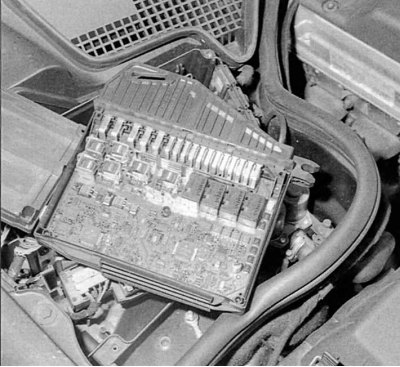
Fig. 4.69. Control unit
Control unit (Fig. 4.69) is mounted on the right side of the unit. It performs the following functions: providing the required amount of fuel, maintaining the number of revolutions, controlling the cruise control, diagnostics, monitoring the "intake-exhaust" function and determining the degree of malfunction of the system.
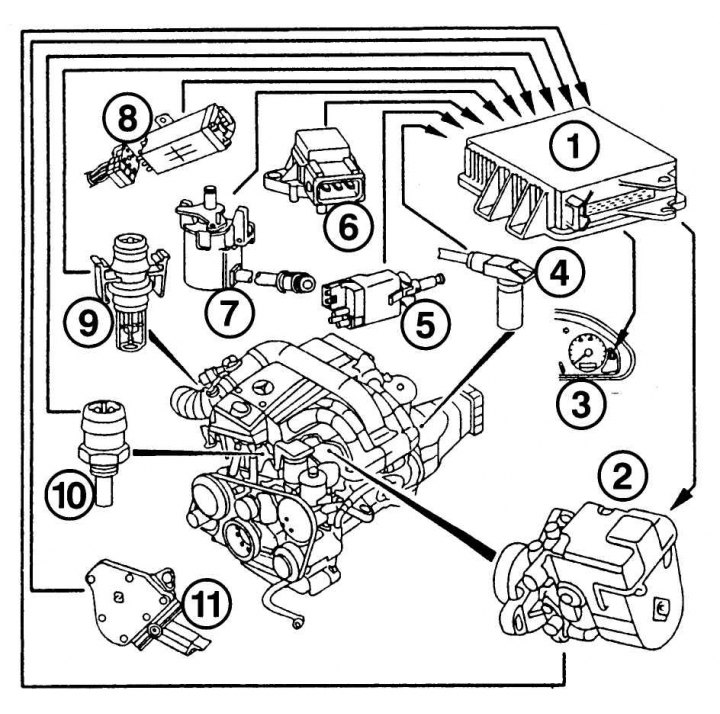
Fig. 4.70. Elements of the electronic control system: 1 – control unit; 2 – Fuel injection pump; 3 – operating mode indicator lamp; 4 – crankshaft position indicator sensor; 5 – brake light; 6 – intake air temperature sensor; 7 – fuel supply sensor; 8 – safety relay; 9 – exhaust gas bleed valve; 10 – coolant temperature sensor; 11 – Lock and reverse signal switch
Input signals come from the following sensors (Fig. 4.70): crankshaft position indicator (at the starter), positions of the starter working gear (at the bottom of the gearbox housing), accelerator pedal position sensor and sensor, suction pressure sensor, intake air temperature sensor, coolant temperature sensor, fuel injection temperature sensor (in the pump), brake light, ABS signal operation sensor, starter operating status sensor in the engine running mode (for automatic transmissions).
The output signals of these sensors control: stop, speed control, ARF valve switching, positioning of the injection valve, switching valve in the automatic transmission, the state of the diesel EDC operating mode (dashboard light), air conditioning control and fault characteristics when connecting the diagnostic device.
All problems in the system operation are noted self-diagnostic system in the computer memory. If the malfunction continues for a long time, then the control lamps on the instrument panel are triggered. Individual "errors" can be corrected by the control system, but this will remain in the computer memory. The control unit in a critical situation will shut it down itself or set the optimal speed to continue driving. If the "EDS" lamp lights up, you need to go to a car repair shop, since only there they carry out high-quality diagnostics and repairs.
All models are equipped with new systems that are controlled by a microcomputer in interaction with the so-called CAN bus (Controller Area Network), which acts as a "counting and distribution device" and sends signals to the computer. Electronic control is the main element in the Common Rail system, which will operate without interruption with regular maintenance.
Coolant temperature sensor is screwed into the front part of the cylinder head and shows the coolant temperature. Resistance at +80°C is 300 Ohm, at +20°C – 2.5 kOhm.
Fuel temperature sensor in the 220-D model it is located on the high-pressure fuel pump and is built into the section of the separator shaft positioning sensor. In the 5-cylinder diesel engine it is located on the stop mechanism. This sensor determines the fuel temperature for subsequent calculation of its density. It also generates a signal when the coolant temperature sensor fails.
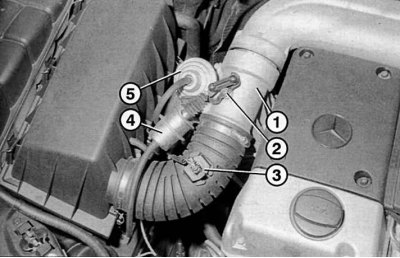
Fig. 4.71. Air intake system control units: 1 – pressure valve body; 2 – valve shaft with lever; 3 – intake air temperature sensor; 4 – vacuum chamber of the control valve; 5 – exhaust gas discharge vacuum chamber (ARF)
Signal from intake air temperature sensor (Fig. 4.71) is used to calculate the air mass when adjusting the amount of injected fuel, correcting smoke, removing exhaust gases and adjusting the pressure of the injected air. Resistance at +20°C is about 6 kOhm, at +40°C - about 2.6 kOhm.
Mass Air Flow Meter (CDI). Information about the mass of the intake air is necessary for calculating the fuel mixture at the injection. Regardless of the air temperature, the measurement is performed as follows. A receiving element is mounted in the intake system (heated plate), which is cooled by the receiving air flow. Depending on the flow strength, it changes its temperature and resistance. The electrical value of the resistance change is output to the control unit.
Crankshaft position sensor serves to determine the number of revolutions and the position of the crankshaft. It is located on the gearbox housing above the starter.
(Publication reprinted from this resource: mercedesman.ru)
Four (five for 5-cylinder engines) segments on the flywheel when the engine is running supply alternating voltage to the sensor. The higher the number of revolutions, the higher the voltage. If the segment passes the sensor with its front edge, a positive voltage surge occurs, if with its back edge, a negative voltage surge occurs.
Starter Pinion Position Sensor is installed only on 5-cylinder models and indicates the number of revolutions. It is located at the bottom of the gearbox housing.
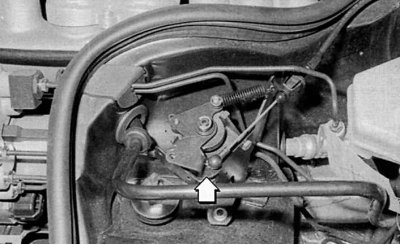
Fig. 4.72. Fuel supply sensor
Fuel supply sensor (Fig. 4.72). The high-pressure fuel pump is not directly connected to the accelerator pedal. The fuel supply sensor is installed in a protective housing and is connected to the pedal by a flexible drive. The sensor contains a speed potentiometer, an idle contact, and a return spring. On models with an automatic transmission, a modulated pressure shift valve is also installed.
Brake light switch. When braking, the control unit receives a signal, turns off the cruise control and gives a command to stop the maximum fuel supply. This allows you to avoid "running away" the car even if you accidentally press the accelerator pedal. The same thing happens when you press the clutch pedal.
Clutch pedal switch. In 5-cylinder diesel engines, when the clutch pedal is pressed, the control unit signals the progress of gear shifting and activation of the vibration damper.
Suction line pressure sensor is located on the left side of the engine compartment and is connected to the intake manifold via a hose. The pressure in the intake manifold is required for the following functions: maximum load limitation, exhaust gas recirculation (ARF) and intake air pressure regulation. In addition, on the E 290 TD it displays information for adjusting the turbocharger charge air.
Air pressure regulator (290 TD) works with the help of an electro-pneumatic valve. The principle of operation: the magnetic valve for limiting the forced air is controlled by the flow of compressed air through the valve on the compressor - when the valve opens, the pressure drops.
Camshaft Position Sensor Fuel Pump (4-cylinder diesel engine) responds to the longitudinal displacement of the camshaft relative to the drive shaft and consists of a coil with a core.
The core is screwed into a hollow camshaft. When the shaft shifts, the core changes the inductance of the coil. This is an important characteristic for adjusting the amount of fuel supplied.
Cam position sensor (4-cylinder diesel engine) also consists of a coil with a core. The core is inserted into the piston. The coil is mounted in the housing of the distribution fuel injection pump. The cam washer, rotating, makes translational movements back and forth, as a result of which the inductance of the coil changes and a signal is sent that controls the adjustment of the fuel injection.
Rack travel sensor (5-cylinder diesel engine) transmits data on the position of the fuel supply control rack to the control unit. The sensor is mounted in the speed controller of the in-line fuel injection pump. When the ignition is turned on, the rack takes the "start" position (the maximum length of the rack stroke is 19.5 mm). When the position of the rack changes, the distance between the coil and the short-circuited washer changes, as a result of which the inductance changes.