



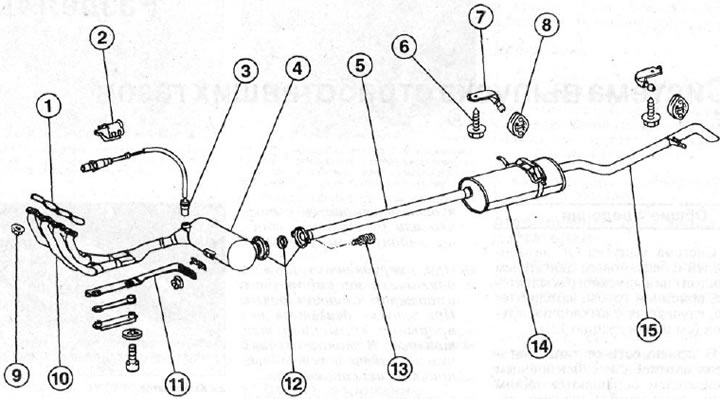
1.0 Exhaust system. Cars with petrol engine
1 - manifold gasket
2 - wiring harness clamp on the oil pan
3 - lambda probe. Tightening torque 55 Nm. Lubricate the thread with heat-resistant grease
4 - catalyst
5 - middle pipe
6 - bolt
7 - pipe suspension bracket
8 - rubber suspension cushion
9 - flange nut. Tightening torque 40 Nm. The nut is self-locking and must be replaced with a new one after each dismantling
10 - exhaust manifold
11 - bracket for suspension of the inlet pipe on the gearbox
12 - flange connection with gasket
13 - connecting bolt. Tightening torque 25 Nm
14 - main muffler
15 - exhaust pipe
Depending on the engine type, cars with a gasoline engine are equipped with one or two lambda probes, which are installed before and after the catalytic converter.
Diesel-powered vehicles are equipped with two catalytic converters (see illustration 1.0a).
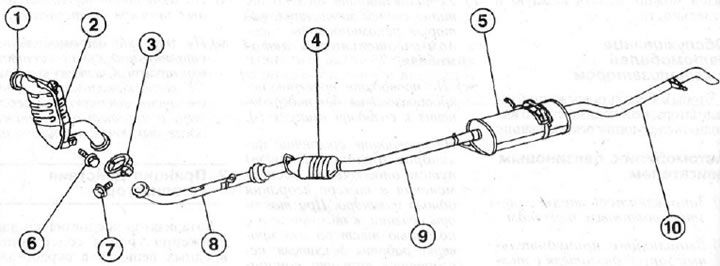
1.0a Exhaust system. Vehicles with diesel engine
1 - flange for fastening the exhaust system to the turbocharger
2 - front catalytic converter
3 - connecting clamp
4 - additional catalyst
5 - main muffler
6 - bolt 8x16
7 - bolt 8x40
8 - intake pipe
9 - middle pipe
10 - exhaust pipe
In case of repair, all parts of the exhaust system can be replaced individually.
Servicing cars with a catalytic converter
To avoid damage to the catalytic converter, it is necessary to strictly follow the following recommendations:
Cars with gasoline engines
a) Use unleaded petrol only.
b) Perform a forced start of the engine by pushing or towing only once and for a distance of no more than 50 meters. In this case, it is recommended to use an auxiliary battery, because when towing, unburned fuel gets into the catalytic converter and when it ignites, it can cause overheating and destruction of the catalytic converter. If the engine is warm, then forced starting by pushing or towing is generally unacceptable.
c) If the engine is difficult to start, do not operate the starter for too long. When starting the engine, fuel is injected continuously. In such cases, it is necessary to find and eliminate the cause of the malfunction.
d) Monitor the amount of fuel in the tank and do not allow it to run dry.
d) If misfires are observed, it is necessary to avoid high engine speeds and immediately eliminate the malfunction.
e) Install only the spark plug types recommended by the vehicle manufacturer.
g) Do not perform spark tests without connecting to a solid ground (-).
c) Do not compare cylinders (balance test) by disabling the ignition in the combustion chamber of one cylinder. When this is done, including with the help of a tester to check the engine operation, unburned fuel gets into the catalyst.
Cars with petrol and diesel engines
i) When adding engine oil, pay special attention to not exceeding the maximum oil level mark on the dipstick. Excess oil gets into the catalytic converter due to incomplete combustion and can damage the precious metal or completely destroy the catalytic converter.
k) Do not apply anti-corrosion protection for the underbody to exhaust system parts.
l) Do not modify the exhaust system heat shields.
m) Do not park the vehicle over dry leaves or grass. The exhaust system near the catalytic converter is very hot and emits heat even after the engine is turned off.