
Cars BMW Cars Volkswagen Cars Chevrolet Cars Land Rover Cars Lada Cars Honda Cars Peugeot
English Русский
Български
Беларускі
Український
Српски
Hrvatski
Română
Polski
Slovenský
Magyar
Bookmark News and articles Sitemap Feedback Site search
MercedesMan.ru


A-Class C-Class E-Class G-Class M-Class S-Class Others
W168 (1997-2004)
  • Main
  • A-Class
  • W168 (1997-2004)
  • Power unit
  • Exhaust system
  • Operating principle of the catalyst

Operating principle of the catalyst (Mercedes-Benz A-Class W168)

0
Contents: Petrol engines ↡ Diesel engines ↡
The catalyst is designed to reduce the level of harmful substances in exhaust gases.

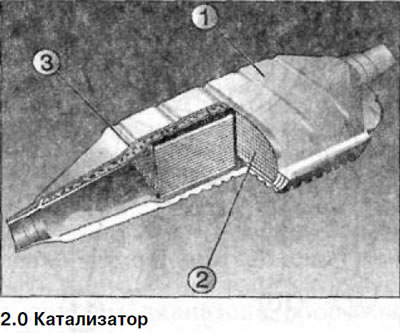
It consists of a honeycomb ceramic monolith 2 covered with a protective layer (see illustration 2.0). The protective layer contains salts of noble metals, which ensure the exhaust gas cleaning process.
It consists of a honeycomb ceramic monolith 2 covered with a protective layer (see illustration…


In the body 1 of the catalyst there is a support insulator 3, which simultaneously compensates for thermal expansion.

Petrol engines


Thanks to the electronic control of the fuel injection system in combination with information from the lambda probe, fuel is injected into the combustion chambers in a metered manner so that the catalyst can reduce the level of harmful substances in the exhaust gases.

The lambda probe is an electrical sensor that reacts to the content of residual oxygen in the exhaust gases by fluctuating electrical voltage, which ultimately allows the control unit to evaluate the composition of the fuel-air mixture.

The injection system control unit can change the fuel-air ratio in a fraction of a second.

On the one hand, this is necessary because the operating conditions are constantly changing ("full throttle", idle), and on the other hand, because afterburning in the catalytic converter occurs only when the exhaust gases contain a sufficient proportion of gasoline.


(Material taken from a web resource: «Mercedesman.ru»)

Diesel engines


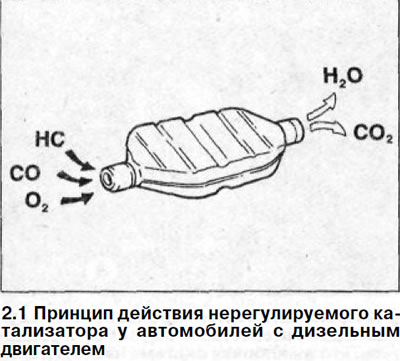
Unlike catalytic converters installed on gasoline engines, diesel vehicles are equipped with 2 non-adjustable catalytic converters, since the diesel engine is supplied with more air than is necessary for combustion.

This catalyst converts carbon monoxide and hydrocarbon compounds contained in the exhaust gases into carbon dioxide CO and water (H 2 O). In addition, it neutralizes the characteristic smell of burnt fuel in a diesel engine (see illustration 2.1).
This catalyst converts carbon monoxide and hydrocarbon compounds contained in the exhaust gases…


High levels of nitrogen oxides (NOx) in the exhaust gases is reduced as a result of the operation of the exhaust gas recirculation system.

The EGR valve is located on the intake manifold and is actuated by low pressure.

The valve ensures that part of the exhaust gases are diverted back into the combustion chambers in order to reduce the ignition temperature of the fuel-air mixture and thereby reduce the content of harmful substances in the exhaust gases.
This article is available at: russian, bulgarian, belarusian, ukrainian, serbian, croatian, romanian, polish, slovak, hungarian
The article has been verified: Lukyanov Nikita Ilyich
Share with friends:
◀ Previous
A-Class W168 / Exhaust system
Next ▶

General information about the exhaust system
Exhaust gas turbocharger
Intake pipe with catalytic converter — removal and installation
Intake pipe with main muffler — removal and installation
Lambda probe — removal and installation
Front catalytic converter — removal and installation
More similar articles for repairing other models

☛ Three in one — or how to protect the catalyst Mercedes W202 (1993-2000)
☛ The operating principle of a contactless ignition system Mercedes W123 (1976-1985)
☛ The operating principle of the control and injection system of a… Mercedes W463 (1999-2019)
☛ The operating principle of the control and injection system of a… Mercedes W163 (1997-2005)
☛ The structure and operating principle of the lubrication system Mercedes W126 (1979-1991, petrol)
☛ Operating principle of the hydraulic clutch release drive Mercedes Vito 2 (2003-2014, diesel)
Link in different formats to this article
Comments and feedback from visitors
No comments yet


How much will 41 + 22 ?


W168 (1997-2004) 
  • General information
  • User manual
  • Maintenance
  • Troubleshooting
  • Power unit
  • Engine repair
  • Cooling and heating
  • Injection system (gasoline)
  • Fuel system (diesel)
  • Fuel system
  • Exhaust system
  • Ignition system
  • Transmission
  • Clutch
  • Transmission
  • Chassis
  • Brake system
  • Suspension
  • Steering
  • Body
  • Interior (all models)
  • Interior (since 1997)
  • Interior (since 2001)
  • Exterior
  • Doors and windows
  • Electrical equipment
  • Equipment and devices
  • Power devices
  • Windshield wipers and washers
  • Headlights and lighting
  • Electrical circuits
 
MercedesMan.ru © 2017–2026 · Mobile version · Read about Mercedes · Sitemap: EN BG BY UA RS HR RO PL SK HU · Feedback · Site search · Bookmark A-Class (W168) · C-Class (W201) · C-Class (W202) · C-Class (W203) · E-Class (W123) · E-Class (W124) · E-Class (W210) · G-Class (W463) · M-Class (W163) · S-Class (W116, petrol) · S-Class (W126, petrol) · S-Class (W140) · S-Class (W220) · Sprinter · Vito 1 · Vito 2 · Vario 814D ·
 
We only use cookies without which some of the site's features may not be available.