



The system includes a distributor sensor with a built-in Hall generator, a switch and a special ignition coil.
Details of the ignition system distributor sensor of M 102 engines
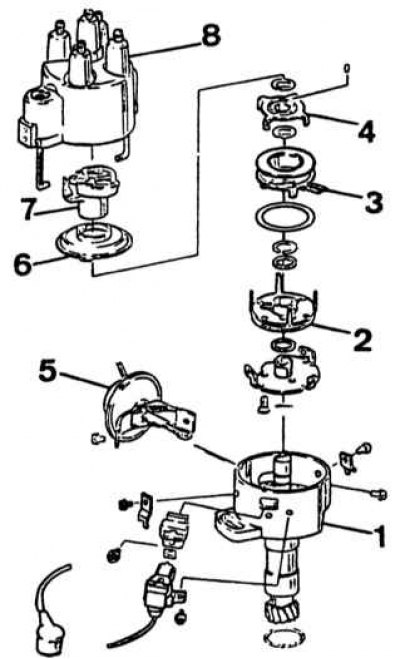
1 - body; 2 - fixed screen with teeth; 3 - induction coil; 4 - movable screen with teeth; 5 - vacuum regulator; 6 - protective screen; 7 - rotor; 8 - lid
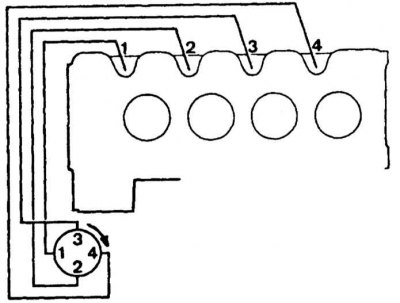
Wiring diagram for ignition wire harness
Operating principle of the Hall pulse generator
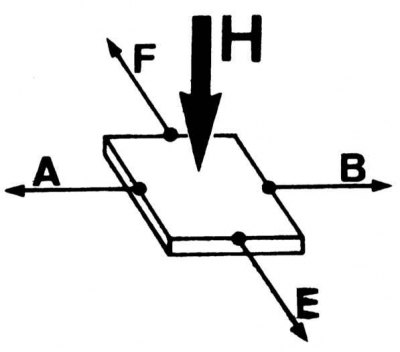
A control current flows through the semiconductor, coming from the connecting wires "A" and "B". When the magnetic field "H" crosses a plane perpendicular to the semiconductor, a potential difference arises between the electrodes "E" and "F". This phenomenon is called the Hall effect.
The Hall generator is built into the sensor distributor. It consists of a stationary (magnetic barrier) and moving (rotor) elements.
The magnetic barrier consists of a permanent magnet mounted on the screen and a Hall sensor or Hall integrated circuit placed opposite the magnet on a ceramic holder.
The rotor consists of four teeth corresponding to the number of engine cylinders. When the rotor rotates, the teeth pass through the gap between the magnet and the Hall sensor. When a tooth is in the gap, the magnetic field is deflected and the Hall effect is interrupted in the sensor. When it disappears, the trigger transistor becomes conductive and passes the primary current to the ignition coil. When the tooth leaves the gap, the magnetic field re-emerges and the primary current stops passing, which generates, as in a conventional ignition coil, a high-voltage current that goes to the spark plugs.
The width of each tooth corresponds to the angle of the cam, i.e. this angle remains unchanged and does not require adjustment.
Like a conventional ignition distributor, the electromagnetic distributor includes a centrifugal and vacuum regulator.
It is not permitted to replace the rotor of the distributor sensor with another one with a different resistance.