



The inductive sensor controls the ignition system switch and thus determines the moment of switching off and switching on the current in the ignition coil. By means of this, the inductive sensor also determines the ignition moment.
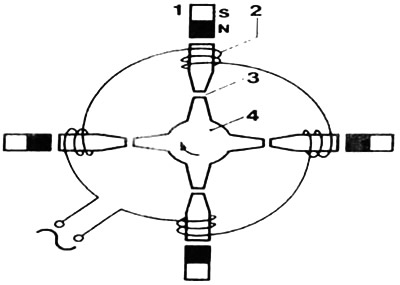
1. Permanent magnet. S. South pole. N. North pole.
Since the distributor armature (4) rotates together with the distributor shaft, the distance (3) between the distributor armature and the stator poles constantly changes. As a result, an alternating voltage is induced in the magnet winding (2). In accordance with the voltage changes, the commutator initiates an ignition spark together with the ignition coil. Ignition always occurs when the pole of the distributor armature moves away from the stator pole again.
In order to protect the switch and ignition coil from overheating, when the ignition is on and the engine is not running, the switch cuts off the voltage supply to the ignition coil.
Publication taken from an online resource MERCEDESMAN.ru
For safety reasons, the ignition coil has a gap of 5.5 mm from the casing. This is done to prevent the coil filler mass from leaking out in case of defects in the transistor ignition system switch.
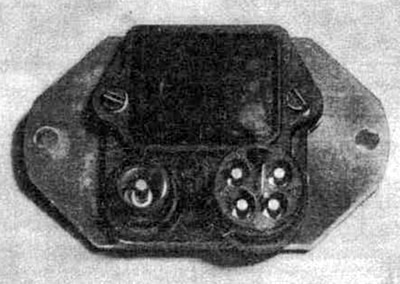
The main board of the switch serves to dissipate heat. Before installing the switch, carefully clean the main board and the mounting location on the body and lubricate with heat-conducting paste to ensure good heat dissipation.
Note: The heat generated by the commutator is dissipated through the body, so the engine should not run until the commutator is attached.