



General information
The fuel system consists of: installed in the rear of the vehicle (under the rear seat cushion) fuel tank, fuel filter, injectors, fuel lines and hoses, fuel level sensor located inside the tank and the engine control unit.
Fuel is supplied by a special pump through a filter. The filter collects dirt and water contained in the fuel.
When a diesel engine is running, clean air is sucked into its cylinders and compressed to high pressure.
In this case, the air temperature rises to 700 - 900°C, exceeding the ignition temperature of diesel fuel. The fuel is injected into the cylinder with some advance and ignites. Thus, spark plugs are not used to ignite the fuel.
To reduce the proportion of harmful substances in the exhaust gases, diesel engines have a diesel oxidation catalytic converter. At the same time, the recirculation system ensures a significant reduction in the content of nitrogen oxides in the exhaust gases. This is achieved by feeding the exhaust gases to the air sucked in by the engine, which reduces the oxygen concentration in the air entering the engine cylinders. This leads to a decrease in ignition delay and a lower combustion temperature, which ultimately reduces the formation of NOx. The process of recirculation of exhaust gases must, however, be precisely dosed, since otherwise the soot content in the exhaust gases increases. For this purpose, the amount of sucked air is determined by a meter, which allows the electronic device to control the recirculation process.
Fuel is injected directly into the combustion chamber.
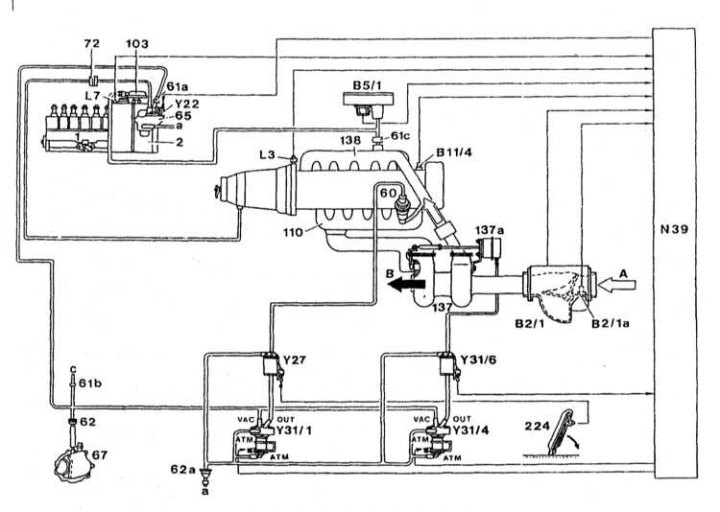
Functional diagram of the diesel engine injection system
1 - Fuel injection pump; 2 - Centrifugal regulator; 60 - EGR valve; 61a - Jet; 61b - Jet 0.5; 61s - Jet 0.7; 62 - Filter; 62a - Filter; 65 - Vacuum distributor; 67 - Vacuum pump; 72 - Vacuum valve; 103 - Aneroid compensator (ALDA); 110 - Exhaust manifold; 137 - Turbocharger; 137a - Vacuum drive for boost pressure control; 138 - Intake manifold; 224 - Accelerator pedal; B2/1 - Air flow sensor; B2/1a - Air temperature sensor in the intake manifold; B5/1 - Pressure sensor; B11/4 - Coolant temperature sensor; L3 - Flywheel ring gear speed sensor; L7 - Fuel line; N39 - EDS Processor Unit; Y22 - Electronic Idle Speed Control (ELR) Solenoid; Y27 - EGR changeover valve; Y31/1 - EGR vacuum sensor; Y31/4 - Boost pressure control system vacuum sensor; Y31/6 - Boost pressure control system shut-off valve
Designations:
- A - Intake air
- B - Exhaust gases
- a - Ventilation duct leading to the passenger compartment
- c - Other vacuum consumers
Pneumatic connections on sensors
| VAC | Vacuum from a vacuum pump |
| ATM | Ventilation duct leading to the passenger compartment |
| OUT | From sensor Y31/1 to recirculation system changeover valve Y27 |
| OUT | From sensor Y31/4 to the vacuum actuator of the distributor valve controlling the air pressure |
The engine is controlled by an electronic system similar to that of gasoline engines. The system controls the engine by analyzing information from a large number of sensors.
Vacuum connection layout diagram
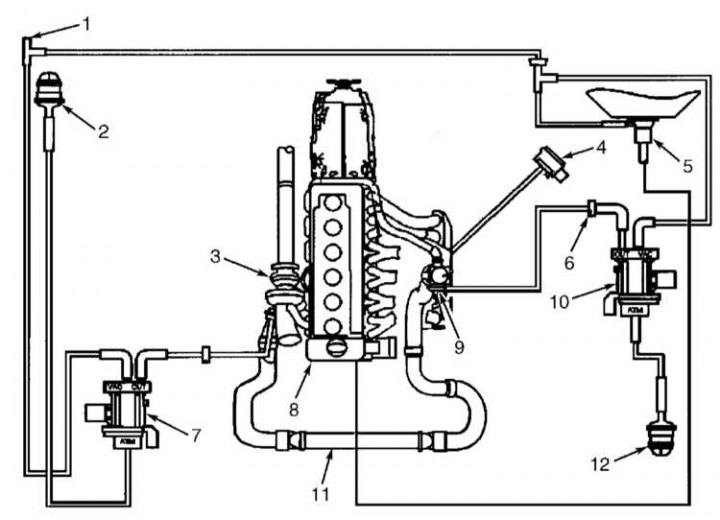
Vacuum line layout diagram (3.0L turbodiesel engine)
1 - To other vacuum consumers; 2 - Boost Control/Press Control Valve Vacuum Transducer Ventilation Filter; 3 - Turbocharger; 4 - Pressure sensor; 5 - Check valve with a flow section diameter of 8 mm; 6 - Connector; 7 - Vacuum transducer for boost control/pressure control valve operation; 8 - Vacuum pump; 9 - Exhaust gas recirculation (EGR) valve; 10 - EGR valve vacuum transducer; 11 - Intercooler; 12 - EGR valve vacuum transducer ventilation filter
Diesel models do not have an accelerator cable. Instead, a pedal position sensor is installed on the pedal.
There is no fuel shut-off valve when the ignition is turned off. In order to shut off the engine when the ignition is turned off, the engine control unit sends a signal to the fuel injection pump control unit, which, in turn, stops the fuel supply to the injectors.
The fuel system is designed to prevent air "sucking" in when there is no fuel in the tank. The control unit constantly checks the fuel level in the tank, processing information coming from the fuel reserve sensor located in the tank. When the fuel reserve drops to a certain level, the control unit lights a warning lamp on the dashboard, after which it forcibly causes fuel supply misfires, thereby limiting the maximum speed. This continues until the fuel level in the tank exceeds the permissible mark.
Information about the crankshaft position and engine speed comes to the control unit from the crankshaft position sensor (CKP). The inductive head of the sensor is located opposite the flywheel and constantly scans special marks (36 pieces) applied to its surface. When a mark passes the sensor head, it sends a pulse to the control unit. The marks are evenly applied to the flywheel surface, but one mark is missing. It should be located 90° before the TDC of the first cylinder. When the flywheel passes this point, the sensor does not send a pulse to the control unit. The unit recognizes this pause and accurately determines the TDC moment. The duration of this pause is used to determine the engine speed.
Information about the amount and temperature of air entering the engine comes from the manifold absolute pressure (MAP) sensor and air temperature sensors. The MAP sensor is connected to the manifold by a vacuum hose and measures the pressure in it. There are two air temperature sensors. One is installed before the turbocharger and the other is after the intercooler. The air temperature and pressure are used to calculate the exact amount of fuel that needs to fall to the injectors.
The traditional coolant temperature sensor has been replaced by a cylinder head temperature sensor. It measures the temperature of the head and sends the received information to the control unit. By analyzing this information, the control unit adjusts the composition and moment of injection of the fuel mixture, and also controls the cold engine warm-up system.
The brake light switch and brake pedal sensor inform the control unit of the current position of the brake pedal. Upon receiving signals from these sensors, the control system immediately switches the engine to idle speed until it receives a signal from the accelerator pedal position sensor.
The accelerator cable is missing. Instead, an accelerator pedal position sensor is installed. The sensor constantly informs the control unit about the pedal position, which in turn accurately calculates the injection parameters. Idle speed is also regulated by the control unit and cannot be adjusted manually. By analyzing information coming from various sensors, the control unit calculates the idle speed, adjusting it depending on the engine load and its temperature.
The fuel injection system is a direct injection system. The piston crowns contain swirl chambers that provide swirl of the fuel entering the combustion chambers. To optimize fuel combustion, the injectors open in two stages (for this purpose, there are two springs inside each nozzle). When the injector opens, a small amount of fuel hits the internal components of the injector, lubricating them, and returns to the fuel tank.
The engine control unit controls the warming up of a cold engine. When the engine is cold, the injection timing is shifted by the control unit. The engine control unit, in turn, controls the operation of the glow plugs. The glow plugs are installed in each cylinder and are switched on before starting the engine, work during the cranking of the engine by the starter and for some time after starting the engine. The glow plugs make starting a cold engine much easier. After switching on the ignition, the corresponding control lamp lights up on the dashboard (refer to Vehicle equipment, arrangement of instruments and controls Chapters User manual), signaling that the glow plugs are on. As soon as the lamp goes out, you can start the engine. If the ambient temperature is very low, the glow plugs continue to work for some time after the engine has started. This ensures stable engine operation and a reduction in harmful impurities in the exhaust gases.
Due to the high starting properties of the direct injection engine in cold conditions, preheating is only required at temperatures below -10°C.
Fuel passes through the fuel filter. In the filter, fuel is separated from water and contaminants. Therefore, it is important to remove water from the fuel and replace the filter element in a timely manner.
The fuel system of diesel engines is very reliable. If clean fuel is used and regular maintenance is performed, it should function properly until the end of the vehicle's service life. After very high mileage, the internal components of the injectors may wear out and need to be repaired. Since the pump-injectors have a complex design, it is recommended that repairs be carried out in a specialized workshop.