



The principle of hydraulic valve clearance compensation
On engines M 102.980 and M 102.982, the valve rocker arms have hydraulic tappets.
Hydraulic valve lifter
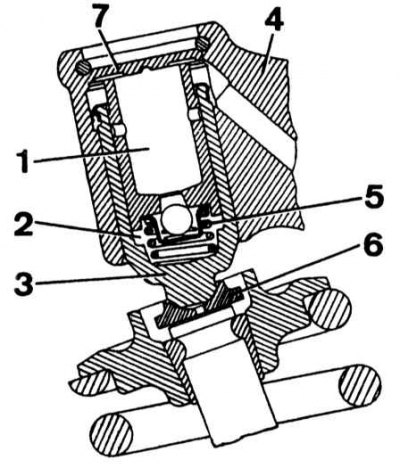
1 - accumulation chamber; 2 - working chamber; 3 - pusher; 4 - rocker arm; 5 - ball valve return spring; 6 - pusher plate; 7 - thrust washer of the pusher
During engine operation, oil under low pressure enters the storage 1 and working 2 chambers (no more than 3 kg/cm²). This ensures constant contact of the tappet 3 with the valve stem. When the rocker arm 4 is lifted by the cam, the tappet enters the rocker arm, the ball valve closes, which causes an increase in pressure in the working chamber. Due to the incompressibility of the oil, the transmission of movement from the cam and rocker arm to the tappet and valve is ensured. Spring 5 ensures constant pressure of the tappet on the valves even when the engine is stopped.
Examination
If there is any doubt about the malfunction of the tappets (knocking, deterioration of engine performance), check their condition.
1. Remove the cylinder head cover.
2. Turn the engine crankshaft manually so that the back of the rocker arm faces the camshaft cam.
3. Measure the pushrod stroke to the stop in the rocker arm. If the stroke exceeds 0.5-2.4 mm, change the thickness of the spherical plate 6 or thrust washer 7 of the pushrod.
4. If one of the pushers drops faster than the others, it should be removed and replaced.