
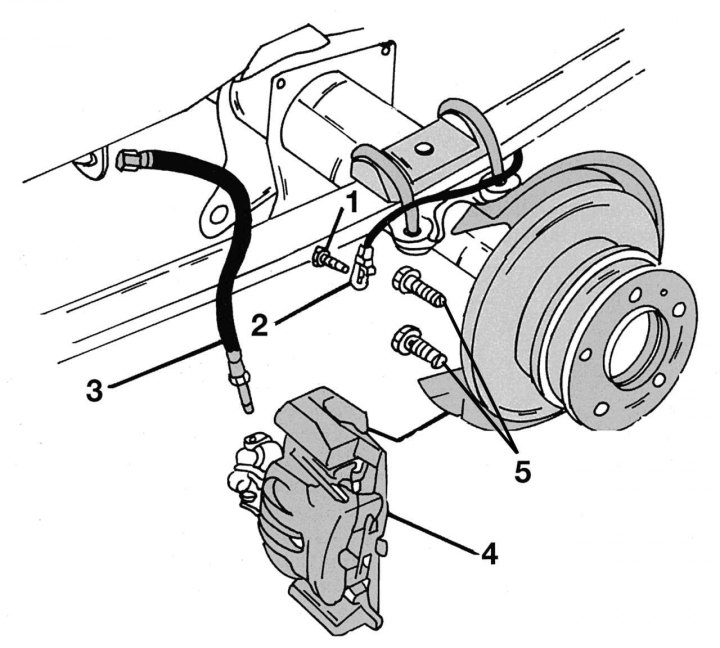
Pic. 284. Removal and installation of the rear brake caliper: 1 - bolt for fastening the wire of the brake pad wear sensor, 10 Nm; 2 - pad wear sensor; 3 - brake hose, 12–16 Nm; 4 - brake cylinder; 5 - caliper mounting bolts, 105–115 Nm
Work on removing the rear caliper must be carried out as follows (pic. 284):
- unscrew the cap of the brake fluid reservoir;
- press the brake pedal several times to remove the vacuum in the system. Put the car on jackstands at the rear (under the rear axle) and unscrew the wheels;
- put the hose on the bleeder fitting, lower the other end of the hose into the prepared container;
Unscrew the fitting bolt and press the brake pedal until the fluid comes out;
- Loosen the hex nut of the brake hose from the caliper so that it can be easily unscrewed. You can also disconnect the hose from the brake line. To do this, unscrew the union nut of the pipeline, remove the hose clamp and pull out the hose. The hose connection to the cylinder must also be loosened. Protect the open ends of the hoses from dirt;
- unscrew bolt 1 (see fig. 284) fastening the plug of the wear sensor 2 pads and remove the wire;
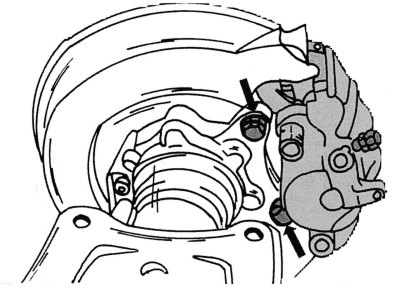
Pic. 285. Brake caliper mounting bolts (105–115 Nm)
- unscrew both bolts 5 of the caliper. These bolts are shown in fig. 285;
- turning, unscrew the caliper from the brake hose connection.
Installation must be carried out in reverse order, taking into account the following:
- when screwing the caliper on, use new self-locking bolts. They are made specifically for the caliper, i.e. you need to order them. Wrap the bolts with a torque of 105–115 Nm;
- screw the caliper onto the brake hose almost to the stop. The final tightening is carried out with the caliper installed;
- tighten the brake hose to 12-16 Nm. When doing this, make sure that the hose is not twisted. Otherwise, remove the caliper again and wrap the hose on it more tightly. Check that the pipeline and hose do not rub against other parts of the rear suspension;
- bleed the brakes.