



Contents: Removal ↡ Installation ↡
Sign of wear on valve stem seals (oil deflector caps) – high oil consumption. The caps can be removed even with the cylinder head installed. In this case, a lever pusher with a support is required, for example, Mercedes-601 589 025 900, 111 589, 186 100 and 111 589 3000 (magnetic pusher). If there is no such special tool, you need to disassemble the cylinder head.
After disassembling the head and at high mileage, be sure to replace the oil deflector caps.
Attention! If the valve control parts are to be used again, they must be installed in their original locations. To avoid confusion, we recommend providing a storage panel.
Removal
1. Disassemble the chain tensioner.
2. Remove the camshaft.
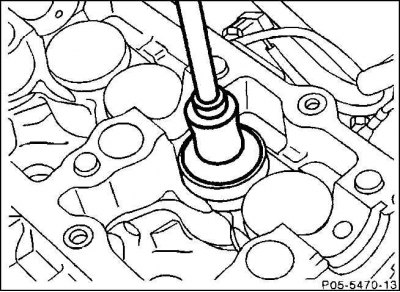
3. Remove the disc plunger using a rubber siphon (diameter 30 mm), for example, HAZET 735-2. Do not use a magnetic siphon: this magnetizes the sliding surface of the disc pusher, and tiny metal shavings are deposited on it, which contributes to damage to the disc pushers and cams. You can make your own siphon using a suction cup and a wall hook.
Caution: Before removing the plunger, thoroughly clean its surface.
Attention! When compressing the valve spring, the corresponding piston must be in the TDC ignition position. Since cylinder 1 is set to TDC ignition when removing the camshaft, it is advisable to start by removing the valve springs of cylinder 1.
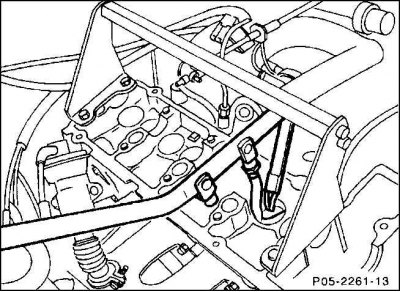
4. Bolt the rocker arm support bridge to the cylinder head.
5. Push down the inlet and outlet valve spring plates of cylinder 1 using a push rod. Cylinder 1 is at the front on the control chain side, cylinder 4 is at the rear on the flywheel side.
6. Remove the crackers (202) using tweezers or a magnet.
7. Slowly release the valve spring (198).
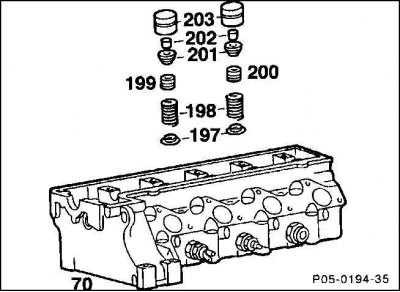
8. Remove the spring plate (201) and spring. (203) plate tappets, (197) lower valve spring plates.
9. A high mileage engine repair shop can check the strength of the valve springs.
10. Remove the second valve spring of cylinder 1.
11. Remove the valve stem seals (199–200) using a special collet, such as HAZET 791-6.
Caution: Be careful not to damage the valve stem and valve guide.
12. Remove burrs from the valve stem groove.
Caution! Replace the pressed-in valve cotters and spring plates. When the valve springs, spring plates and cotters are removed, the engine must not be rotated, as the valves rest on the pistons and may fall into the cylinder.
Installation
Intake Valve Oil Seal (199)
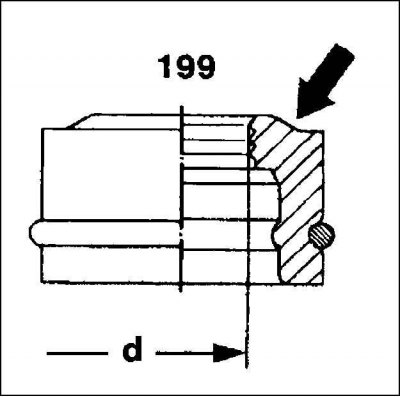
The chamfer (arrow) is offset.
Inner diameter d = 7.3 mm.
The wire ring is phosphated, black in color.
Original published on the website [mercedesman]
Exhaust valve oil seal (200)
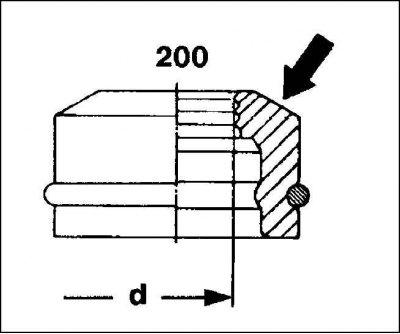
The chamfer (arrow) is beveled.
Inner diameter d = 8.2 mm.
Wire ring, galvanized, yellow color.
1. Lubricate the new valve stem seals with oil and install them on the rod using a mounting mandrel, e.g. HAZET 2577.
Caution! Do not confuse the caps for the exhaust and inlet valves.
2. Install the valve springs from below according to their color.
3. Place the valve spring plates on and press down on them from below, insert the crackers into the corresponding grooves on the valve stems.
4. Set the next piston to TDC and replace the oil deflector caps by turning the engine 1/2 turn on the central bolt of the crankshaft pulley until the notch indicating 180° is positioned under the pointer on the crankcase. Thus, the piston of the third cylinder is at TDC (cylinder firing order 1-3-4-2). Then, by turning the corresponding half turn, pistons 4 and 2 are set to TDC.
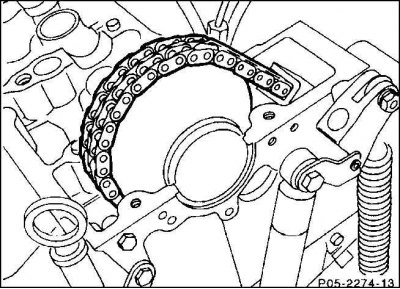
Caution! When turning the engine, lift the control chain so that it does not get sucked in. In the workshop, a special support wheel for the control chain is used for this purpose.
5. Install the tappets and camshaft.
6. Install the chain tensioner.