
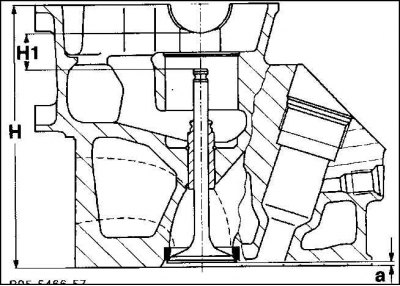
2. Check the cylinder head/engine block for length and width deflection using a ruler and template set. Over the entire length, the deflection should not exceed 0.08 mm. There should be no deflection across the entire width.
3. Check the flatness of the cylinder head also on the upper sealing surface to the cylinder head cover. The permissible deviation should be no more than 0.1 mm.
Attention! If light scratches are found on the partition between the inlet and outlet valves, then there is no need to replace the cylinder head. If the surface of the cylinder head, especially the surface of the separation of the combustion chambers, is uneven, deformed or has slight damage such as scratches, scratches, etc., grind the damaged surfaces. This does not apply to the sealing surface of the cylinder head cover.
4. 2.0 liter engine: total cylinder head height H = 142.9–143.1 mm.
After grinding, the height of the cylinder head must be at least H = 142.2 mm.
The height of the microroughness of the sealing surface should not exceed 0.004 mm. With a distance from the end of the valve stem to the surface of the camshaft bearing H1 = 20.4–21.4 mm, this valve can be used further. With H1 = 21.4–21.97 mm, a new valve 106.4 mm long should be installed. With H1 = 19.5–20.3 mm, a repaired valve with a length of 105.5 mm can be installed.
After possible grinding of the surface of the motor block, pay attention to the maximum piston protrusion, which should be 0.74–0.96 mm. If the protrusion is 0.96-1.16 mm, install a thicker cylinder head gasket (1.85 mm).
Valve clearance must be checked in the ground cylinder head before installation (A) and protrusion of the prechamber. Prechamber protrusion: 7.6–8.1 mm.
5. Check engine timing.
6. Install the cylinder head.