



Check the operation of the hydraulic tappets if noise continues in the valve train when the engine reaches operating temperature.
1. Drive with the engine warmed up. Once the coolant reaches operating temperature, continue driving for another 5 km to ensure that the engine oil is at a sufficient temperature.
2. If the hydraulic tappet is still noisy, stop the engine.
3. Check the engine oil level: it should never be higher than the "max" mark on the dipstick.
4. Remove the air cleaner cross pipe.
5. Remove the cylinder head cover.
6. When checking the plate tappet, the cam tops of the intake and exhaust valves of the corresponding cylinder must be in the upper position. In this case, the corresponding tappets are unloaded. Since unnecessary cranking of the engine contributes to the settling of the valve clearance compensation element, it is advisable to start checking from the cylinder at TDC ignition.
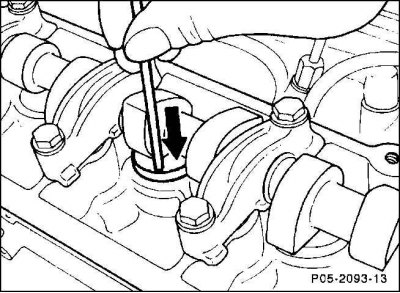
7. Press the plate tappet downwards with a wooden or plastic rod and check the air gap. If the air gap is greater than 0.4 mm and the tappet moves downwards more easily than the others, it should be replaced.
8. Turn the camshaft so that the cams of the cylinder to be checked point upwards. To do this, set the gearbox to idle, apply the parking brake and turn the crankshaft by the camshaft gear mounting bolt.
9. If, when checked, the plate tappet is pressed down more easily than the others, or if there is a gap around the circumference of the cam, check the condition of the oil access and drain holes by disassembling the tappet (work for a repair shop).
10. If necessary, disassemble the camshaft and replace the tappet.
11. Install the cylinder head cover.
12. Install the air filter cross pipe.