



The sequence of actions for checking compression is given for a 2.0 L engine.
1. Lift the hood.
2. Remove the injectors.
3. Unscrew the windshield washer fluid reservoir, remove it and set it aside.
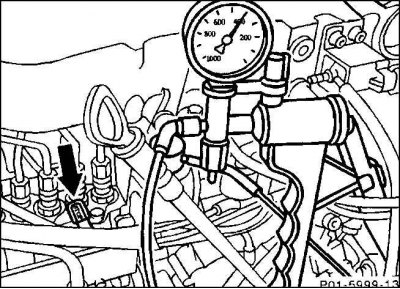
4. 2.0L engine: To prevent fuel from being injected when turning the engine over with the starter, the stop lever (arrow) must be set to the "stop" position. To do this, connect a vacuum pump to the tank (arrow) of the fuel pump. Create a vacuum of about 400 mbar in the tank and maintain it throughout the compression test.
5. Turn the engine over several times with the starter to remove carbon deposits and soot.
Warning! Set the gearbox to idle and apply the parking brake. Do not lean over the engine while it is cranking: an accident may occur!
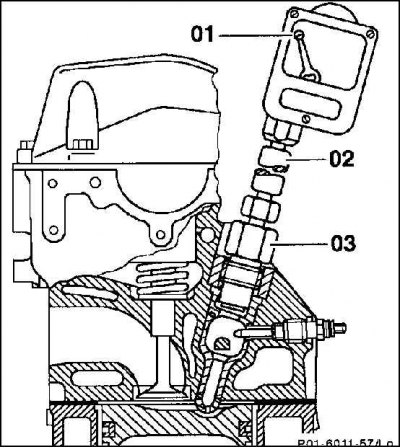
6. Screw the compression tester (01) with the coupling element (02) and the connection part (03) into place of the injector in the pre-chamber of the cylinder to be tested.
7. Have an assistant press the accelerator pedal all the way down and hold it there while checking.
8. Turn the engine approximately 9 revolutions until the pressure on the gauge stops rising.
9. Take the value of the controlled quantity and check the compression in all other cylinders sequentially. Then compare the measured values with the nominal values. Keep in mind that the measurement results also depend on the compression tester used. If the compression pressure in one or more cylinders is below the minimum, the cylinder should be checked for leaks.
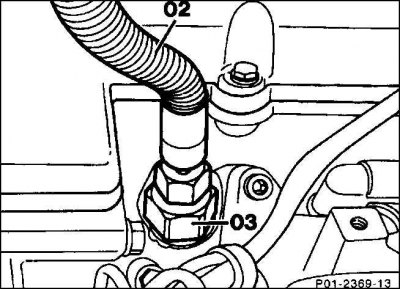
10. Unscrew the compression gauge (02) and install the injectors with new gaskets.
11. Remove the vacuum pump.
12. Install the windshield washer fluid reservoir and secure with bolts.
13. Lower the engine hood.
Features of 2.2/2.5 L engines
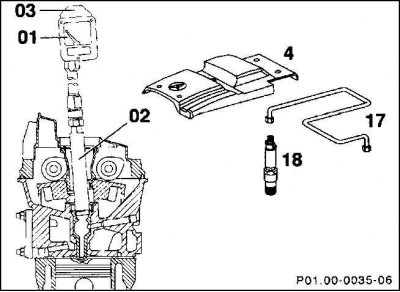
1. Remove the air cleaner cross pipe.
2. Unscrew the cylinder head cover (4).
3. Remove the injector (18) with the fuel injection pipes (17).
4. Screw the compression gauge (01) to the pre-chamber using the connecting part (02) according to the operating instructions. Install new chart paper (03).