



Contents: Nominal compression value ↡ Compression measurement ↡ Troubleshooting ↡ Compressed air leak when the engine…↡ Pressure loss test ↡
Compression shows the condition of the engine. When the fuel-air mixture ignites, very high pressure occurs in the combustion chamber. This leads to high loads on the pistons, rings, cylinder walls, as well as on the valves and their seats. Damage to the cylinder head gasket leads to increased oil and fuel consumption, poor exhaust gas release and, accordingly, smoking, loss of power, and difficulties in starting a cold engine.
Nominal compression value
The compression value varies for different types of engines. Usually, when the engine is warm, it is from 26 to 32 bar, the minimum is 18 bar.
The difference should not exceed 3 bar. If the compression value differs by more than 3 bar between different cylinders, the reason for this should be sought in the following:
- 1. Wear of pistons or piston rings.
- 2. Sticking of rings in pistons.
- 3. Cylinder wear (often a consequence of piston ring sticking).
- 4. Carbon deposits on valves and seats.
- 5. Damaged valve.
- 6. Burnt valve (when the gap is too small).
Compression measurement
You can measure the compression yourself if you have a compression tester. You need an assistant who will crank the engine while you take measurements. For an accurate compression measurement, the valve mechanism must be adjusted. The service station has a pressure loss measuring device. With its help, you can find the part responsible for the pressure loss.
Sequence of works


1. Warm up the engine to operating temperature.
2. Raise the hood.
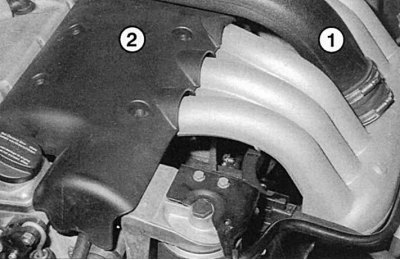
Fig. 4.22. Location of the injector cover: 1 – highway; 2 – nozzle cover
3. Remove the suction line branch pipe (Fig. 4.22).
4. Remove the injector cover.
5. Unscrew the injectors.
6. Set the car to the handbrake and put the gear lever in neutral.
7. Do not turn the engine with the ignition key, otherwise fuel will be supplied to the engine, which may damage the measuring device. Use a self-recording compression tester with a contact switch to which the engine is electrically connected.
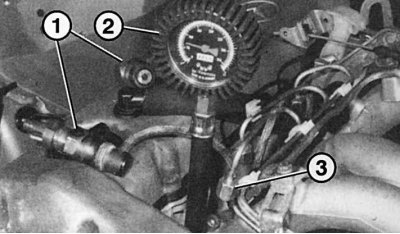
Fig. 4.23. Compression measurement: 1 – injectors; 2 – compression gauge; 3 – high pressure pipeline
8. Screw the compression gauge into the corresponding threaded part of the pre-chamber (Fig. 4.23).
9. Remove the control unit cover, disconnect contact "50" and connect the compression gauge.
10. Remove the cover from the "+" on the left inner arch of the engine compartment.
11. Connect the compression tester connecting cable to "+" (contact "30").
12. Ask an assistant to press the accelerator pedal all the way down and keep it pressed throughout the measurement.
13. Turn the engine over with the starter while pressing the contact switch of the compression tester (about 5 sec).
14. Connect the compression gauge to the next cylinder.
15. Check all cylinders one by one and compare the recorded values with the nominal values.
Troubleshooting
1. Drop a small amount of oil into the injector hole and then measure the compression again.
2. If the values obtained are too low, this may indicate that the valves, valve seats, valve ports, cylinder head or cylinder head gasket are damaged.
3. If you get better results, then the cause should be sought in the piston rings or in the cylinders themselves. Oil improves the sealing of the pistons and cylinder walls for a short time, and therefore the compressed air leaves with greater resistance (compared to the previous version).
Compressed air leak when the engine is running
If, when the engine is running, a compressed air leak is observed in the engine compartment area, the following may be the reasons:
1. Intake manifold or damper: Intake valve is faulty.
2. When opening the radiator or expansion tank: the cylinder head gasket is faulty, there is a crack in the cylinder head.
3. When opening the oil filler neck or when the oil dipstick is removed: the cylinder walls, pistons or piston rings are worn out.
4. "Shots" in the muffler: the exhaust valve is faulty.
Pressure loss test
At the service station, along with compression, pressure loss is often checked. To perform measurements, the engine must be warmed up, all injectors must be unscrewed, and the intake manifold casing, oil filler cap and radiator cap must be open. For measurements, the piston of the cylinder being tested must be at the top dead center. The tester is connected to the injector socket of the corresponding cylinder and the compressor. The pressure gauge scale is calibrated before air is supplied to the combustion chamber. If there is a pressure loss in the combustion chamber, this is shown as a percentage on the instrument scale. The total pressure loss should not exceed 25%, and the loss on the valves and cylinder head seal should not be less than 10%, and on the piston rings - 20%. By listening, you can determine whether air is coming out through the intake manifold (discharge pipeline), exhaust manifold, oil filler cap, cooling system or through the chamber of the adjacent cylinder.
Article was obtained from the portal [www.MercedesMan.ru]