



The pressure difference between individual cylinders should be a maximum of 1.5 bar. If the pressure difference is more than 1.5 bar, this is a sign of faulty valves, worn piston rings or cylinder guides. If the wear limit is reached, the engine must be repaired or replaced.
The compression pressure should be: for a 4-cylinder engine 10–14 bar, for a 6-cylinder engine about 12 bar.
1. To check the compression, warm up the engine. After reaching the operating temperature of the coolant, drive another 5 km to ensure sufficient engine oil temperature.
2. Lift the engine hood.
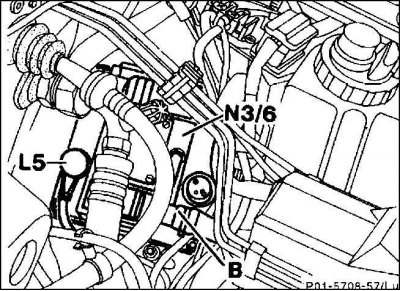
3. 1.8/2.0L engine: Turn off ignition. Disconnect the crankshaft position sensor (L5) from the PMS control unit.
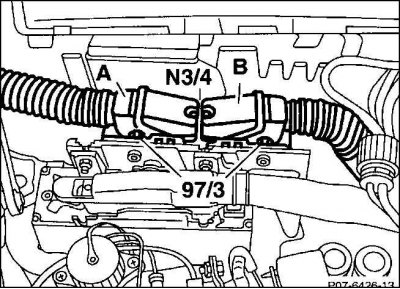
4. 2.2/2.8L engine: Switch off the ignition. Remove the control unit cover behind the front body wall. Disconnect the plug (A) from the HFM control unit (N3/4).
5. Remove all spark plugs.
6. Crank the engine several times with the starter to remove deposits and soot.
Warning! Set the gearbox to idle and apply the parking brake. Do not lean over the engine while cranking: risk of injury!
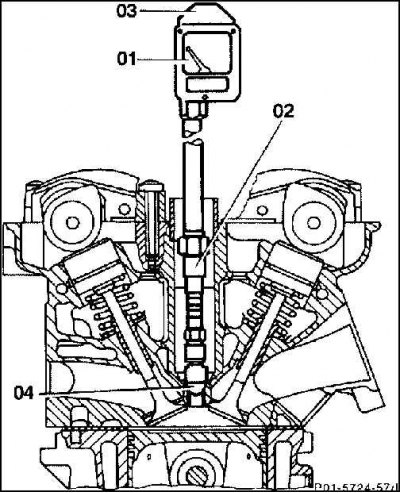
7. Insert or screw the compression tester (01) into the spark plug hole with the rod (04) in accordance with the operating instructions. Insert a new sheet for the diagram (03), (02) intermediate part.
8. Have an assistant press the accelerator pedal all the way down and keep it pressed until the end of the test.
9. The engine should make about eight revolutions until the pressure rise is recorded by the measuring instrument.
10. Check all cylinders one by one and compare with the nominal value.
11. Then insert the spark plugs.
12. With the ignition off, attach the crankshaft position sensor to the PMS or HFM control unit. Install the HFM control unit cover.
13. Close the hood.