



Contents: Removal ↡ Installation ↡
Removal
Caution! If the valve control parts are to be used again, they must be installed in their original locations. To avoid mixing up the parts, make a panel for storing them.
1. Remove the cylinder head and place it on two wooden stands.
2. Remove the camshafts.
3. Remove the plate tappet.
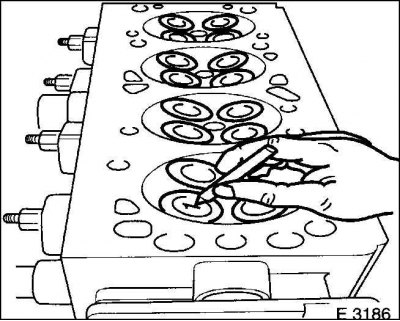
4. Mark the valves before disassembling so that they can be installed in their original places during assembly. To do this, number the valve plates with a felt-tip pen.
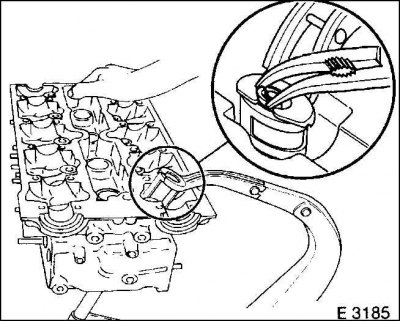
5. Remove the valves using the spring tensioner provided. This will tension the springs and remove the valve stem keepers. Then release the spring and remove the upper valve retainer and spring.
6. Remove the oil seals.
7. Remove the valve from the cylinder head towards the combustion chamber.
8. Clean the valve. Replace valves with a burnt plate, with a low plate height, with a worn and scratched stem.
9. In a repair shop, you can check the valve stem for permissible runout, which should not be more than 0.03 mm.
Warning! The exhaust valves are sodium filled. They should not be soldered or used as a working tool (for example, as an ejector): explosion hazard!
Installation
1. Before assembling the valves, check their guides and, if necessary, modify the valve seats.
Caution! If you are installing a new valve, pre-treat the valve seat just in case.
2. Remove burrs from the valve stem on the mating surface of the valve stem parts.
3. Lightly lubricate the valve stem and valve guide with engine oil and insert the valve.
4. Install the oil seal.
5. Install the valve spring.
6. Then install the next valve, being careful not to confuse the inlet and outlet valves.
7. Install the plate plunger.
8. Install the camshafts.
9. Install the cylinder head.