
Cars BMW Cars Volkswagen Cars Chevrolet Cars Land Rover Cars Lada Cars Honda Cars Peugeot
English Русский
Български
Беларускі
Український
Српски
Hrvatski
Română
Polski
Slovenský
Magyar
Bookmark News and articles Sitemap Feedback Site search
MercedesMan.ru


A-Class C-Class E-Class G-Class M-Class S-Class Others
190 (W201) (1982-1993) W202 (1993-2000) W203 (2000-2007)
  • Main
  • C-Class
  • W202 (1993-2000)
  • Power unit
  • Gasoline engines
  • Valve stem seals — removal and installation

Valve stem seals — removal and installation (Mercedes-Benz C-Class W202)

0
Contents: Removal ↡ Installation ↡
Worn oil seals can cause increased oil consumption. The seals can be removed with the cylinder head installed. However, this requires compressed air and a lever ejector with a support device, such as Mercedes-11 589 015900, 11 589 186 186 100 and 11 589 256 300. If there is no special tool, then the cylinder head must be removed.

Below is a description of how to replace the oil seals for a 4-cylinder engine, and for a 6-cylinder engine, follow the instructions below using the appropriate tool.

Removal


Attention! If the valve control parts are to be used again, they must be mounted in the same places. To avoid mixing up the parts, make a special panel for their storage.


1. Remove the camshafts.

2. Remove the spark plugs.

3. Remove the protective covering from the engine wires on the front body wall.
3. Remove the protective covering from the engine wires on the front body wall.


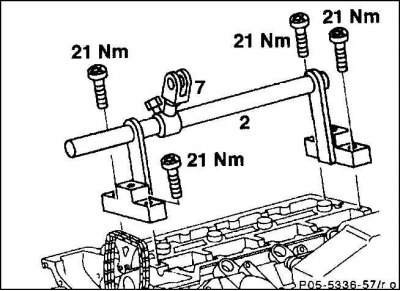
4. Screw the support bridge (2) with the movable part (7) to bearings 1 and 5 of the camshaft or later to bearings 6 and 10 with a torque of 20 Nm.

5. Turn the piston of the corresponding cylinder to TDC using a wrench with a socket. 4-cylinder engine: when the belt pulley is in TDC position, pistons 1 and 4 are in TDC. When the 180-degree mark of the belt pulley coincides with the base mark, pistons of cylinders 1 and 6 are in TDC. 6-cylinder engine: when the belt pulley is in TDC position, pistons of cylinders 1 and 6 are also in TDC. When the 120-degree mark of the belt pulley coincides, pistons of cylinders 2 and 5 are in TDC; at the 240-degree mark - pistons of cylinders 3 and 4.


Caution: When turning the crankshaft, lift the control chain high to prevent it from jamming.


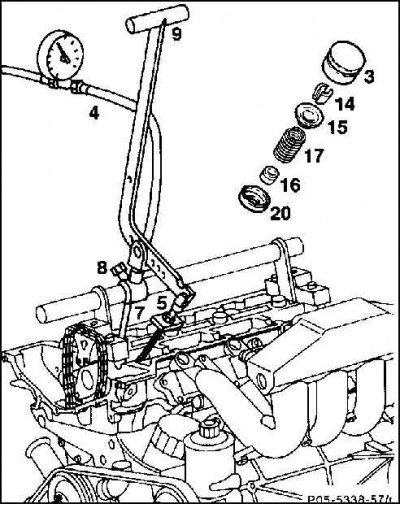
6. Attach the lever pusher.
6. Attach the lever pusher.


7. Pull out the plate pusher (3) with a rubber suction cup (diameter 30 mm), for example, HAZET 735-2.

Caution! Do not use a magnetic siphon for this, as the sliding surface of the disc tappet will become magnetized and subsequently tiny metal shavings will be deposited on it, which will damage the tappet and cams.


8. Lock the crankshaft. To do this, set the first gear and apply the parking brake.

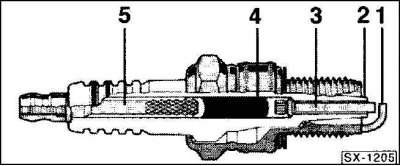
9. Set the cylinder combustion chamber to an excess pressure of at least 6 bar. To do this, screw the connecting hose (4) of the cylinder leak tester into the spark plug hole. If there is no leak tester, you can make a suitable hose using an old spark plug.
9. Set the cylinder combustion chamber to an excess pressure of at least 6 bar. To do this, screw…


10. Bite off the ground electrode of the old spark plug (1). Break off the ceramic insulator (2) with a screwdriver, and also break off the middle electrode (3) by rocking it back and forth and remove it. Push it out with a punch (about 3 mm) the remains of the middle electrode with the glass mass (4) and the connecting pin (5). In this case, clamp the spark plug in a vice or use a suitable screw-cutting machine.


Caution: Do not damage the spark plug threads to avoid damaging the threads of the cylinder head hole.


11. Screw the spark plug into the appropriate cylinder, connect it to the booster air hose and set the cylinder to an excess pressure of at least 6 bar.
11. Screw the spark plug into the appropriate cylinder, connect it to the booster air hose and set…


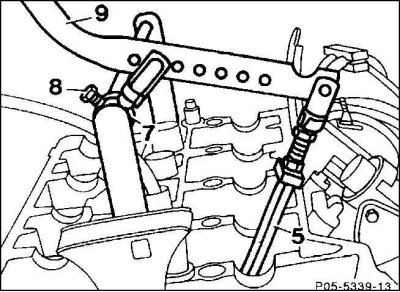
12. Install the lever pusher (9) with the pressure part (5) on the valve spring plate. Position the pressure part and the movable part parallel to each other. Secure the movable part with the bolt (8).

13. Compress the valve spring.

Caution! Do not compress the valve spring without compressed air, otherwise the valves and pistons may be damaged.
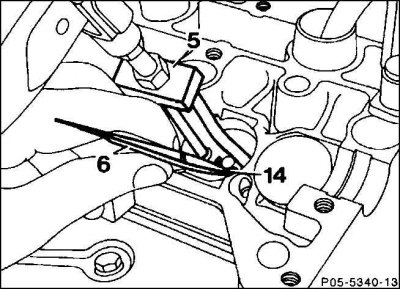

Caution! Do not compress the valve spring without compressed air, otherwise the valves and pistons…


14. Remove the valve stem parts (14) from the valve stem using tweezers (6) or a magnetic siphon.

15. Remove the valve spring plate (15) and valve spring (17).


15. Remove the valve spring plate (15) and valve spring (17).


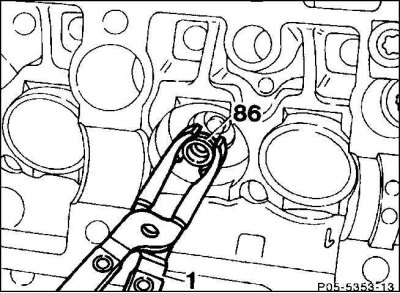
16. Remove the valve stem seal (86) from the valve stem using special pliers, such as HAZET 791-6.

Caution: Do not damage the valve stem or guide.


17. Remove the valve spring plate (15) and valve spring (17).

18. If necessary, remove burrs from the valve stem groove with fine-grit emery cloth.

19. Check the valve guides for wear in the area where they contact the valve stem seals. Replace the valve guides (work for repair shops).

Installation


1. Replace bent parts of the stem, valves and spring plate.

2. Valve guides that are out of alignment with the valve stem seal retaining groove must be replaced (work for the workshop).
2. Valve guides that are out of alignment with the valve stem seal retaining groove must be…


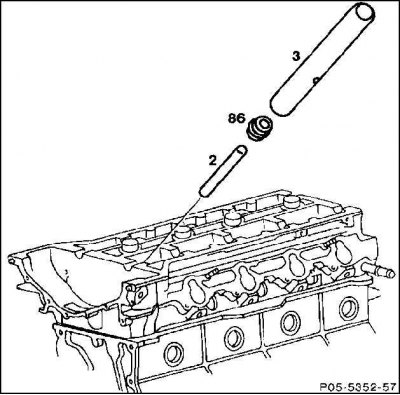
3. Place the protective sleeve (2) onto the valve stem.

4. Lubricate the oil deflector cap (86) with oil and fit it by hand using a mounting mandrel.


Attention! The mounting mandrel is included in the repair kit. If the attachment is made without the mounting mandrel, the sealing chamfer of the oil deflector cap is damaged.


5. Install and secure the valve springs and valve spring retainer.

6. Insert the valve stem parts, release the valve springs.

7. Install the plate plunger.

8. Replace the oil seal.

9. Unscrew the spark plugs.

10. Install the camshafts.

11. Secure the engine wiring harness cover to the front body wall.
This article is available at: russian, bulgarian, belarusian, ukrainian, serbian, croatian, romanian, polish, slovak, hungarian
The article has been verified: Khromov Roman Mikhailovich
Share with friends:
◀ Previous
C-Class W202 / Gasoline engines
Next ▶

Hydraulic disc tappets
Camshafts (6-cylinder engine)
Camshafts — Main Position Adjustment (4 Cylinders)
Camshafts (4-cylinder engine)
Cylinder head (6-cylinder engine)
Valves — removal and installation
Directional valves
Valve seats in the cylinder head
Checking the compression in the cylinders
V-belt (4-cylinder engine)
More similar articles for repairing other models

☛ Fuel Shut-Off Solenoid Valve — Removal and Installation Mercedes W168 (1997-2004)
☛ Design and specification of the valve timing mechanism Mercedes W123 (1976-1985)
☛ Removal and installation the expansion valve Mercedes W463 (1999-2019)
☛ Removal and installation the expansion valve Mercedes W163 (1997-2005)
☛ Replacing valve guide bushings Mercedes W140 (1991-1998)
☛ Replacing valve stem seals Mercedes Vario 814D (1996-2003, diesel)
Link in different formats to this article
Comments and feedback from visitors
No comments yet


How much will 29 + 27 ?


W203 (2000-2007) 
  • General information
  • Introduction to guide
  • User manual
  • Maintenance
  • Power unit
  • Gasoline engines
  • Diesel engines
  • Cooling system
  • Ventilation and heating
  • Supply system
  • Injection system (gasoline)
  • Injection system (diesel)
  • Exhaust system
  • Ignition and control system
  • Charge and launch systems
  • Transmission
  • Mechanical gearbox
  • Automatic gearbox
  • Clutch and drive shafts
  • Differential
  • Chassis
  • Brake system
  • Car suspension
  • Steering
  • Body
  • Exterior (external elements)
  • Interior (internal elements)
  • Electrical equipment
  • Equipment and devices
  • Lighting system
  • Electrical diagrams (2000)
  • Electrical diagrams (since 2001)
W202 (1993-2000) 
  • General information
  • User manual
  • Driving a car
  • Car care
  • Maintenance
  • Power unit
  • Gasoline engines
  • Diesel engines
  • Lubrication system
  • Cooling system
  • Heating and ventilation
  • Ignition system
  • Fuel system
  • Injection system (gasoline)
  • Injection system (diesel)
  • Exhaust system
  • Transmission
  • Clutch
  • Car gearbox
  • Chassis
  • Suspension, wheels and tires
  • Steering
  • Brake system
  • Body
  • Exterior (external elements)
  • Interior (internal elements)
  • Doors and windows
  • Electrical equipment
  • Equipment and devices
  • Power devices
  • Lighting system
  • Electrical circuits
190 (W201) (1982-1993) 
  • General information
  • Introduction to the guide
  • Operation and care
  • Maintenance (gasoline)
  • Maintenance (diesel)
  • Troubleshooting
  • Power unit
  • Petrol engine I4
  • Petrol engine V6
  • Diesel engines
  • Engine overhaul
  • Cooling and heating
  • Power system (carburetor)
  • Injection system (gasoline)
  • Injection system (diesel)
  • Exhaust system
  • Charge and start system
  • Ignition system (I4)
  • Ignition system (V6)
  • Diesel heating system
  • Transmission
  • Clutch
  • Mechanical gearbox
  • Automatic gearbox
  • Cardan shaft and axle shafts
  • Chassis
  • Brake system
  • Car suspension
  • Steering
  • Body
  • Exterior (external elements)
  • Interior (internal elements)
  • Doors, locks and windows
  • Electrical equipment
  • Equipment and devices
  • Electrical circuits
 
MercedesMan.ru © 2017–2026 · Mobile version · Read about Mercedes · Sitemap: EN BG BY UA RS HR RO PL SK HU · Feedback · Site search · Bookmark A-Class (W168) · C-Class (W201) · C-Class (W202) · C-Class (W203) · E-Class (W123) · E-Class (W124) · E-Class (W210) · G-Class (W463) · M-Class (W163) · S-Class (W116, petrol) · S-Class (W126, petrol) · S-Class (W140) · S-Class (W220) · Sprinter · Vito 1 · Vito 2 · Vario 814D ·
 
We only use cookies without which some of the site's features may not be available.