



Contents: Removal ↡ Installation ↡
High oil consumption is an indicator of worn out oil seals. The seals can be removed with the cylinder head installed. However, this requires compressed air and a lever pusher with a support device, such as Mercedes-111 589 015 900, 111 589 186 100, 605 589 006 300 and 604 589 006 300. If such tools are not available, the cylinder head must be removed when replacing the seals.
Removal
Caution! If the valve control parts are to be reused, they must be installed in their original locations. To avoid confusion, make a special panel for storing them.
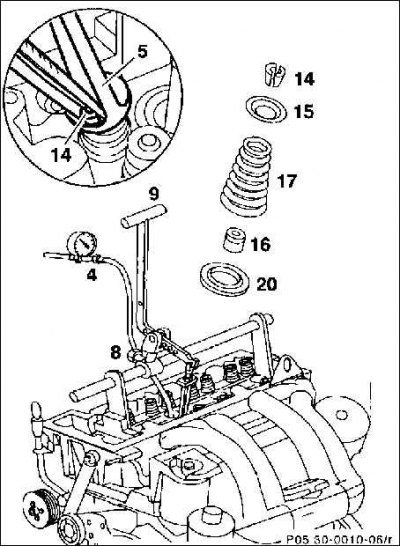
1. Remove the camshafts.
2. Remove the camshaft housing.
3. Remove the injectors.
4. Remove the engine wire harness housing from the front body wall.
5. Screw the support partition with the movable part of the lever pusher to the cylinder head. For this, you can use the camshaft housing bolts (M7x42).
6. Using a wrench with a socket, set the piston of the corresponding cylinder to the TDC position. 4-cylinder engine: when the belt pulley is in the TDC position, pistons of cylinders 1 and 4 are in the TDC position. When the belt pulley mark coincides 180° with the mark on the crankcase, pistons of cylinders 3 and 4 are in the TDC position.
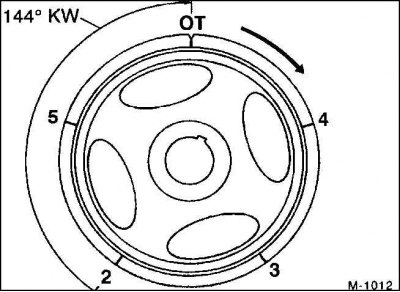
7. 5-cylinder engine: When the belt pulley is at TDC, the piston of cylinder 1 is at dead center. After turning the crankshaft through an angle of 144°, the piston of the next cylinder in the sequence (1–2–4–5–3) is at TDC. Note: For example, you can apply four additional marks on the belt pulley, each at a distance of 72°. After replacing the oil deflector caps of cylinder 1, rotate the crankshaft until mark 2 is opposite the mark on the crankcase. This will set piston 2 to TDC. Replace the oil deflector caps of cylinder 2. Then crank the engine to mark (4). Now piston 4 will be at TDC. In this way, you can sequentially set the pistons to TDC.
8. The TDC position of the corresponding cylinder can also be set using an electrode wire. To do this, pass the electrode wire through the hole in the injector of cylinder 2 (piston of cylinder 2 is at TDC). With an assistant, slowly rotate the crankshaft in the direction of its rotation and watch the position of the wire as it rotates. As soon as the wire reaches its highest position, the piston is set to TDC.
Caution: When turning the crankshaft, hold the control chain high to prevent it from jamming.
9. Attach the lever pusher (9).
10. Lock the crankshaft by engaging first gear and applying the parking brake.
11. In the compression chamber of the cylinder, create an excess pressure of at least 5 bar (about 5 atm.). To do this, screw the connecting hose (4) of the cylinder leak tester with the Mercedes-604 589 006300 connecting piece into the pre-chamber (nozzle hole).
12. Maintain a constant excess pressure of at least 5 bar in the cylinder via the compressed air hose.
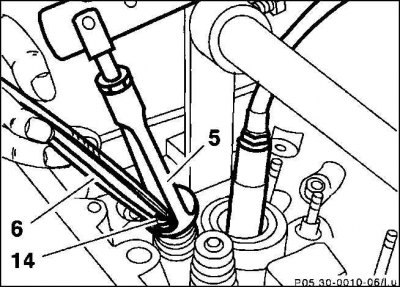
13. Install the pressure part (5) of the lever pusher (9) on the valve spring plate. Orient the pressure and movable parts parallel to each other. Secure the movable part with the bolt (8).
14. Remove the valve spring.
Caution! Do not remove the valve spring without using compressed air, otherwise the valve and piston may be damaged.
15. Remove the valve stem parts (14) from the valve stem using tweezers or a magnet.
16. Remove the valve plate (15) and valve spring (17).
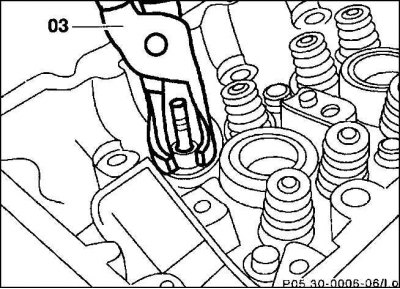
17. Remove the valve stem seal from the valve stem (16) using a special collet (03), e.g. HAZET 791-6.
Caution! Do not damage the valve stem and valve guide!
18. Remove the lower spring plate (20) and check for damage, replace if necessary.
19. If necessary, sand the rod groove with fine-grit sandpaper.
20. Check the valve guides for wear in the area where the valve caps fit. If the valve guides are not tightly seated, replace them (work for a repair shop).
Installation
1. Replace the pressed-in valve stem parts and valve spring retainers with new ones.
2. Valve guides with loose rings on the valve stem seals need to be replaced (work for a repair shop).
[Article was borrowed from the website: www.mercedesman.ru]
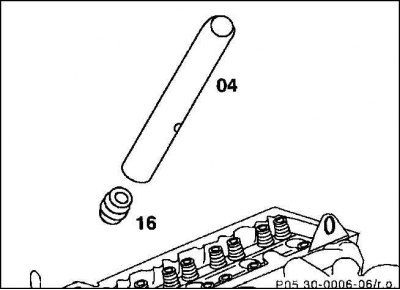
3. Lubricate the valve stem cap (16) with oil and insert manually using the mounting mandrel (04).
4. Install the valve spring and retainer and compress the valve spring.
5. Install the valve stem components and release the valve spring.
6. Replace the caps on the other valve stems in the same manner.
7. Release the compressed air.
8. Install the camshafts.
9. Install the injectors.
10. Install the camshaft housing.
11. Secure the engine wire sheath to the front body wall.