



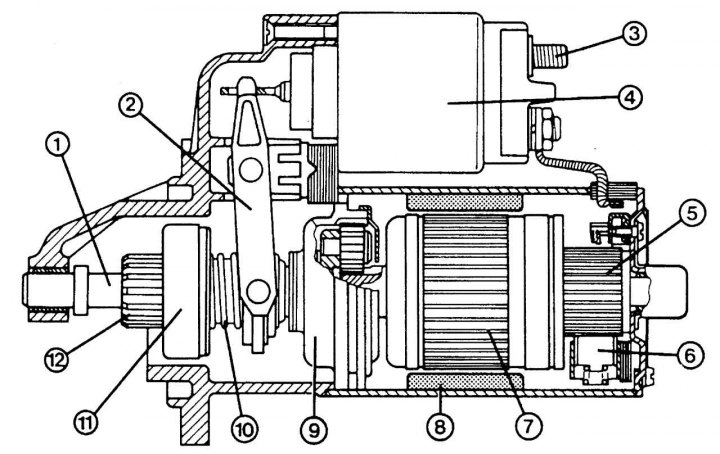
Figure 317. Starter device: 1 — anchor shaft; 2 — drive lever; 3 - positive wire connection contact; 4 - traction relay; 5 — collector; 6 - brushes; 7 - anchor; 8 - permanent magnet; 9 - planetary gear; 10 — spring; 11 — freewheel clutch; 12 - drive gear
Figure 317 shows the design of a starter used on diesel engines. Specially designed for diesel vehicles, it is equipped with a planetary gearbox, which makes it possible to make the anchor and the entire starter shorter. Starters generally have a long service life. If the starter has been in use for a long time, there is no point in repairing it. For replacement, it is better to select a serviceable starter, repaired at a Mercedes or Bosch branded technical station. The old starter can be handed in for exchange.
Minor starter faults that frequently occur can be eliminated without replacing the entire unit.
Replacing the traction relay
To do this you need:
- disconnect the connecting wire between the traction relay and the starter;
- from the front side of the relay, unscrew the mounting bolts and, having disengaged the starter drive engagement lever, remove the traction relay;
- install the new relay in reverse order.
Replacing brushes
To do this, do the following:
- unscrew and remove the cover from the back of the starter;
- unscrew the two bolts securing the manifold bearing cover;
- use a screwdriver to pry up the locking clamp at the end of the armature shaft, remove it, take out the small parts, and then remove the cover. If necessary, press with a screwdriver to remove. Save spacer washers;
- remove both brushes from the mount and remove the brush holder. Brushes can be screwed or soldered. If they are soldered, you should use a soldering iron. Solder or screw on new brushes. Assemble the starter in reverse order.
Note: If the starter has been in use for a long time, it is better not to repair it, but to replace it with a new one or a working used one. You can also select a starter in a specialized Bosch workshop.