



Contents: Removal ↡ Installation ↡
Removal
Caution! To fix the fuel pump shaft in the installation position, it is necessary to use a special tool. Using a tool made by yourself can damage the internal parts of the fuel pump.
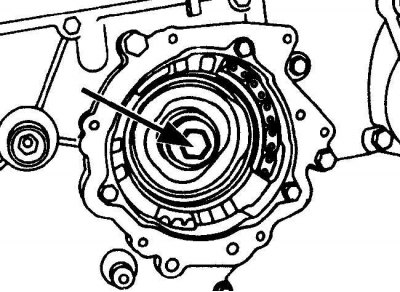
Location of left-hand threaded bolt securing fuel pump sprocket
Setting the piston of the first cylinder to the 15° position
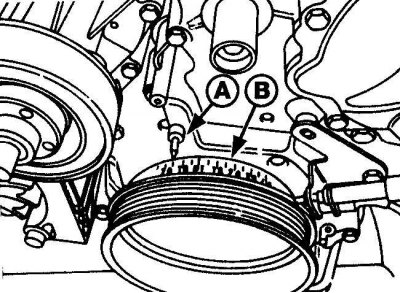
When setting the piston of the first cylinder to the 15° after TDC position, align the corresponding mark on the pulley with the pointer.
A – pointer; B – marks on the pulley
Location of the drive chain tensioning mechanism
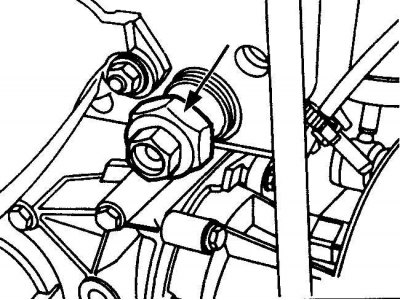
Unscrewing the fuel lines from the fuel pump
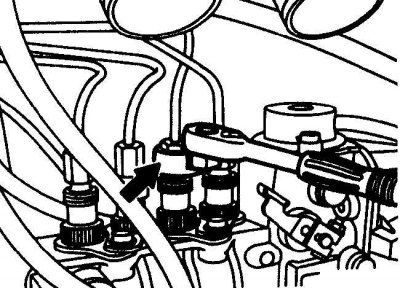
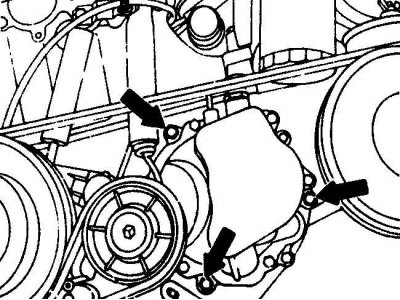
Location of bolts securing the front part of the fuel pump to the mounting flange
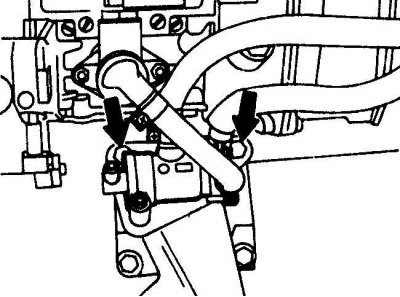
Location of fuel thermostat mounting bolts
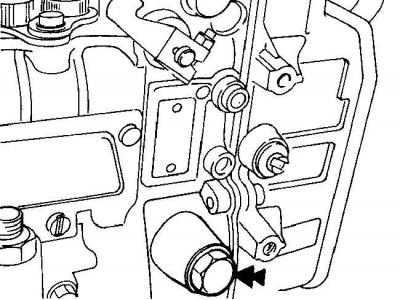
Location of the plug that closes the installation hole of the high-pressure fuel pump
Using a special tool to prevent the regulator body from turning
[Original material on the website: mercedesman.ru]
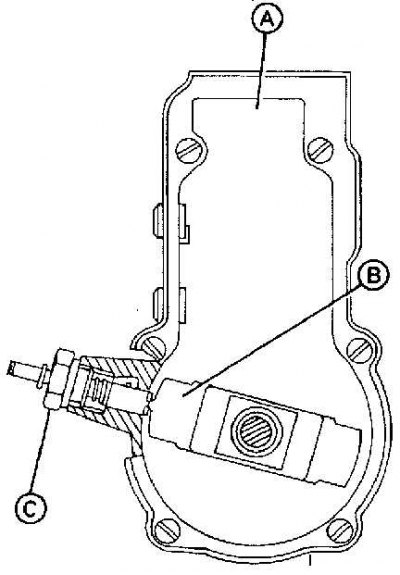
A – fuel pump (rear view); B – regulator body; C – special tool for fixing the regulator body
1. Remove the ground cable from the battery.
2. Remove the retaining clips and mounting panel from the lower engine compartment.
3. Remove the auxiliary drive belt tensioner.
4. Remove the radiator fan and shroud.
5. Remove the vacuum pump from the cylinder head cover. Remove the gasket from the vacuum pump.
6. Remove the intake manifold.
7. On 6-cylinder models with vehicle speed control, unscrew the actuator and move it to the side.
8. Secure the engine crankshaft from turning, then unscrew the central bolt securing the fuel pump sprocket (see Fig. Location of left-hand threaded bolt securing fuel pump sprocket).
Caution! The fuel pump sprocket mounting bolt has a left-hand thread.
9. Using the crankshaft pulley mounting bolt, turn the engine crankshaft in the working direction until the piston of the first cylinder is set to the 15° position after the top dead center. Perform the installation by aligning the corresponding mark on the crankshaft pulley with the pointer (see Fig. Setting the piston of the first cylinder to the 15° position).
10. Remove the drive chain tensioner mechanism (see Fig. Location of drive chain tensioning mechanism).
11. Using the appropriate wrench, unscrew the fuel lines from the fuel pump that go to the fuel injectors (see fig. Unscrewing the fuel lines from the fuel pump).
12. Unscrew the connecting bolts and disconnect the fuel supply and return hoses from the fuel pump.
13. Label and disconnect the vacuum hoses from the actuators at the top and rear of the fuel pump.
14. Label and disconnect the electrical connectors from the actuators and sensors on the top and rear of the fuel pump.
15. Disconnect the accelerator rod from the fuel pump control lever.
16. Using a scriber, mark the position of the fuel pump relative to the rear surface of the mounting flange.
17. After removing the fuel pump, secure the chain to the fuel pump sprocket in the timing chain cover so that the timing mechanism can be turned. On later models, a special housing is used to secure the fuel pump sprocket.
18. On early models without a special casing, prepare a metal tubular mandrel with a diameter equal to the diameter of the fuel pump sprocket bolt head.
19. Remove the bolts securing the front of the high pressure fuel pump to the mounting flange (see Fig. Location of bolts securing the front part of the fuel pump to the mounting flange). Remove the bolt securing the rear of the high-pressure fuel pump to the bracket and remove the fuel pump. At the same time, use a pipe mandrel or a special housing to support the fuel pump sprocket in place.
Caution! When removing the high-pressure fuel pump, a small amount of engine oil may leak out.
Caution: Do not allow the drive chain to be removed from the fuel pump sprocket.
20. Unscrew the bolts securing the fuel thermostat to the fuel pump housing and, without disconnecting the pipes from the thermostat, move it to the side (see Fig. Location of fuel thermostat mounting bolts).
21. Close all disconnected fuel lines with plugs.
22. On the side of the fuel pump, unscrew the plug that covers the installation hole (see Fig. Location of the plug closing the installation hole of the high-pressure fuel pump).
23. Using special grips, turn the fuel pump shaft in the direction of the working movement until you see the regulator housing through the installation hole. Turn the fuel pump shaft until the protrusion on the regulator housing aligns with the center of the installation hole. Using a special tool, fix the regulator housing from turning through the installation hole (see fig. Using a special tool to prevent the regulator body from turning).
Caution: When turning the high-pressure fuel pump shaft, be careful not to damage the surface of the fuel pump shaft.
24. Remove the sealing ring from the front of the fuel pump.
Installation
1. Installation is carried out in the reverse order of removal, taking into account the following points.
2. Install a new sealing ring onto the front of the high pressure fuel pump and lubricate it with a thin layer of engine oil.
3. Before installing the high pressure fuel pump, check that the piston of the first cylinder is set to the position 15° after top dead center.
4. Secure the engine crankshaft from turning and then tighten the fuel pump sprocket mounting bolt to the required torque.
Caution! The fuel pump sprocket mounting bolt has a left-hand thread.
5. Remove the special locking tool from the hole in the fuel pump and close the hole with a plug.
6. Tighten the high pressure fuel pump mounting bolts to the specified torque.
7. Connect the high pressure lines to the fuel pump and secure with union nuts, tightening them to the required torque.
8. When securing the fuel supply and return lines with connecting bolts, new sealing rings must be used.
9. When installing the vacuum pump, a new sealing ring must be used. Check and, if necessary, adjust the injection timing of the fuel pump.