



Contents: Removal ↡ Installation ↡
Removal
Caution: To perform the operation described below, the injection pump shaft must be fixed using a special device of a special configuration. Independent manufacture of such a device with the required accuracy is too difficult and when used can lead to internal damage to the fuel pump. Therefore, it is recommended to rent this tool from Mercedes-Benz dealers or from Bosch diesel fuel system specialists.
1. Disconnect the negative battery terminal.
2. If necessary, remove the lower engine guard.
3. Remove the accessory drive belt in the following order.
- a) Remove the plastic plug, unscrew the mounting bolt and remove the auxiliary drive belt tension pulley.
- b) Loosen the mounting bolt and remove the fan pulley.
- c) Unscrew the bolts and remove the tensioner damper spacer. Remove all gaskets and/or brackets from the bolts, remembering their location.
- d) Using pliers, unhook the tension spring, remembering its correct position to restore it during assembly.
- d) If necessary, remove the plug and, after unscrewing the tensioner mounting bolt, pull out the sleeve on which the tensioner is mounted.
- e) Remove the tensioner and remove the gasket (if provided).
4. In accordance with chapter 3 remove the fan and its casing.
5. In accordance with Chapter 9, remove the brake booster pump from under the timing chain cover. Note that the gasket must be replaced during installation.
6. If desired, access can be improved by removing the intake manifold as described in paragraph 16.
7. Lock the crankshaft by holding it with a socket or wrench on the pulley/damper mounting bolt to the hub, then loosen and remove the center bolt of the fuel pump sprocket (see fig. 7.7).
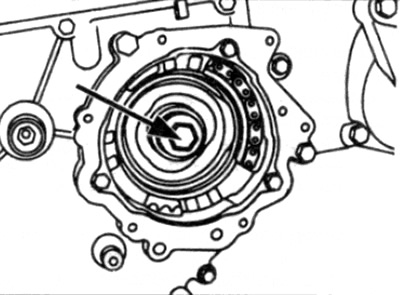
Fig. 7.7. Loosen and remove the central bolt of the fuel injection pump sprocket (shown by arrow) - note that the bolt has a left-hand thread
Note: This bolt has a left-hand thread. Remove the washer.
8. Using a socket or wrench, turn the crankshaft in the direction of normal rotation by 15 degrees after piston #1 reaches TDC using the pulley/damper-to-hub bolt. Use the pointer on the camshaft timing chain cover and the scale on the damper to determine the correct position (see fig. 7.8).
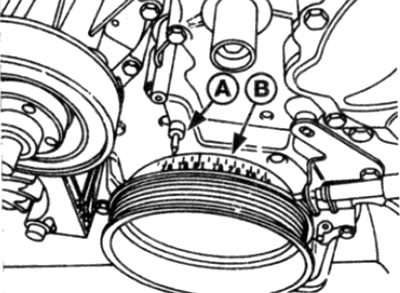
Fig. 7.8. Set the engine crankshaft to 15 degrees after TDC of cylinder No.4, using the pointer on the camshaft timing chain cover and the graduated scale on the damper
A Pointer
In Graduated scale
9. Contact chapter 2B and remove the camshaft drive chain tensioner (see fig. 7.9).
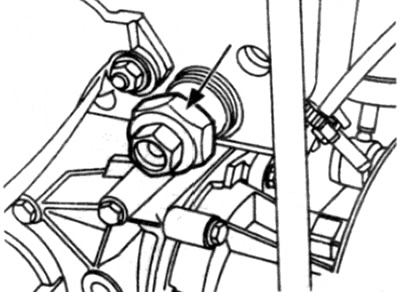
Fig. 7.9. Remove the camshaft drive chain tensioner (shown by arrow)
10. Using a suitable wrench, loosen the fittings and disconnect the high-pressure fuel line from the injection pump. To prevent fuel from spilling, place a highly absorbent cleaning material underneath (see fig. 7.10).
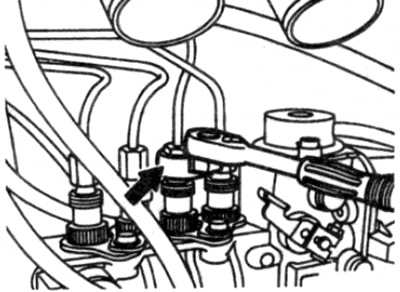
Fig. 7.10. Unscrew the fittings and disconnect the high-pressure fuel line from the high-pressure fuel pump
11. Similarly, loosen and remove the bypass bolts, then disconnect the inlet, feed and outlet hoses from the high-pressure fuel pump. Remove the sealing gaskets and dispose of them - new ones must be used during installation. Clamp the flexible sections of the hoses to prevent fuel from leaking later.
12. If equipped, remove the high pressure fuel pump control lever damper.
13. Disconnect all vacuum hoses from the actuators at the top and rear of the injection pump, remembering their location for correct reinstallation.
14. Similarly, disconnect all electrical wires from the actuators at the top and rear of the high pressure fuel pump, remembering the location of the connectors so that they can be reconnected during installation.
15. Disconnect the accelerator lever mechanism from the high-pressure fuel pump control lever.
16. Place marks on the fuel pump housing to indicate its position relative to the rear surface of the support flange to ensure approximate alignment during installation.
17. Once the fuel pump is removed, remove the sprocket (and synchronization device)must be held still inside the camshaft drive chain housing so that it cannot come out of engagement with the chain, but in such a way that it can turn when the crankshaft is turned by hand. On the latest models, a special holding housing is installed for this purpose.
18. On early models not equipped with such a housing, you need to have ready a piece of metal pipe of approximately the same diameter as the threaded section of the central bolt securing the sprocket.
19. Loosen and remove the bolts that secure the front part of the fuel injection pump to the support flange, (see fig. 7.19). Remove the bolt that secures the rear of the pump to the support bracket and remove the fuel pump. At the same time, hold the pump sprocket in place (and synchronization device).
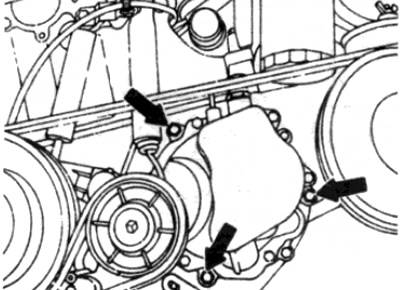
Fig. 7.19. Loosen and remove the bolts (indicated by arrows), which hold the front part of the fuel injection pump on the support flange
Caution: Do not allow the sprocket and chain to separate. Be prepared for some engine oil to leak out when the pump is removed from the flange.
20. If early models do not have a sprocket retaining housing, insert a length of pipe into the center hole of the sprocket. Thread a piece of strong wire or heavy nylon cable tie through the pipe, then use it to secure the sprocket to the top of the timing chain case.
21. Loosen the bolts and remove the fuel thermostat from the high pressure fuel pump housing and remove it from the work area (see fig. 7.21). There is no need to disconnect the thermostat from the fuel lines.
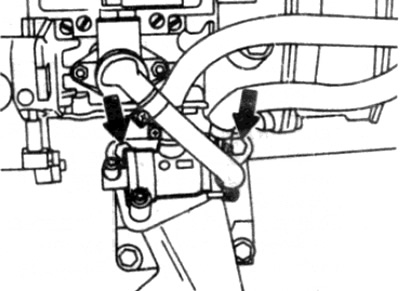
Fig. 7.21. Unscrew the bolts (shown by arrows) and disconnect the fuel thermostat from the high pressure fuel pump housing
22. Seal all open fuel line connections to reduce fuel loss and prevent dirt from entering (see Homemade tool).
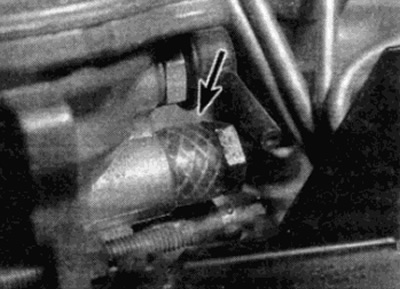
Pull a length of hose over the bypass bolt to cover the holes, then screw the bolt back into place in the fuel pump and tighten it by hand.
23. Clamp the fuel pump in a vice, unscrew and remove the plug on the side of the pump body (see fig. 7.23).
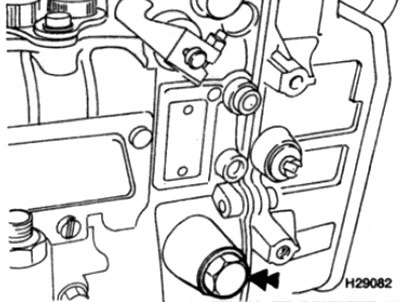
Fig. 7.23. Unscrew and remove the plug (shown by arrow) on the side of the pump body
24. Using pliers, turn the fuel pump shaft in the normal direction, observing the movement of the regulator rotor through the plug hole. Continue turning the shaft until the protrusion on the regulator aligns with the hole. In this position, the rotor should be fixed relative to the pump body with a special device from Mercedes-Benz (please see the note at the beginning of this paragraph) (see fig. 7.24).
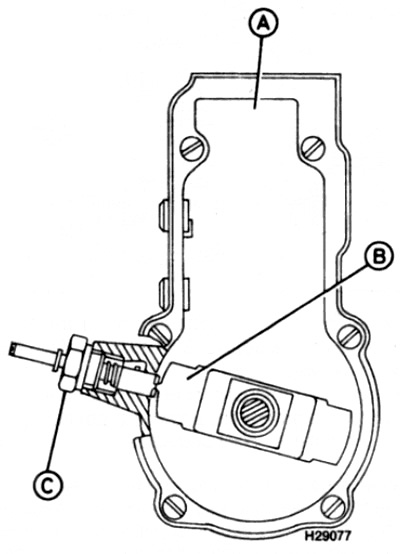
Fig. 7.24. Rotate the fuel pump shaft until the protrusion on the regulator rotor aligns with the inspection hole
A The pump being tested - rear view
In the regulator rotor
With Fixing Device
Caution: Be careful not to damage the pump shaft surface when clamping with the gripper jaws.
25. Remove the sealing ring and discard it - a new one must be used during installation.
Installation
26. Installation is carried out in the reverse order of removal, taking into account the following points:
- a) Install the sealing ring on the fuel pump, after having lightly lubricated it with engine oil.
- b) Make sure that the crankshaft has not moved from the position corresponding to 15° after piston No.1 has reached the TDC position.
- c) Lock the crankshaft and tighten the fuel pump sprocket mounting bolt to the required torque, taking into account that the bolt has a left-hand thread.
- d) Before turning the crankshaft, remove the fuel pump locking device and install the plug.
- d) Tighten the fuel pump mounting bolts to the required torque.
- e) Connect the high pressure fuel lines and tighten all connections securely.
- g) New sealing washers must be installed on the bolts of the inlet, feed and return fuel lines.
- h) If the vacuum pump has been removed, a new seal must be used when reinstalling it - for details, refer to chapter 9.
- i) Upon completion, check and, if necessary, adjust the fuel supply by the fuel pump in accordance with paragraph 9.