



EBV
Electronic brake force distribution system (EBV) prevents excessive braking of the rear wheels when the load on the rear axle is low or when the wheels have poor traction (for example on a wet road).
ABS
The anti-lock braking system regulates the pressure in the brake system so that the wheels do not lock when braking. As a result, the vehicle's controllability is maintained.
With the system turned off ABS the wheels may be locked. The car may skid when braking. For off-road driving, you can turn off the system ABS. Never turn off the system ABS when driving on normal roads.
System ABS operates regardless of road conditions, starting at a speed of approximately 3 km/h.
If full braking is required, press the brake pedal with full force.
This guarantees the action ABS on all wheels.
On a slippery road the system ABS makes adjustments already during light braking, causing the brake pedal to pulsate, which indicates insufficient grip of the wheels on the road and the need to adapt the driving style to the road conditions.
If further braking is required, continue to press the brake pedal with the same force. Only in this case you will take advantage of all the benefits of the system ABS.
Warning: If you are towing a trailer that is not equipped with ABS, then when braking with full force, excessive braking and loss of traction of the wheels with the road are possible. There is a risk of losing control of the vehicle. When braking with full force, monitor the trailer's reaction through the outside rear-view mirrors.
The vehicle's position on the trajectory of movement remains stable if the trailer wheels are not locked. Anti-lock braking systems do not relieve you of the need to adapt your driving style to road and weather conditions.
System ABS improves vehicle control and maintaining a given trajectory when braking. However, the system ABS is unable to prevent consequences, such as failure to keep a safe distance from the vehicle in front or exceeding the speed limit when turning, etc.
BAS system
The emergency braking system helps reduce the braking distance in emergency braking situations.
You can use all the benefits of the system ABS when the emergency braking system is operating ВAS.
When the brake pedal is pressed quickly, the braking pressure is increased to its maximum. If further braking is required, continue to press the brake pedal with the same force. If you release the brake pedal, the emergency braking system BAS turns off.
ASR/ESP
Traction control system ASR controls the ability to transmit traction force, i.e. the transfer of torque between the tires and the road.
[Article was obtained from the portal MERCEDESMAN.ru]
If the warning light on the instrument cluster flashes #img#, this means that the anti-skid system has been activated ASR and there is a risk of an accident, as the car may skid. In this case, proceed as follows:
- if the indicator light starts to flash when you start moving, then operate the accelerator pedal more carefully (your acceleration should be less intense);
- if the indicator light starts to flash while driving, it means that the road is too slippery for your driving mode, so gradually release the accelerator pedal.
Adapt your driving style to road conditions.
If you do not heed this warning, your vehicle may skid.
By selectively braking individual wheels and limiting engine power, the system ASR/ESP stabilizes the vehicle. System ASR/ESP provides you with support especially when starting off on wet or slippery roads.
Caution: If the warning lamp on the instrument cluster is constantly on -ASR/ESP, then the system ESP disabled.
Turn off the engine and turn the ignition key to position 0 when:
- towing a vehicle with the front/rear axle raised;
- checking the parking brake on a brake test stand.
Otherwise, the active braking effect exerted by the system ESP or ASR, may cause the wheels to lock and damage the brake system.
Proper functioning of the system ESP is only provided if you use wheels with tires of the recommended sizes.
Turning off ASR
You can turn off torque control ASR in the speed range from 0 to 60 km/h.
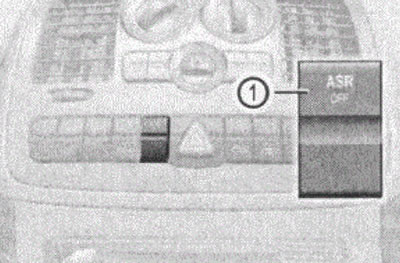
Figure 26 1. ASR switch
To turn off the system, press button (1).
At the same time, a warning lamp lights up on the instrument cluster
 - "Engine torque control disabled."
System ASR should be turned off in the following situations:
- when using anti-skid purposes;
- when driving in deep snow;
- when driving on sand and gravel.
Active braking effect provided by the system ESP to stabilize the direction of the vehicle's movement, may result in damage to the braking system.
Enabling ASR
To turn on the system, press button (1) when the system is turned off.
Warning lamp
 goes out on the instrument cluster. Engine torque control is enabled and the system ASR is again in normal operating condition.
Traction control automatically engages if you drive faster 60 km/h or the car gets into an unstable situation.