



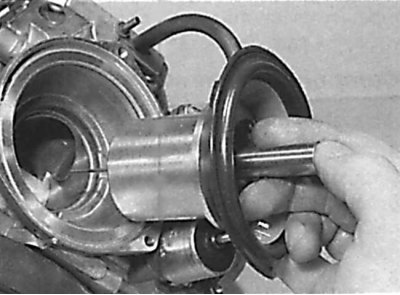
Removal the carburetor shock absorber cover together with the piston vibration damper
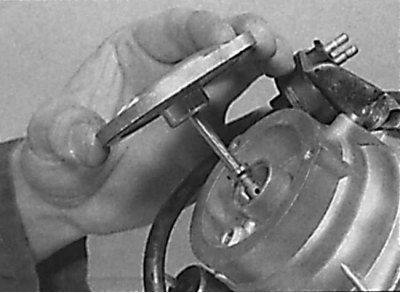
Removal the shock absorber from the carburetor body
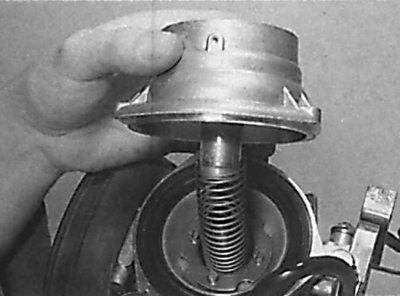
The location of the screw that also secures the delay valve
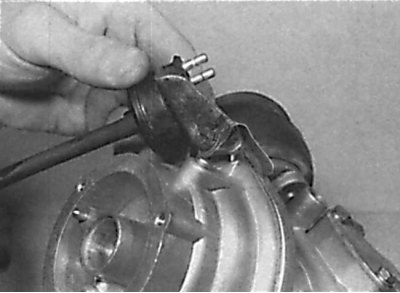
Removal the piston return spring
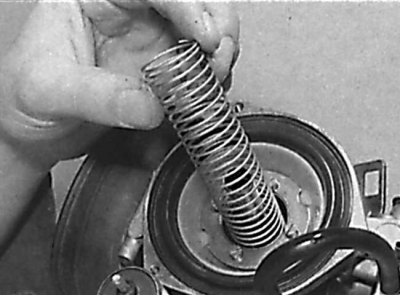
Extraction in the form of a single block of piston, diaphragm and jet needle
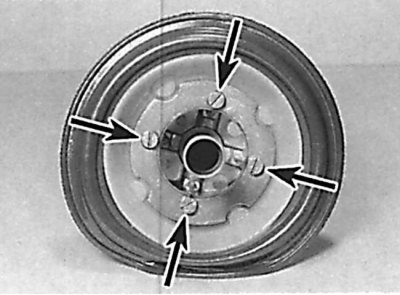
Location of piston diaphragm mounting screws
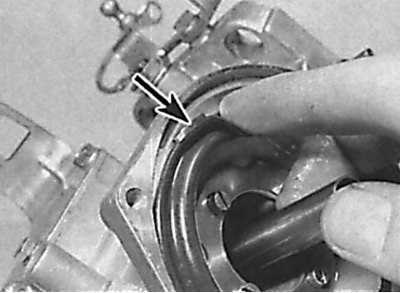
Alignment of the protrusion on the outer edge of the diaphragm with the recess on the carburetor body
1. Unscrew the screws and remove the carburetor shock absorber cover together with the piston vibration damper (see fig. Removing the carburetor shock absorber cover together with the piston vibration damper). Remove the sealing gasket from the cover.
2. Unscrew the screws and remove the shock absorber from the piston housing. Keep in mind that one of these screws secures the delay valve (see fig. Removing the shock absorber from the carburetor body, Location of the screw that also secures the delay valve).
3. Remove the piston return spring, then remove the piston, diaphragm and jet needle as a unit from the carburetor body (see fig. Removing the piston return spring, Removing the piston, diaphragm and jet needle as a single unit).
4. Check the condition of the piston diaphragm. If the diaphragm has defects in the form of cracks or through holes, the operation of the carburetor will be disrupted. Replace the diaphragm, for which, holding the piston, unscrew the diaphragm mounting screws, remove the washer and diaphragm from the piston (see Fig. Location of piston diaphragm mounting screws).
5. Install the new diaphragm onto the piston so that the protrusion on the back of the diaphragm aligns with the recess on the surface of the piston.
6. Place the washer on the diaphragm and secure with screws.
7. Install the piston, diaphragm and jet needle assembly into the carburetor body so that the protrusion on the outer edge of the diaphragm aligns with the recess in the carburetor body (see fig. Alignment of the protrusion on the outer edge of the diaphragm with the recess on the carburetor body). Check that the air hole on the piston base is on the engine side.
8. Install the piston return spring, then the shock absorber and secure with screws, taking into account that one of the screws secures the delay valve.
Caution! To avoid displacement of the diaphragm during installation, do not rotate the shock absorber. Install the shock absorber cover with the piston vibration damper with a new gasket and secure with screws.
9. Unscrew the filler plug from the shock absorber and add the required oil to the shock absorber so that the oil level is below the base of the filler plug hole. Screw the filler plug back in place.
Jet needle
Piston, diaphragm and jet needle assembly
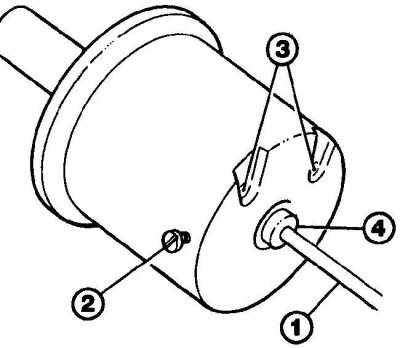
1 – jet needle; 2 – screws for fastening the jet needle; 3 – air channel; 4 – plastic sleeve
1. Remove the block with the piston, diaphragm and jet needle from the carburetor.
2. Loosen the screw on the side of the piston and remove the jet needle (see picture).
3. Check the condition of the jet needle. If there is dirt on it, wash the needle in a suitable solvent. Do not damage the needle. If the needle is worn, replace it.
4. Install the needle into the piston so that the plastic sleeve aligns with the piston body and secure the needle with the screw.
5. Install the piston block with the jet needle into the carburetor body.
Delay valve
1. Check the operability of the delay valve on a cold engine. Turn on the ignition without starting the engine. Disconnect the longer vacuum hose from the carburetor body and create a vacuum in it. Air should pass through the valve in the first 5-15 seconds, after which the valve should close. If air passes through the valve constantly or does not pass at all, the valve is faulty and must be replaced.
2. Remove the short curved vacuum hose from the base of the valve. Disconnect the electrical connector from the valve.
3. Unscrew the screw and remove the delay valve from the carburetor.
4. Installation is carried out in the reverse order of removal.
Damper control diaphragm
1. Label and disconnect the electrical connectors and vacuum hoses from the throttle body.
2. Unscrew the screws and remove the bimetallic spring housing from the valve housing. Do not disconnect the coolant supply hoses. Remove the gasket.
3. Remove the connecting rod from the spherical socket on the throttle lever.
4. Remove the three screws and remove the throttle body from the carburetor body. Remove the gasket.
5. Remove the retaining ring and take out the throttle lever together with the gasket.
6. Remove the screws and remove the damper control diaphragm cover and gasket.
7. Remove the retaining ring and move the fast idle cam actuator lever forward to allow the diaphragm rod to be disconnected.
8. Remove the diaphragm and rod from the valve housing.
9. Check the condition of the diaphragm and, if there are any defects in the form of cracks or through holes, replace it.
10. Install the diaphragm and linkage into the valve housing, then install the spring and cover with a new gasket and secure with screws.
11. Connect the damper drive lever to the damper control diaphragm rod and secure with a retaining ring.
12. Adjust the position of the throttle lever by moving the diaphragm rod up to the stop and the drive lever to the left so that it is positioned opposite the diaphragm rod (i.e. to the position of accelerated idle speed). In this case, the throttle lever should be installed in the center of the second step from the top on the high-speed idle cam. Otherwise, bend its shoulder to install the drive lever.
13. Move the drive lever to the left until it stops in the engine start position. In this case, the throttle lever should be installed on the upper step of the fast idle cam. Otherwise, bend the lever arm to install the drive lever.
14. Move the drive lever to the right until it stops in the normal idle position. In this case, the throttle lever should not rest against the steps of the fast idle cam.
15. After adjusting the throttle lever, remove the lever, install the protective gasket, then reinstall the lever and secure with the retaining ring.
16. Install the throttle body with a new gasket onto the carburetor and secure with screws.
17. Install the bimetallic spring housing with a new gasket onto the damper body so that the spring projection aligns with the damper drive lever. Align the marks on the damper and bimetallic spring housings and secure the bimetallic spring housing with screws.
18. Secure the rod into the throttle body's spherical socket.
19. Connect the electrical connectors and vacuum hoses to the valve body according to the markings made earlier.