
Cars BMW Cars Volkswagen Cars Chevrolet Cars Land Rover Cars Lada Cars Honda Cars Peugeot
English Русский
Български
Беларускі
Український
Српски
Hrvatski
Română
Polski
Slovenský
Magyar
Bookmark News and articles Sitemap Feedback Site search
MercedesMan.ru


A-Class C-Class E-Class G-Class M-Class S-Class Others
W123 (1976-1985) W124 (1984-1995) W210 (1996-2002)
  • Main
  • E-Class
  • W124 (1984-1995)
  • Power unit
  • Fuel system (carburetor)
  • Replacement of carburetor elements PIERBURG 2E-E

Replacement of carburetor elements PIERBURG 2E-E (Mercedes-Benz E-Class W124)

0
Contents: Damper actuator ↡ Throttle actuation mechanism ↡ Coolant temperature sensor ↡ Electronic control unit (ecu) ↡

Damper actuator


Carburetor flap actuator PIERBURG
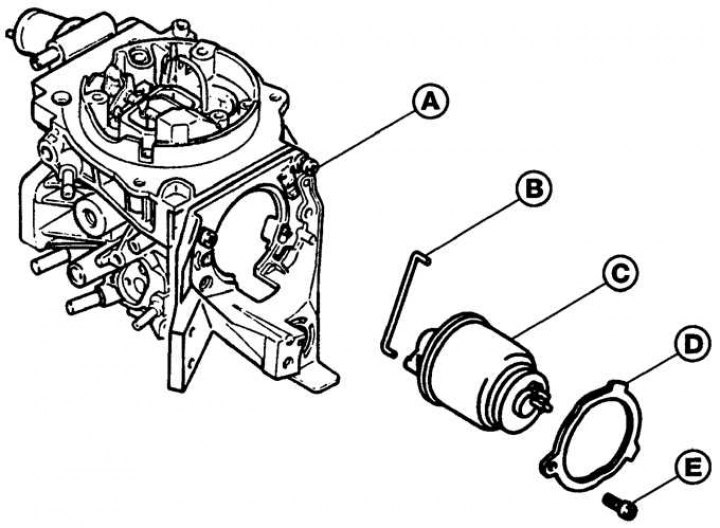


A – carburetor body; B – thrust; C – actuator housing; D – fastening ring; E – screw

A – carburetor body; B – thrust; C – actuator housing; D – fastening ring; E – screw


1. Remove the air filter.

2. Disconnect the electrical connectors from the actuator.

3. Unscrew the screw and remove the actuator mounting ring (see fig. Actuator of the PIERBURG carburetor flap).

4. Disconnect the rod from the choke lever, then rotate the actuator housing, remove the locking pin and remove the actuator from the carburetor.

5. Installation is carried out in the reverse order of removal.

Throttle actuation mechanism


PIERBURG carburetor actuator
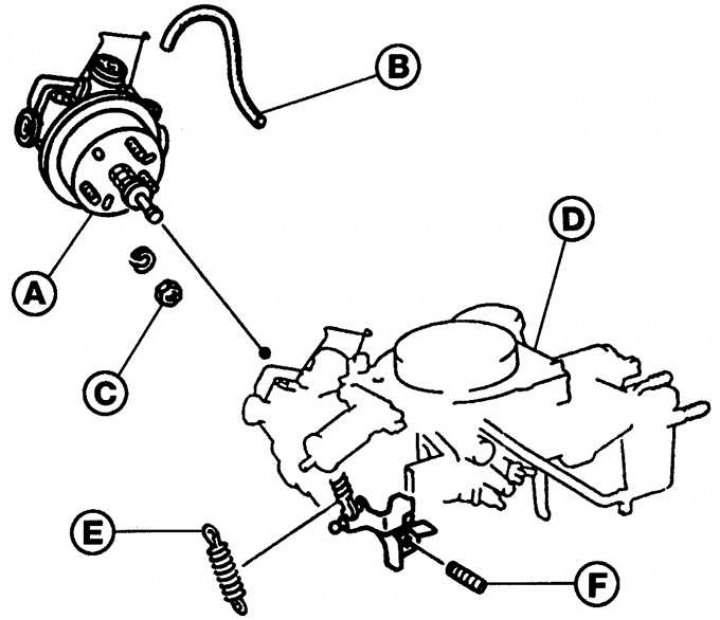


A – actuator housing; B – vacuum hose; C – nut; D – carburetor body; E – spring; F – adjusting screw

A – actuator housing; B – vacuum hose; C – nut; D – carburetor body; E – spring; F – adjusting screw


1. Remove the air filter.

2. Disconnect the electrical connector and vacuum hose from the side of the actuator.

3. Unscrew the three nuts and remove the actuator from the carburetor (see fig. Actuator of the PIERBURG carburetor).

4. Installation is performed in the reverse order of removal. Check that the gap between the actuator rod and the screw on the throttle lever should be within 1.5 - 2.5 mm.

Coolant temperature sensor


Location of the coolant temperature sensor on the cylinder head
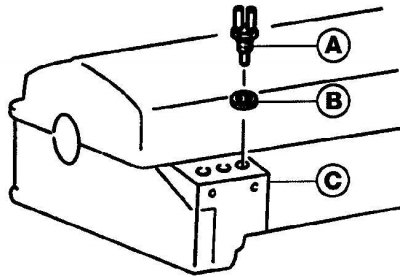


A – coolant temperature sensor; B – sealing ring; C – cylinder head

A – coolant temperature sensor; B – sealing ring; C – cylinder head


1. The coolant temperature sensor is located at the front of the cylinder head (see Fig. Location of the coolant temperature sensor on the cylinder head).

2. Disconnect the electrical connector from the sensor.

3. Make sure the engine is cold, then briefly unscrew the cap from the expansion tank to relieve pressure in the cooling system.

4. Unscrew the coolant temperature sensor and remove the sealing ring.

5. The coolant temperature sensor can be tested by heating it in a container of water. Use a thermometer to determine the water temperature. Connect an ohmmeter to the sensor contacts and measure the sensor resistance at different temperatures.


6. The coolant temperature sensor is installed in the reverse order of removal.

Electronic control unit (ecu)


Caution! The Electronic Control Unit (ECU) contains static-sensitive components, so when disconnecting electrical connectors from the ECU, do not touch the connector contacts with your hands or tools, as this may damage the ECU components. When working on the ECU, discharge static electricity from your body by touching grounded metal objects. Disconnect electrical connectors from the ECU only for the time required for repairs.


The ECU is located in the rear right side of the engine compartment.

1. Remove the ground cable from the battery.

2. Release the clips and remove the ECU cover.

3. Press the retaining clips on the ECU unit and remove the multi-pin electrical connector from the unit. When removing the connector, be careful not to damage the connector contacts.

4. Remove the screws and remove the ECU unit.

5. Installation is carried out in the reverse order of removal.
This article is available at: russian, bulgarian, belarusian, ukrainian, serbian, croatian, romanian, polish, slovak, hungarian
The article has been verified: Levin Kirill Glebovich
Share with friends:
◀ Previous
E-Class W124 / Fuel system (carburetor)
Next ▶

Carburetor PIERBURG 2E-E
Replacement of carburetor elements STROMBERG 175 CDT
Carburetor STROMBERG 175 CDT
Accelerator cable — removal and installation
Fuel pump — removal and installation
Removal and installation the carburetor
Intake manifold — removal and installation
Intake Manifold Heater — Removal and Installation
More similar articles for repairing other models

☛ Pierburg 2E-E carburetor fuel system — basic information and… Mercedes 190 (W201) (1982-1993)
☛ Replacement of the auxiliary drive belt and elements of its… Mercedes W463 (1999-2019)
☛ Elements of security systems — general information Mercedes W163 (1997-2005)
☛ Elements of security systems Mercedes W140 (1991-1998)
☛ Moments of fastening of suspension elements Mercedes Vito 1 (1996-2003)
Link in different formats to this article
Comments and feedback from visitors
No comments yet


How much will 40 + 25 ?


W210 (1996-2002) 
  • General information
  • Vehicle description
  • Working conditions and tools
  • Car care
  • Diesel engines
  • Engine repair
  • Lubrication system
  • Cooling system
  • Injection system
  • Supply system
  • Exhaust system
  • Gasoline engines
  • Engine repair
  • Lubrication system
  • Cooling system
  • Control system
  • Power and exhaust system
  • Transmission
  • Clutch
  • Mechanical gearbox
  • Automatic gearbox
  • Drive shafts
  • Chassis
  • Car suspension
  • Steering
  • Tires and wheels
  • Brake system
  • Body
  • Exterior (external elements)
  • Interior (internal elements)
  • Doors and windows
  • Heating and ventilation
  • Electrical equipment
  • Equipment and devices
  • Power devices
  • Lighting and signaling
  • Electrical circuits
W124 (1984-1995) 
  • General information
  • Governing bodies
  • Driving and operation
  • Weekly care
  • Maintenance (gasoline)
  • Maintenance (diesel)
  • Troubleshooting
  • Power unit
  • I4 petrol engine
  • V6 petrol engine (SOHC)
  • V6 petrol engine (DOHC)
  • Diesel engines
  • Engine overhaul
  • Cooling system
  • Heating and ventilation
  • Fuel system (carburetor)
  • Injection system «Bosch CIS-E»
  • Injection system «Bosch HFM»
  • Diesel fuel system
  • Supply system
  • Starting and charging system
  • Ignition system (I4)
  • Ignition system (V6)
  • Preheating
  • Transmission
  • Clutch
  • Mechanical gearbox
  • Automatic gearbox
  • Drive shafts
  • Chassis
  • Brake system
  • Car suspension
  • Steering
  • Body
  • Exterior (external elements)
  • Interior (internal elements)
  • Doors, locks and windows
  • Electrical equipment
  • Equipment and devices
  • Switches
  • Headlights and lighting
  • Electrical circuits
W123 (1976-1985) 
  • General information
  • Introduction to the guide
  • Power unit
  • Engine device
  • Repair M102 engines
  • Repair M110 and M123 engines
  • Cooling and lubrication (M102)
  • Cooling (M110 and M123)
  • Ignition system
  • Power system «Stromberg»
  • Power system «Solex 4A1»
  • Fuel injection «K-Jetronic»
  • Fuel injection «L-Jetronic»
  • Transmission
  • Clutch
  • Mechanical gearbox
  • Automatic gearbox
  • Cardan and rear axle
  • Chassis
  • Front suspension
  • Rear suspension
  • Steering
  • Brake system
  • Body
  • Exterior (external elements)
  • Interior (internal elements)
  • Doors, locks and windows
  • Electrical equipment
  • Equipment and devices
  • Power devices
  • Electrical circuits
 
MercedesMan.ru © 2017–2026 · Mobile version · Read about Mercedes · Sitemap: EN BG BY UA RS HR RO PL SK HU · Feedback · Site search · Bookmark A-Class (W168) · C-Class (W201) · C-Class (W202) · C-Class (W203) · E-Class (W123) · E-Class (W124) · E-Class (W210) · G-Class (W463) · M-Class (W163) · S-Class (W116, petrol) · S-Class (W126, petrol) · S-Class (W140) · S-Class (W220) · Sprinter · Vito 1 · Vito 2 · Vario 814D ·
 
We only use cookies without which some of the site's features may not be available.