
Cars BMW Cars Volkswagen Cars Chevrolet Cars Land Rover Cars Lada Cars Honda Cars Peugeot
English Русский
Български
Беларускі
Український
Српски
Hrvatski
Română
Polski
Slovenský
Magyar
Bookmark News and articles Sitemap Feedback Site search
MercedesMan.ru


A-Class C-Class E-Class G-Class M-Class S-Class Others
W123 (1976-1985) W124 (1984-1995) W210 (1996-2002)
  • Main
  • E-Class
  • W124 (1984-1995)
  • Power unit
  • Injection system «Bosch CIS-E»
  • Fuel tank — removal and installation

Fuel tank — removal and installation (Mercedes-Benz E-Class W124)

0
Contents: Removal ↡ Installation ↡
Warning! Gasoline is extremely flammable and explosive, so care must be taken when working on any part of the fuel system.


Warning: The container that held the fuel contains fuel vapor and is potentially explosive.


Attention! Work on the fuel system must be carried out in a well-ventilated area, for which you can open all the windows and doors to create a draft.


Warning! When working on the fuel system, do not use open flames, electric welding or tools that may generate sparks. Make sure that a charged fire extinguisher is in the immediate vicinity of the work area.


Warning! Use goggles to protect your eyes from fuel getting into them. If fuel gets on your skin, rinse the area with plenty of water.


Caution! When working with the fuel system, keep it clean, as dirt that gets into the fuel system channels can block them, which will disrupt the normal operation of the engine.


Removal


1. Pump the fuel out of the fuel tank through the fuel filler neck.

2. Raise the rear of the vehicle and support it on stands.

Warning! It is not advisable to remove the fuel tank on a vehicle installed over an inspection pit, as fuel vapors accumulate in the inspection pit, which may cause harm to health.


3. Relieve pressure in the fuel system.

4. Remove the ground cable from the battery.

5. While working under the vehicle, disconnect the fuel supply and return hoses and the ventilation hose from the fuel tank. Mark the hoses to avoid mixing them up during installation. Close the ends of the fuel lines and the openings in the fuel tank with plugs.


Sedan and coupe models


Removal the fuel tank gasket panel
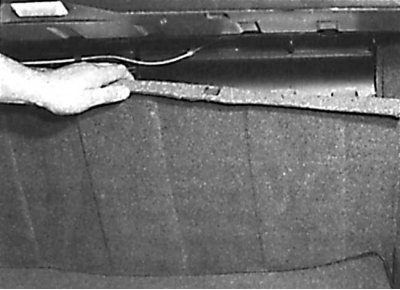


Removal the fuel tank gasket panel


Location of the left side fuel tank mounting nuts
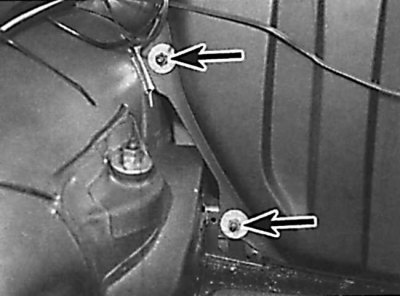


Location of the left side fuel tank mounting nuts


Location of the fuel tank right side mounting nuts
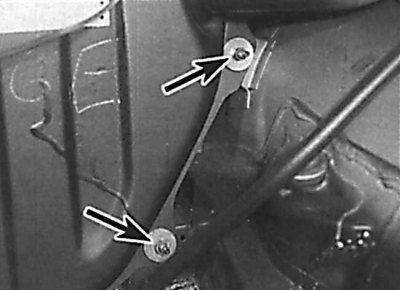


Location of the fuel tank right side mounting nuts


Fastening the fuel filler neck to the body panel
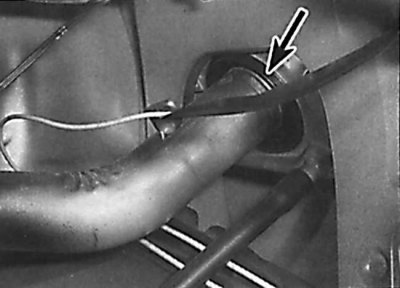


Fastening the fuel filler neck to the body panel


1. Remove the large rubber seal covering the fuel tank pipes.


2. In the luggage compartment, remove the clips and move the carpet to the side. Release the fasteners and fasteners and remove the fuel tank gasket panel (see Fig. Removing the Fuel Tank Gasket Panel).

3. Disconnect the electrical connector from the fuel level sensor and remove the wires from the mounting brackets.

4. Unscrew the fuel tank mounting nuts, lift the tank and disconnect the fuel drain hose. Disconnect the fuel filler neck from the body panel and remove the sealing ring and bushings (see fig. Location of fuel tank left side mounting nuts, Location of fuel tank right side mounting nuts, Fastening fuel filler neck to body panel).

5. Lift the fuel tank up, then move it back and out of the luggage compartment. Remove the sealing strips.

Station wagon models


Fuel tank for station wagon models
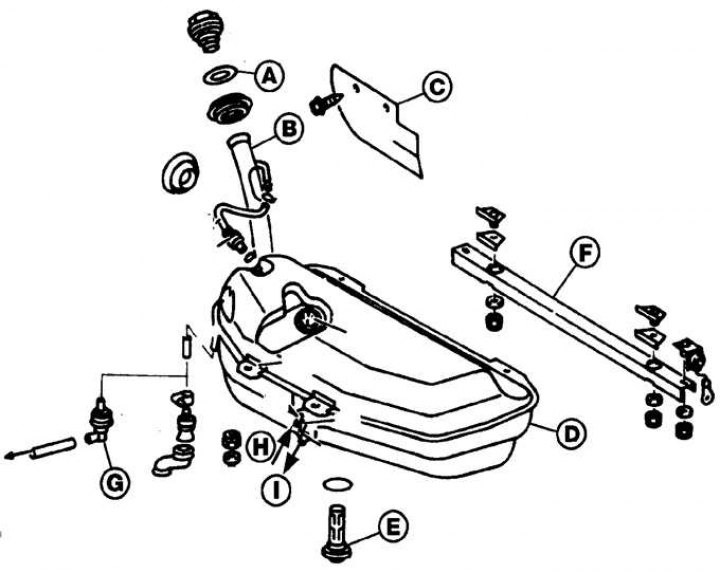


A – gasket; B – fuel filler neck; C – mudguard; D – fuel tank; E – mesh filter; F – support beam; G…

A – gasket; B – fuel filler neck; C – mudguard; D – fuel tank; E – mesh filter; F – support beam; G – inlet valve; H – return fuel line; I – fuel supply line


1. Remove the rear section of the exhaust system from the rubber mounts and support it with boards to avoid deforming the exhaust system connections.


2. Disconnect the electrical connector from the fuel level sensor.

3. Using a jack and a wooden block, support the fuel tank from below.

4. Remove the nuts and the support beam from the rear of the fuel tank. Remove the nuts securing the brackets to the front of the fuel tank and remove the washers and bushings (see fig. Fuel tank of the Station wagon models).

5. Slowly lower the jack with the fuel tank and disconnect the filler neck ventilation hose from the tank. Disconnect the fuel filler neck from the body panel and remove the sealing ring and bushings.

6. Remove the fuel tank from underneath the vehicle and remove the sealing strips.

All models


1. Visually inspect the fuel tank from the outside. Unscrew and remove the mesh filter from the fuel tank. Using clean fuel, wash off any deposits from the inside walls of the fuel tank. Install the mesh filter with a new sealing ring.

2. If there is sediment or water in the fuel tank, remove the fuel level sensor and flush the fuel tank with a large amount of clean fuel. If there is mechanical damage to the fuel tank, restore the fuel tank in a specialized workshop or replace it.

Warning! Do not repair the fuel tank yourself using welding or soldering, as the tank contains fuel vapors that are explosive.


Installation


1. Installation is carried out in the reverse order of removal, taking into account the following points.

2. Tighten all bolts and nuts to the specified torque.

3. Use only new self-locking nuts to secure the fuel tank on Estate models.


4. Check that the sealing strips are installed correctly.

5. Check that the fuel level sensor electrical connector is connected correctly and securely.

6. Perform a test drive, then check all installed components for fuel leaks.
This article is available at: russian, bulgarian, belarusian, ukrainian, serbian, croatian, romanian, polish, slovak, hungarian
The article has been verified: Levin Kirill Glebovich
Share with friends:
◀ Previous
E-Class W124 / Injection system «Bosch CIS-E»
Next ▶

Fuel pump — removal and installation
Fuel level sensor — removal and installation
Pressure accumulator — removal and installation
Fuel filter — removal and installation
Air Filter Housing — Removal and Installation
Throttle body — removal and installation
Intake manifold — removal and installation
KE-Jetronic fuel injection system components
Fuel distributor — removal and installation
Air flow sensor — removal and installation
More similar articles for repairing other models

☛ Emergency opening of the fuel filler flap Mercedes W168 (1997-2004)
☛ Fuel tank — design description Mercedes W202 (1993-2000)
☛ Emptying the fuel tank Mercedes W463 (1999-2019)
☛ Access to the fuel tank filler neck Mercedes W163 (1997-2005)
☛ Access to the fuel tank filler neck Mercedes W140 (1991-1998)
☛ Removal and installation the fuel tank flap Mercedes Vito 2 (2003-2014, diesel)
Link in different formats to this article
Comments and feedback from visitors
No comments yet


How much will 18 + 11 ?


W210 (1996-2002) 
  • General information
  • Vehicle description
  • Working conditions and tools
  • Car care
  • Diesel engines
  • Engine repair
  • Lubrication system
  • Cooling system
  • Injection system
  • Supply system
  • Exhaust system
  • Gasoline engines
  • Engine repair
  • Lubrication system
  • Cooling system
  • Control system
  • Power and exhaust system
  • Transmission
  • Clutch
  • Mechanical gearbox
  • Automatic gearbox
  • Drive shafts
  • Chassis
  • Car suspension
  • Steering
  • Tires and wheels
  • Brake system
  • Body
  • Exterior (external elements)
  • Interior (internal elements)
  • Doors and windows
  • Heating and ventilation
  • Electrical equipment
  • Equipment and devices
  • Power devices
  • Lighting and signaling
  • Electrical circuits
W124 (1984-1995) 
  • General information
  • Governing bodies
  • Driving and operation
  • Weekly care
  • Maintenance (gasoline)
  • Maintenance (diesel)
  • Troubleshooting
  • Power unit
  • I4 petrol engine
  • V6 petrol engine (SOHC)
  • V6 petrol engine (DOHC)
  • Diesel engines
  • Engine overhaul
  • Cooling system
  • Heating and ventilation
  • Fuel system (carburetor)
  • Injection system «Bosch CIS-E»
  • Injection system «Bosch HFM»
  • Diesel fuel system
  • Supply system
  • Starting and charging system
  • Ignition system (I4)
  • Ignition system (V6)
  • Preheating
  • Transmission
  • Clutch
  • Mechanical gearbox
  • Automatic gearbox
  • Drive shafts
  • Chassis
  • Brake system
  • Car suspension
  • Steering
  • Body
  • Exterior (external elements)
  • Interior (internal elements)
  • Doors, locks and windows
  • Electrical equipment
  • Equipment and devices
  • Switches
  • Headlights and lighting
  • Electrical circuits
W123 (1976-1985) 
  • General information
  • Introduction to the guide
  • Power unit
  • Engine device
  • Repair M102 engines
  • Repair M110 and M123 engines
  • Cooling and lubrication (M102)
  • Cooling (M110 and M123)
  • Ignition system
  • Power system «Stromberg»
  • Power system «Solex 4A1»
  • Fuel injection «K-Jetronic»
  • Fuel injection «L-Jetronic»
  • Transmission
  • Clutch
  • Mechanical gearbox
  • Automatic gearbox
  • Cardan and rear axle
  • Chassis
  • Front suspension
  • Rear suspension
  • Steering
  • Brake system
  • Body
  • Exterior (external elements)
  • Interior (internal elements)
  • Doors, locks and windows
  • Electrical equipment
  • Equipment and devices
  • Power devices
  • Electrical circuits
 
MercedesMan.ru © 2017–2026 · Mobile version · Read about Mercedes · Sitemap: EN BG BY UA RS HR RO PL SK HU · Feedback · Site search · Bookmark A-Class (W168) · C-Class (W201) · C-Class (W202) · C-Class (W203) · E-Class (W123) · E-Class (W124) · E-Class (W210) · G-Class (W463) · M-Class (W163) · S-Class (W116, petrol) · S-Class (W126, petrol) · S-Class (W140) · S-Class (W220) · Sprinter · Vito 1 · Vito 2 · Vario 814D ·
 
We only use cookies without which some of the site's features may not be available.