



It is possible to check the spark plugs for electrical conductivity only when installed, so a special control device with an LED is used for this purpose. It is better to entrust the checking of spark plugs to service station specialists.
If carbon deposits are found on the removed spark plug, this most likely indicates a faulty injector. Inaccurate injection start timing also affects spark plug life. When purchasing spark plugs, always select them according to the engine type and year of manufacture of the vehicle.
Spark plug failure is usually noticeable when starting a cold engine. The fuel in the cylinder with a working spark plug will ignite, but with a faulty spark plug, ignition will occur with a delay. Rough engine operation and blue exhaust also indicate a faulty spark plug. To access the spark plugs, you must first remove a number of parts.
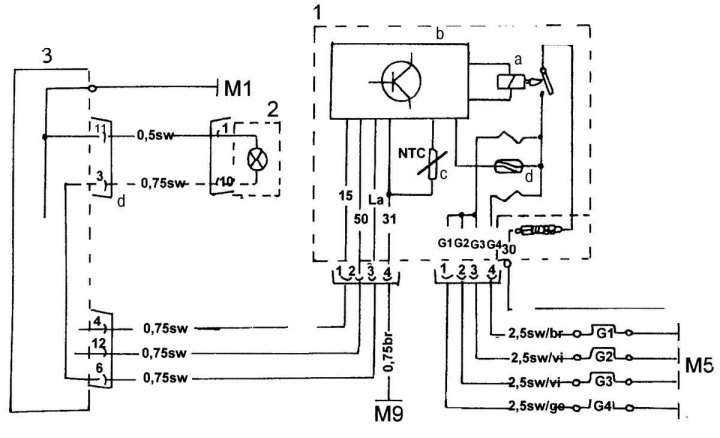
Figure 171. Electrical diagram of the engine pre-heating system: 1 - glow plug relay; 2 - indicator lamp in the instrument cluster; 3 - central distribution device; a, d — relay; b — electronic unit; c — temperature sensor; G — glow plugs; M-connection to "mass"
In the electrical diagram in the figure 171 it can be seen that the preheating device consists of glow plugs, a relay for regulating the glow plug response time and a control lamp in the instrument cluster. When the ignition is turned on, current is supplied to terminal "15" via the relay. Relay A supplies voltage from phase terminal "30" via a fuse (80A) to the spark plugs. The voltage supplied to the spark plugs is at least 11.5 V at a current of about 30 A, which is reduced by the installed regulator to 8–15 A to prevent spark plug burnout. Within 10 seconds the spark plugs heat up to approximately 900°C, after 30 seconds the glow temperature can rise to 1180°C.
(Original article is on the portal MercedesMan)
The relay regulates the operating time of the spark plugs. It is controlled based on information from the outside temperature sensor. The lower the outside temperature, the longer the spark plug life. At -30°C it can be, for example, 25 seconds, in summer it is reduced to 2 seconds. When the spark plugs stop working, the control lamp in the instrument cluster goes out. If the engine does not start immediately when the ignition is on, the safety device cuts off the voltage supply to the spark plugs. When the engine is started, preheating is switched on again. This happens through the starter terminal "50".
The candle may burn out due to high temperature. Spark plugs can fail due to faulty injectors, incorrect injection timing or too low injection pressure. In this case, the spark plugs must be removed and replaced. When replacing, you should once again make sure that they are compatible with the engine.