



Contents: Distribution type fuel injection pump ↡ In-line fuel injection pump ↡ Checking the fuel supply system for…↡
Distribution type fuel injection pump
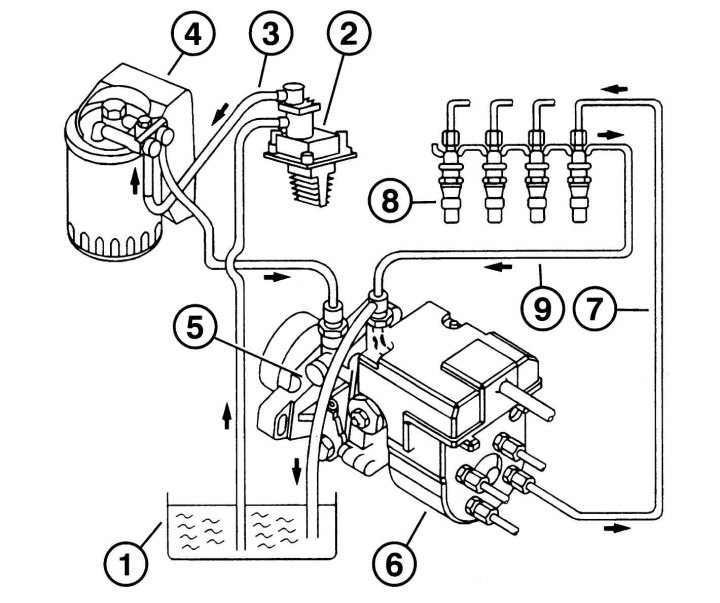
Fig. 4.88. Fuel supply with a distribution fuel injection pump: 1 – fuel tank; 2 – fuel heat exchanger; 3 – heated fuel; 4 – coarse fuel filter; 5 – fine fuel filter; 6 – high pressure pump; 7 – fuel to injectors; 8 – injectors; 9 – return fuel line
The fuel pump of the distributor-type injection pump sucks fuel through the fuel heat exchanger and fuel filter (Fig. 4.88). A throttle in the pump casing serves to remove air. For reliable operation of diesel fuel in winter conditions (usually air temperatures up to –25°C), it is preheated. The heating system consists of a fuel heat exchanger with a thermostat on the cylinder head. The thermostat works as follows: full heating — if the fuel temperature is up to +18°C, mixed mode — from +18 to +30°C (fuel temperature).
The fuel filter consists of a metal housing with a paper filter inserted inside (with very small pores). The coarse filter is located on the side.
The fuel pump is a vane pump integrated into the injection pump. The pump housing is eccentric to the drive shaft. The volume under the vanes is not uniform. The largest volume of fuel enters through the inlet. The fuel is forced into the outlet by the pump vane. If the engine is rotating at a speed of more than 5000 min⁻¹, the supply pressure is limited to approximately 8 bar by a pressure regulating valve with pistons and springs. The supply pressure must be both as high as possible and constant so that the various hydraulic units of the pump are properly supplied. When the engine is started, air is automatically removed from the fuel supply system due to the operation of the pump and throttle. When the engine is started, the starter must rotate continuously until the engine starts, otherwise the air will not be released.
In-line fuel injection pump
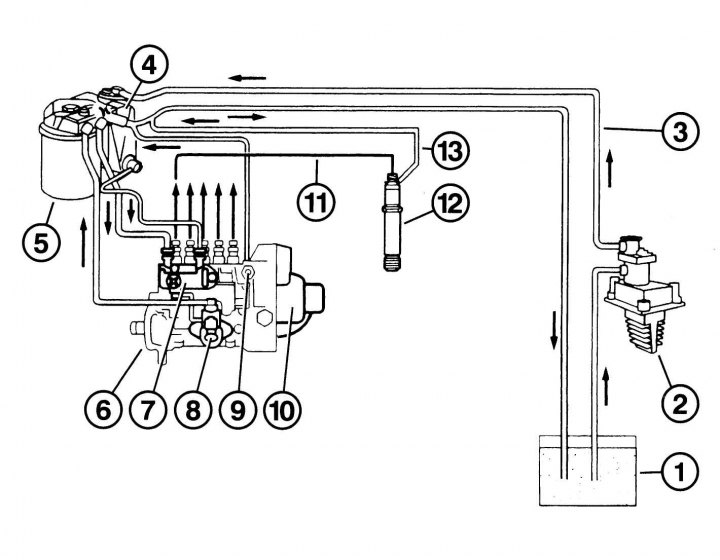
Fig. 4.89. Fuel supply with in-line fuel injection pump: 1 – fuel tank; 2 – fuel heat exchanger; 3 – heated fuel; 4 – coarse fuel filter; 5 – fine fuel filter; 6 – Fuel injection pump; 7 – Electrohydraulic switch (ERE); 8 – fuel pump; 9 – throttle with check valve; 10 – fuel rail (ERE); 11 – high pressure pipeline; 12 – nozzle; 13 – return fuel line
The fuel pump is mounted on flanges (Fig. 4.89). It sucks in fuel through the fuel heat exchanger and fuel filter. A throttle with a check valve in the suction zone of the high-pressure fuel pump is used to remove air.
Warning! Handling fuel.
- Working with fuel is dangerous. Therefore, work carefully if you service or repair the fuel supply system. Be especially careful when draining the fuel tank.
- 1. Disconnect the battery, make sure that the cables cannot touch the battery terminals.
- 2. Drain the fuel from the tank outside. You will need a suitable device for this (for example, a hose with a squeeze bulb). Never drain fuel through the fuel reserve sensor hole or by sucking fuel out with your mouth through a hose - poisoning from highly toxic additives is possible.
- 3. Have a carbon dioxide or foam fire extinguisher at hand.
- 4. Do not drain fuel into a pit. The gases released from the fuel are heavier than air and will accumulate at the bottom of the pit. Consequences: gas poisoning and explosion hazard.
- 5. Make sure that there are no electrical appliances, open flames, heat sources or sparks in or near the work area.
- 6. Drain the fuel into a tightly sealed, fire-resistant container with a pressure equalization valve.
- 7. Fuel vapors remain in the drained tank. They are also very dangerous. Therefore, work with special care.
The fuel preheating system includes a fuel heat exchanger with a thermostat installed on the cylinder head. For reliable operation of diesel fuel in winter conditions, it must be preheated. The thermostat works as follows: full heating - if the fuel temperature is up to + 18°C, mixed mode - from + 18 to + 30°C. The fuel filter consists of a metal housing with a paper filter inserted inside.
Checking the fuel supply system for leaks
If there is a diesel smell in the parking area, it means that fuel is leaking somewhere. To check for loose connections, park the Mercedes overnight in a dry, clean place.


"30,000 km"
1. Check if there are any stains under the car.
2. If there are no stains, start the engine and let it run for a few minutes.
3. Turn off the engine. Check again for stains.
4. If there are no stains, check all pipes and components of the fuel supply system for the characteristic smell of diesel fuel.