
Cars BMW Cars Volkswagen Cars Chevrolet Cars Land Rover Cars Lada Cars Honda Cars Peugeot
English Русский
Български
Беларускі
Український
Српски
Hrvatski
Română
Polski
Slovenský
Magyar
Bookmark News and articles Sitemap Feedback Site search
MercedesMan.ru


A-Class C-Class E-Class G-Class M-Class S-Class Others
W123 (1976-1985) W124 (1984-1995) W210 (1996-2002)
  • Main
  • E-Class
  • W124 (1984-1995)
  • Transmission
  • Clutch
  • Clutch assembly — removal, inspection and installation

Clutch assembly — removal, inspection and installation (Mercedes-Benz E-Class W124)

0
Contents: Removal ↡ Examination ↡ Installation ↡
Warning! When the clutch is in operation, dust is generated that contains asbestos, which is harmful to health, so when cleaning the clutch, do not use compressed air or inhale the dust. Clean the clutch parts from dust using brake fluid or methyl alcohol. After cleaning the clutch parts using methyl alcohol or brake fluid, wipe the parts dry.


Clutch
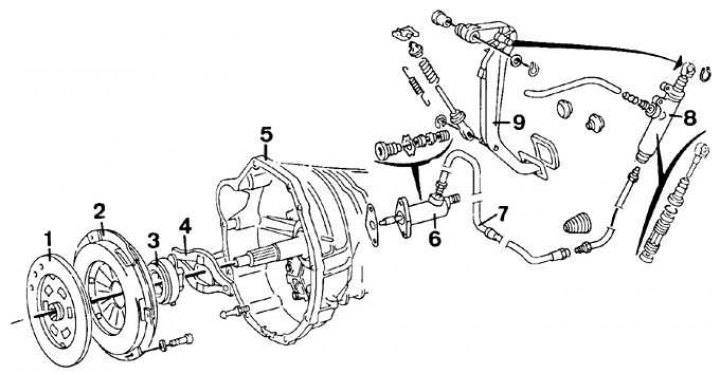


1 – clutch disc; 2 – leading clutch assembly with pressure plate; 3 – release bearing; 4 – clutch…

1 – clutch disc; 2 – leading clutch assembly with pressure plate; 3 – release bearing; 4 – clutch release fork; 5 – clutch housing; 6 – clutch slave cylinder; 7 – hydraulic tubes; 8 – clutch master cylinder; 9 – clutch pedal


Removal


Removal the leading part of the clutch from the flywheel


(Read more on the website Mercedesman.ru)
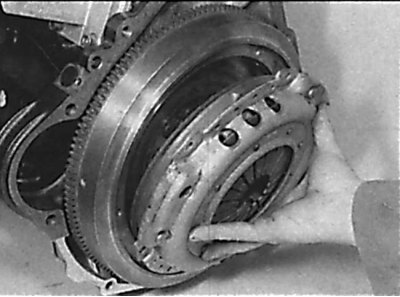
Removal the leading part of the clutch from the flywheel


1. Remove the gearbox.


2. Mark the position of the clutch master assembly in relation to the flywheel using a marker or paint.

3. Gradually loosen the clutch master assembly mounting bolts in a diagonal sequence, turning each bolt half a turn until the spring force is released and the bolts can be removed by hand.

4. Remove the clutch master assembly and clutch disc from the flywheel (see Fig. Removing the leading part of the clutch from the flywheel). When removing, use caution as the clutch disc may fall out of the clutch drive. Note the orientation of the clutch disc in relation to the flywheel. The larger protrusion of the clutch disc hub should be towards the gearbox.

Examination


1. Check the clutch disc linings for wear, mechanical damage or oil contamination.

2. If these defects are present, the clutch disc must be replaced.

3. If the friction linings are in good condition and not worn down to the grooves, the damper springs are securely fastened and the riveted connections are not loose, then the clutch disc can be installed in the car.

4. If the clutch disc is contaminated with oil, check the left crankshaft or transmission input shaft oil seal. Replace the seals if necessary before installing a new clutch disc.

5. Check the drive disc assembly for wear on the pressure plate, mechanical damage, reliability of the riveted joint, damage to the clutch diaphragm spring. If the diaphragm spring is worn or damaged, or there is a suspicion that the elasticity of the spring has changed, then it is necessary to replace the drive disc assembly.


6. Check the working surfaces of the pressure plate and flywheel that mate with the clutch disc linings. They should be clean, flat and free of scratches and wear.

7. Check the thrust bearing, which should rotate easily, evenly and quietly. The working surface of the bearing, which acts on the thrust spring, should be smooth, without cracks, local corrosion or wear.

Installation


Installing the clutch disc on the flywheel
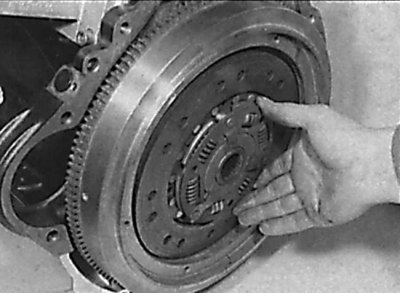


Installing the clutch disc on the flywheel


When installing the clutch disc on the flywheel, the inscription on the disc "engine side" or the smaller side of the hub should be facing the flywheel.

Using a mandrel to center the clutch disc
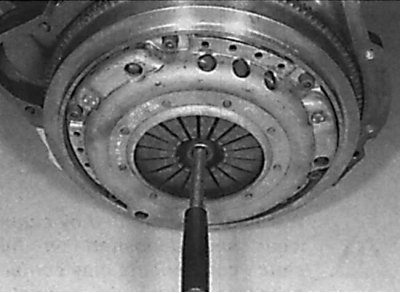


Using a mandrel to center the clutch disc


1. When installing new clutch discs or pressure plate, remove the anti-corrosion protection from them.


2. When installing the clutch disc, make sure that no oil gets on its friction lining, even in small quantities. Therefore, before installing the clutch disc, wipe the mating surface of the flywheel and the surface of the pressure plate with a clean rag, and install the clutch disc with clean hands.

3. Lubricate the splines in the clutch disc hub with a thin layer of special grease based on molybdenum disulfide. Install the clutch disc on the flywheel so that the inscription on the clutch disc "engine side" or the smaller side of the hub was facing the flywheel (see Fig. Installing the clutch disc on the flywheel). When installing the clutch drive part, press the clutch disc against the flywheel.

4. Install the clutch master part by aligning the marks on the flywheel and the clutch master part. Check that the mounting holes on the clutch master part are aligned with the mounting pins on the flywheel. Tighten the clutch master part mounting bolts so that the clutch disc is pressed down, but at the same time can still move sideways.

5. Using a drift or an old transmission input shaft, center the clutch disc relative to the flywheel (see Fig. Using a mandrel to center the clutch disc).

6. After centering the clutch disc, tighten the clutch master cylinder mounting bolts gradually and in a diagonal sequence to the specified torque. Remove the mandrel from the clutch disc.

7. Lubricate the splined portion of the gearbox input shaft and the release bearing guide sleeve with a thin layer of special molybdenum disulfide-based grease.


Attention! The lubricant layer must be thin and uniform, otherwise, when the clutch is operating, excess lubricant will be thrown onto the working surfaces of the clutch, which may disrupt its operation.


8. Install the gearbox.
This article is available at: russian, bulgarian, belarusian, ukrainian, serbian, croatian, romanian, polish, slovak, hungarian
The article has been verified: Levin Kirill Glebovich
Share with friends:
◀ Previous
E-Class W124 / Clutch
Next ▶

General information about the clutch
Clutch specifications
Release bearing — removal, inspection and installation
Clutch release lever — removal, inspection and installation
Clutch slave cylinder — removal and installation
Clutch Master Cylinder — Removal, Repair and Installation
Adjusting the Clutch Master Cylinder Pusher
More similar articles for repairing other models

☛ General description of the clutch Mercedes W168 (1997-2004)
☛ Hydraulic fan clutch — removal and installation Mercedes W202 (1993-2000)
☛ Description of the clutch design Mercedes W163 (1997-2005)
☛ Overdrive clutch Mercedes W140 (1991-1998)
☛ Viscous fan clutch Mercedes Sprinter (1995-2000, diesel)
Link in different formats to this article
Comments and feedback from visitors
No comments yet


How much will 27 + 28 ?


W210 (1996-2002) 
  • General information
  • Vehicle description
  • Working conditions and tools
  • Car care
  • Diesel engines
  • Engine repair
  • Lubrication system
  • Cooling system
  • Injection system
  • Supply system
  • Exhaust system
  • Gasoline engines
  • Engine repair
  • Lubrication system
  • Cooling system
  • Control system
  • Power and exhaust system
  • Transmission
  • Clutch
  • Mechanical gearbox
  • Automatic gearbox
  • Drive shafts
  • Chassis
  • Car suspension
  • Steering
  • Tires and wheels
  • Brake system
  • Body
  • Exterior (external elements)
  • Interior (internal elements)
  • Doors and windows
  • Heating and ventilation
  • Electrical equipment
  • Equipment and devices
  • Power devices
  • Lighting and signaling
  • Electrical circuits
W124 (1984-1995) 
  • General information
  • Governing bodies
  • Driving and operation
  • Weekly care
  • Maintenance (gasoline)
  • Maintenance (diesel)
  • Troubleshooting
  • Power unit
  • I4 petrol engine
  • V6 petrol engine (SOHC)
  • V6 petrol engine (DOHC)
  • Diesel engines
  • Engine overhaul
  • Cooling system
  • Heating and ventilation
  • Fuel system (carburetor)
  • Injection system «Bosch CIS-E»
  • Injection system «Bosch HFM»
  • Diesel fuel system
  • Supply system
  • Starting and charging system
  • Ignition system (I4)
  • Ignition system (V6)
  • Preheating
  • Transmission
  • Clutch
  • Mechanical gearbox
  • Automatic gearbox
  • Drive shafts
  • Chassis
  • Brake system
  • Car suspension
  • Steering
  • Body
  • Exterior (external elements)
  • Interior (internal elements)
  • Doors, locks and windows
  • Electrical equipment
  • Equipment and devices
  • Switches
  • Headlights and lighting
  • Electrical circuits
W123 (1976-1985) 
  • General information
  • Introduction to the guide
  • Power unit
  • Engine device
  • Repair M102 engines
  • Repair M110 and M123 engines
  • Cooling and lubrication (M102)
  • Cooling (M110 and M123)
  • Ignition system
  • Power system «Stromberg»
  • Power system «Solex 4A1»
  • Fuel injection «K-Jetronic»
  • Fuel injection «L-Jetronic»
  • Transmission
  • Clutch
  • Mechanical gearbox
  • Automatic gearbox
  • Cardan and rear axle
  • Chassis
  • Front suspension
  • Rear suspension
  • Steering
  • Brake system
  • Body
  • Exterior (external elements)
  • Interior (internal elements)
  • Doors, locks and windows
  • Electrical equipment
  • Equipment and devices
  • Power devices
  • Electrical circuits
 
MercedesMan.ru © 2017–2026 · Mobile version · Read about Mercedes · Sitemap: EN BG BY UA RS HR RO PL SK HU · Feedback · Site search · Bookmark A-Class (W168) · C-Class (W201) · C-Class (W202) · C-Class (W203) · E-Class (W123) · E-Class (W124) · E-Class (W210) · G-Class (W463) · M-Class (W163) · S-Class (W116, petrol) · S-Class (W126, petrol) · S-Class (W140) · S-Class (W220) · Sprinter · Vito 1 · Vito 2 · Vario 814D ·
 
We only use cookies without which some of the site's features may not be available.