Cars BMW Cars Volkswagen Cars Chevrolet Cars Land Rover Cars Lada Cars Honda Cars Peugeot
English Русский
Български
Беларускі
Український
Српски
Hrvatski
Română
Polski
Slovenský
Magyar
Bookmark News and articles Sitemap Feedback Site search
MercedesMan.ru


A-Class C-Class E-Class G-Class M-Class S-Class Others
Sprinter (1995-2000, diesel) Vito 1 (1996-2003) Vito 2 (2003-2014, diesel) Vario 814D (1996-2003, diesel)
  • Main
  • Mercedes-Benz
  • Vito 2 (2003-2014)
  • Diesel engine OM646
  • Power and exhaust system
  • High pressure fuel pump

High pressure fuel pump (Mercedes-Benz Vito W639)

0
Contents: Purpose ↡ Accommodation ↡ Design ↡ Functioning ↡
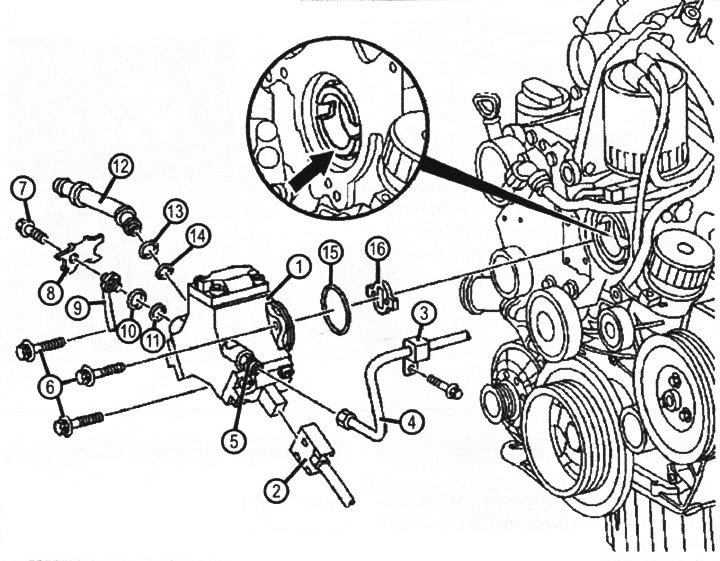
VN 2.120

VN 2.120
1. Fuel injection pump (M41)
2. Fuel quantity control valve (Y94)
3. Fuel temperature sensor (B50)
4. High pressure fuel line

VN 2.121

VN 2.121
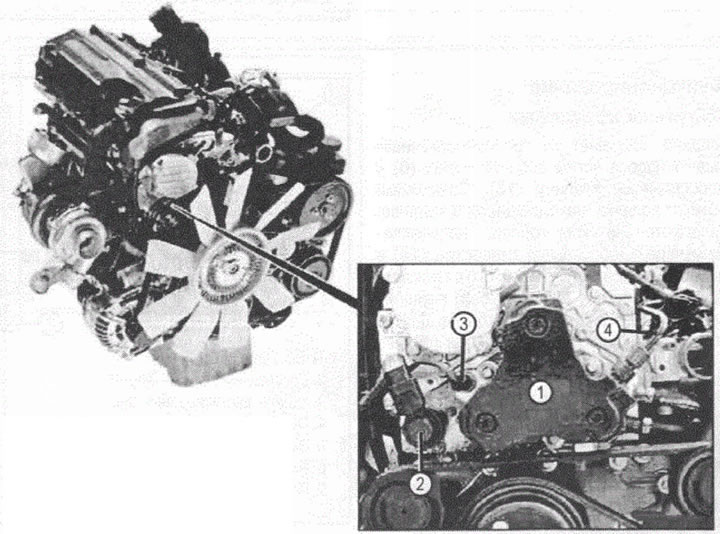
Fuel injection pump. Placement and design
1. Fuel injection pump
2. Electrical connector

VN 2.122

VN 2.122
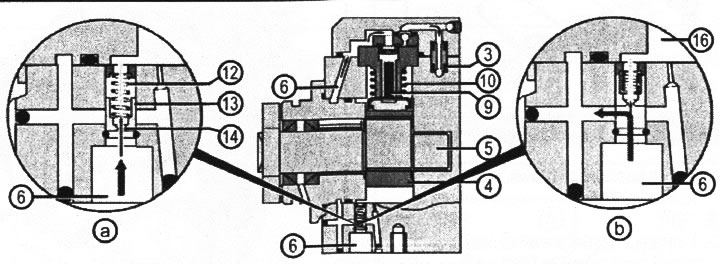
Fuel injection pump. Operating principle
a. Throttle valve closed:
3. High pressure channels
4. Eccentric cam
5. Eccentric shaft
6. Input channel
9. Plungers
10. Plunger springs
12. Throttle valve spring
b. Throttle valve open:
13. Throttle valve piston
14. Throttle valve metering hole
16. Return flow


VN 2.123

VN 2.123
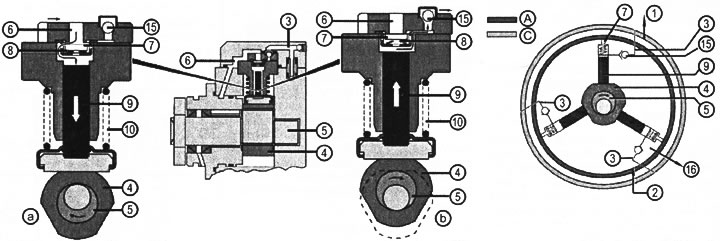
Fuel injection pump. Operating principle
a. Incoming flow
b. High pressure channel
C. Pressure from the fuel pump
D. High pressure
1. High pressure fuel line
2. Fuel inlet line
3. High pressure channels
4. Eccentric cam
5. Eccentric shaft
6. Input shaft
7. Valve disc
8. Valve spring
9. Plungers
10. Plunger return springs
15. Ball valve
16. Return flow


Purpose


Creation and maintenance of high pressure in the fuel manifold, the required fuel pressure (from 20 to 135 MPa (from 200 to 1350 bar).

Accommodation


The high-pressure fuel pump is located on the front cover of the cylinder head.

Design


The high-pressure fuel pump is a three-plunger cam-type pump with a radial arrangement of plunger pairs in a star-shaped pattern. The injection pump rotates at a speed approximately 1.3 times higher than the camshaft rotation speed.

Functioning


Low pressure circuit


Fuel is supplied from the fuel pump through the inlet channel (6) to the throttle valve (13). Any remaining air in the fuel is carried away by the fuel flow directed through the throttle opening (14) into the return flow cavity (16). At a pressure above 0.04 MPa (0.4 bar), the piston of the valve (13) is displaced, opening access for fuel into the annular channel for supplying fuel to the plungers (9),


The eccentric shaft (5) with the eccentric cam (4) pushes the plungers (9) of the three pump elements. The plungers are returned using springs (10). Fuel leaks through the plunger pairs are collected in the return cavity.

High pressure circuit


a. Filling the cylinder

The plunger (9), under the action of the return spring (10), moves towards the eccentric shaft. Fuel from the fuel pump is supplied through the low pressure annular channel (6), the valve disk (7) and the valve spring (3) into the cavity of the pressure cylinder. The ball valve (15) prevents the backflow of fuel from the high-pressure channel (3) into the low-pressure cavity.

b. Creating high pressure

The plunger (9), pushed by the eccentric cam (5), displaces the fuel into the high-pressure channel (3) through the ball valve (15). In this case, the pumped volume of fuel is cut off from the low-pressure cavity (6) by means of the valve disk (6).
This article is available at: russian, bulgarian, belarusian, ukrainian, serbian, croatian, romanian, polish, slovak, hungarian
The article has been verified: Lukyanov Nikita Ilyich
Share with friends:
◀ Previous
Mercedes Vito 2 / Power and exhaust system
Next ▶

High pressure circuit
Low pressure circuit
Elements of the air supply system
Removal and installation the intercooler
Removal and installation a turbocharger
Fuel injection pump drive
High pressure fuel manifold (HPFC)
High pressure fuel lines
Pressure regulating valve in the high pressure fuel system
Fuel injectors
More similar articles for repairing other models

☛ Fuel System — Pressure Relief Mercedes W168 (1997-2004)
☛ High pressure fuel pump — removal and installation Mercedes 190 (W201) (1982-1993)
☛ Scheme 8. Diesel engine injection system with high-pressure fuel pump… Mercedes W210 (1996-2002)
☛ Removal and installation of high pressure fuel pump (HPFP) Mercedes W463 (1999-2019)
☛ Removal and installation of high pressure fuel pump (HPFP) Mercedes W163 (1997-2005)
☛ Removal and installation the high pressure fuel pump (OM603) Mercedes W140 (1991-1998)
Link in different formats to this article
Comments and feedback from visitors
No comments yet


How much will 20 + 22 ?


Vario 814D (1996-2003, diesel) 
  • General information
  • Maintenance
  • Power unit
  • Engines 602.984/985
  • Engines 904.908/914/923/936
  • Transmission
  • Clutch
  • Manual gearbox 711.613
  • Manual gearbox 710.64/66
  • Manual gearbox 715.051
  • Automatic gearbox 723.345
  • Power take-off box
  • Chassis
  • Front suspension
  • Rear suspension
  • Steering
  • Brake system
  • Body and electrical equipment
  • Interior (internal elements)
  • Exterior (external elements)
  • Heater and air conditioner
  • Electrical diagrams
Vito 2 (2003-2014, diesel) 
  • General information
  • User manual
  • Maintenance
  • Diesel engine OM646
  • Engine repair
  • Cooling and lubrication system
  • Power and exhaust system
  • Transmission
  • Clutch
  • Car gearbox
  • Chassis
  • Front suspension
  • Rear suspension
  • Steering
  • Brake system
  • Body
  • Body elements
  • Electrical equipment
  • Equipment and devices
  • Security systems
  • Electrical circuits
Vito 1 (1996-2003) 
  • General information
  • User manual
  • Maintenance
  • Petrol engines 2.0 l
  • Engine repair
  • Lubrication system
  • Cooling system
  • Power and control system
  • Petrol engines 2.8 l
  • Engine repair
  • Lubrication system
  • Cooling system
  • Power and control system
  • Diesel engines 2.3 l
  • Engine repair
  • Cooling system
  • Lubrication system
  • Turbocharging and recycling
  • Power and control system
  • Diesel engines 2.2 l
  • Engine repair
  • Cooling system
  • Lubrication system
  • Turbocharging and recycling
  • Power and control system
  • Transmission
  • Clutch
  • Mechanical gearbox
  • Automatic gearbox
  • Chassis
  • Front suspension and wheels
  • Rear suspension
  • Steering
  • Brake system
  • Body
  • Exterior (external elements)
  • Interior (internal elements)
  • Electrical equipment
  • Equipment and devices
  • Heater and air conditioner
  • Electrical circuits
Sprinter (1995-2000, diesel) 
  • General information
  • Introduction to the guide
  • Maintenance
  • Power unit
  • Engine repair
  • Lubrication system
  • Cooling system
  • Power and exhaust system
  • Transmission
  • Clutch
  • Mechanical gearbox
  • Automatic gearbox
  • Front axle
  • Rear axle and cardan
  • Chassis
  • Car suspension
  • Steering
  • Brake system
  • Tires and wheels
  • Electrical equipment
  • Equipment and devices
  • Headlights and lighting
  • Power devices
  • Electrical circuits
 
MercedesMan.ru © 2017–2026 · Mobile version · Read about Mercedes · Sitemap: EN BG BY UA RS HR RO PL SK HU · Feedback · Site search · Bookmark A-Class (W168) · C-Class (W201) · C-Class (W202) · C-Class (W203) · E-Class (W123) · E-Class (W124) · E-Class (W210) · G-Class (W463) · M-Class (W163) · S-Class (W116, petrol) · S-Class (W126, petrol) · S-Class (W140) · S-Class (W220) · Sprinter · Vito 1 · Vito 2 · Vario 814D ·
 
We only use cookies without which some of the site's features may not be available.