Cars BMW Cars Volkswagen Cars Chevrolet Cars Land Rover Cars Lada Cars Honda Cars Peugeot
English Русский
Български
Беларускі
Український
Српски
Hrvatski
Română
Polski
Slovenský
Magyar
Bookmark News and articles Sitemap Feedback Site search
MercedesMan.ru


A-Class C-Class E-Class G-Class M-Class S-Class Others
Sprinter (1995-2000, diesel) Vito 1 (1996-2003) Vito 2 (2003-2014, diesel) Vario 814D (1996-2003, diesel)
  • Main
  • Mercedes-Benz
  • Vito 2 (2003-2014)
  • Diesel engine OM646
  • Power and exhaust system
  • Functional diagram of the air supply system

Functional diagram of the air supply system (Mercedes-Benz Vito W639)

0
Contents: Purpose ↡ Functioning ↡

Air supply system (functional diagram, the arrangement of elements is shown conditionally)
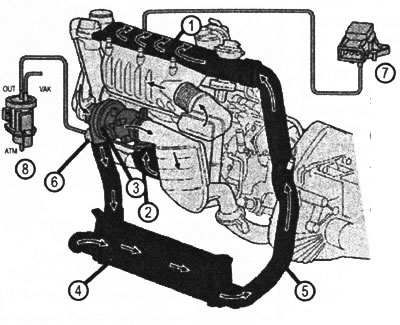


VN 2.108

VN 2.108
1. Intake manifold
2. Exhaust manifold
3. Turbocharger
4. Charge air cooler
5. Compressed air duct
6. Vacuum boost control device
7. Intake manifold pressure sensor (B28)
8. Vacuum converter controlling the boost pressure control flap ATM. Atmospheric pressure output OUT. Control vacuum output VAK. Vacuum supply from the vacuum pump (Y31/5)


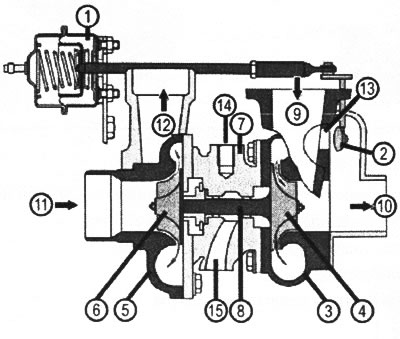
Constant Geometry Turbocharger for Gas Turbine


VN 2.109

VN 2.109
1. Vacuum boost pressure control device
2. Bypass line valve
3. Supercharger housing
4. Compressor wheel
5. Gas turbine housing
6. Turbine wheel
7. Turbine bearing housing
8. Turbine aal
9. Supercharger inlet (outside air)
10. Supercharger outlet (compressed air)
11. Feed exhaust gases to the turbine wheel
12. Exhaust gas outlet
13. Bypass hole
14. Oil supply
15. Returning oil to the engine crankcase


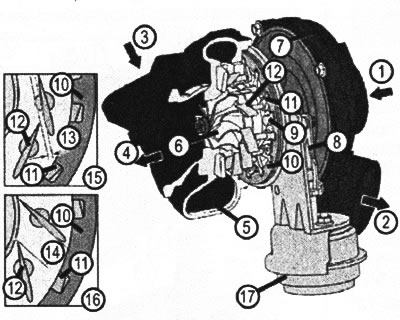
Variable Geometry Turbocharger for Gas Turbine


VN 2.110

VN 2.110
1. Compressor inlet (outside air)
2. Compressor outlet (forced air)
3. Supply of exhaust gases to the turbine wheel
4. Exhaust gas outlet
5. Turbine housing
6. Turbine wheel
7. Compressor housing (supercharger)
8. Control rod
9. Synchronizing ring drive lever
10. Synchronizing (regulating) ring
11. Guide vane rotary lever
12. Guide vane
13. Air gap in the "closed" position of the blades
14. Air gap in the "open" position of the blades
15. Guide vanes "closed"
16, Guide vanes "open"
17. Boost pressure control vacuum chamber


[Material taken from a web resource: mercedesman.ru]

Purpose


The boost pressure supply system is designed to bring the amount of air supplied to the cylinders in line with the required power at the given moment and with external conditions.

The boost pressure is regulated by means of a valve starting from an engine speed of approximately 2000 rpm, depending on the engine load and the engine speed, by opening it in the turbocharger bypass line. Until the rotation speed reaches 2000 rpm, the control valve is closed (boost pressure is not yet sufficient).


Functioning


The exhaust gases are directed through the exhaust manifold into the turbine housing onto the turbine wheel. The energy of the exhaust gas flow causes the turbine wheel to rotate. On the same shaft as the turbine wheel is the supercharger turbine wheel, which, when rotating, creates a flow of air directed under pressure into the engine cylinders. Maximum turbine speed (in high altitude conditions) can reach 18000 rpm.

Boost pressure regulation is performed in various ways.

The first method uses a controlled valve to regulate the capacity of the bypass hole that directs exhaust gases around the turbine, thus reducing its performance.

The second method regulates the direction and intensity of the gas flow directly in front of the turbine wheel blades. Figure VN 2.110 shows how, when the installation angle of the guide blades changes, the flow cross-section of the gap between the blades and the angle at which the gas flow is directed to each blade of the turbine wheel change.

The advantages of a turbocharger with variable geometry turbine guide vane are:
  • increasing boost pressure, especially in the low engine speed range;
  • increased torque as a result of improved cylinder filling;
  • reduction of harmful emissions in the exhaust gases as a result of increasing the amount of air supplied to the cylinders;
  • increased engine power as a result of higher boost pressure combined with reduced exhaust back pressure
This article is available at: russian, bulgarian, belarusian, ukrainian, serbian, croatian, romanian, polish, slovak, hungarian
The article has been verified: Lukyanov Nikita Ilyich
Share with friends:
◀ Previous
Mercedes Vito 2 / Power and exhaust system
Next ▶

 
Turbocharger — purpose, control
Removal and installation a turbocharger
Removal and installation the intercooler
Elements of the air supply system
Low pressure circuit
More similar articles for repairing other models

☛ Exhaust system — visual inspection Mercedes W168 (1997-2004)
☛ Electrical diagram of the charging system Mercedes W203 (2000-2007)
☛ Power supply system design and specification Mercedes W123 (1976-1985)
☛ Power supply system specifications Mercedes W463 (1999-2019)
☛ Anti-theft system Mercedes W163 (1997-2005)
☛ Fuel injection and fuel supply system of a gasoline engine — general… Mercedes W140 (1991-1998)
Link in different formats to this article
Comments and feedback from visitors
No comments yet


How much will 46 + 23 ?


Vario 814D (1996-2003, diesel) 
  • General information
  • Maintenance
  • Power unit
  • Engines 602.984/985
  • Engines 904.908/914/923/936
  • Transmission
  • Clutch
  • Manual gearbox 711.613
  • Manual gearbox 710.64/66
  • Manual gearbox 715.051
  • Automatic gearbox 723.345
  • Power take-off box
  • Chassis
  • Front suspension
  • Rear suspension
  • Steering
  • Brake system
  • Body and electrical equipment
  • Interior (internal elements)
  • Exterior (external elements)
  • Heater and air conditioner
  • Electrical diagrams
Vito 2 (2003-2014, diesel) 
  • General information
  • User manual
  • Maintenance
  • Diesel engine OM646
  • Engine repair
  • Cooling and lubrication system
  • Power and exhaust system
  • Transmission
  • Clutch
  • Car gearbox
  • Chassis
  • Front suspension
  • Rear suspension
  • Steering
  • Brake system
  • Body
  • Body elements
  • Electrical equipment
  • Equipment and devices
  • Security systems
  • Electrical circuits
Vito 1 (1996-2003) 
  • General information
  • User manual
  • Maintenance
  • Petrol engines 2.0 l
  • Engine repair
  • Lubrication system
  • Cooling system
  • Power and control system
  • Petrol engines 2.8 l
  • Engine repair
  • Lubrication system
  • Cooling system
  • Power and control system
  • Diesel engines 2.3 l
  • Engine repair
  • Cooling system
  • Lubrication system
  • Turbocharging and recycling
  • Power and control system
  • Diesel engines 2.2 l
  • Engine repair
  • Cooling system
  • Lubrication system
  • Turbocharging and recycling
  • Power and control system
  • Transmission
  • Clutch
  • Mechanical gearbox
  • Automatic gearbox
  • Chassis
  • Front suspension and wheels
  • Rear suspension
  • Steering
  • Brake system
  • Body
  • Exterior (external elements)
  • Interior (internal elements)
  • Electrical equipment
  • Equipment and devices
  • Heater and air conditioner
  • Electrical circuits
Sprinter (1995-2000, diesel) 
  • General information
  • Introduction to the guide
  • Maintenance
  • Power unit
  • Engine repair
  • Lubrication system
  • Cooling system
  • Power and exhaust system
  • Transmission
  • Clutch
  • Mechanical gearbox
  • Automatic gearbox
  • Front axle
  • Rear axle and cardan
  • Chassis
  • Car suspension
  • Steering
  • Brake system
  • Tires and wheels
  • Electrical equipment
  • Equipment and devices
  • Headlights and lighting
  • Power devices
  • Electrical circuits
 
MercedesMan.ru © 2017–2026 · Mobile version · Read about Mercedes · Sitemap: EN BG BY UA RS HR RO PL SK HU · Feedback · Site search · Bookmark A-Class (W168) · C-Class (W201) · C-Class (W202) · C-Class (W203) · E-Class (W123) · E-Class (W124) · E-Class (W210) · G-Class (W463) · M-Class (W163) · S-Class (W116, petrol) · S-Class (W126, petrol) · S-Class (W140) · S-Class (W220) · Sprinter · Vito 1 · Vito 2 · Vario 814D ·
 
We only use cookies without which some of the site's features may not be available.