Cars BMW Cars Volkswagen Cars Chevrolet Cars Land Rover Cars Lada Cars Honda Cars Peugeot
English Русский
Български
Беларускі
Український
Српски
Hrvatski
Română
Polski
Slovenský
Magyar
Bookmark News and articles Sitemap Feedback Site search
MercedesMan.ru


A-Class C-Class E-Class G-Class M-Class S-Class Others
Sprinter (1995-2000, diesel) Vito 1 (1996-2003) Vito 2 (2003-2014, diesel) Vario 814D (1996-2003, diesel)
  • Main
  • Mercedes-Benz
  • Vito 2 (2003-2014)
  • Diesel engine OM646
  • Power and exhaust system
  • Fuel injectors

Fuel injectors (Mercedes-Benz Vito W639)

0
Contents: Purpose ↡ Design ↡ Accommodation ↡ Functioning ↡ Removal and installation ↡

Purpose


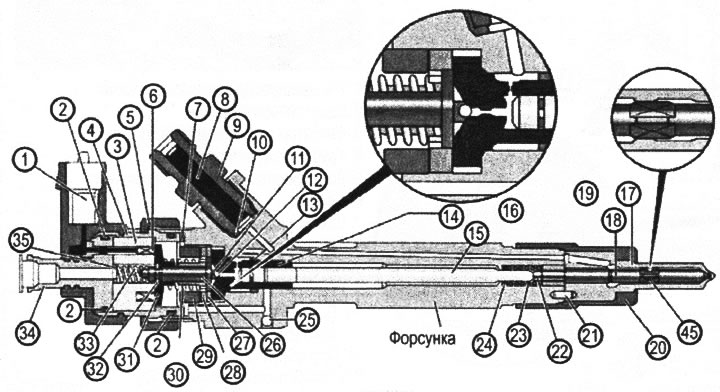
The injectors are designed to inject atomized fuel into the combustion chamber with the most advantageous spray pattern.

Design


VN 2.128

VN 2.128
1. Electrical connector
2. Sealing ring
3. Solenoid coil
4. Sleeve
5. Solenoid mounting union nut
6. Solenoid
7. Adjusting gasket
8. Filter
9. High pressure tube nipple
10. Sealing gasket
11. Ball guide
12. Valve ball
13. Sealing ring
14. Valve guide
15. Valve piston
16. Valve assembly
17. Sprayer body
18. Spray needle
19. Sprayer
20. Spray nozzle mounting union nut
21. Pin
22. Pusher
23. Sprayer spring
24. Gasket
25. Ball used as a stopper
26. Solenoid core
27. Adjusting gasket
28. Solenoid armature disk
29. Valve pressure screw
30. Solenoid spring
31. Plate
32. Locking washer
33. Spring
34. Connection
35. Gasket
45. Needle guide


Accommodation


The injectors are located in the cylinder head and are connected to the high-pressure fuel manifold via high-pressure pipes.

Note: The spray spring (23) holds the needle (18) in the spray lock position when the pressure difference in the upper and lower chambers is no more than 40 bar (4 MPa).


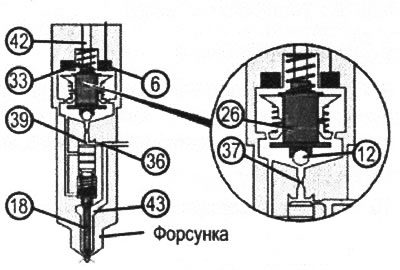
2. There is no electrical power to the solenoid, there is high pressure, but no injection.

In this phase of the injector operation, pressure from the HPC is supplied through the feed channel to the lower chamber, and also through the throttle opening to the upper chamber. The fuel pressure in the upper and lower chambers is balanced. The spray needle return spring holds the needle in the spray valve closed position. There is no injection.

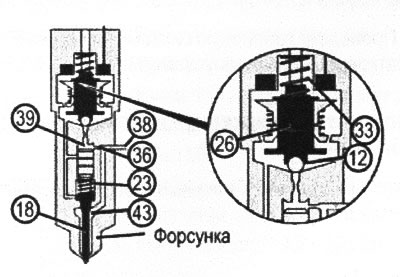
3. Start of injection (the solenoid valve is open, power is supplied to the injector).

When voltage is applied to the winding of the electromagnetic valve (6), the solenoid core (26) is drawn in, compressing the spring (33). At the same time, the ball valve (12) opens and the fuel from the upper chamber (39) flows through the throttle opening (37) of the pressure relief channel into the fuel return circuit. Pressure in the upper (balancing) the camera is lowered. The unbalanced fuel pressure in the lower chamber creates a force that lifts the needle.

4. Injection (the solenoid valve is open, power is supplied to the injector).

While the ball valve (12) is held open, the unbalanced pressure in the chamber (43) holds the spray needle (18) open. The pressure difference in the upper (39) and lower (43) chambers is ensured by the ratio of the flow capacity values of the throttle openings (36) and (37).

5. End of injection (solenoid valve closed).

When the electrical power is removed from the solenoid coil, the valve closes. In this case, the pressure in the upper chamber is restored to a value equal to the pressure in the lower chamber. The force of the return spring (23) closes the spray valve.


Functioning


1. There is no electrical power supplied to the solenoid, there is no injection.

The pressure in the high pressure feed channel (38) is approximately equal to atmospheric pressure. The ball valve (12) is locked by the force of the spring (33) acting on the core of the solenoid (26).
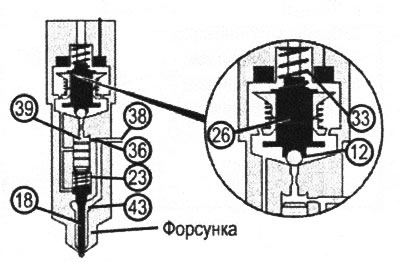
VN 2.129

VN 2.129
There is no electrical power supplied to the solenoid, no injection
6. Solenoid
12. Valve ball
18. Spray needle
23. Sprayer spring
26. Solenoid core
33. Spring


VN 2.129

VN 2.129
Start of injection (the solenoid valve is open, power is supplied to the injector)
36. Calibrated hole (throttle function)
37. Pressure relief channel from the upper chamber
38. High pressure supply channel


VN 2.129

VN 2.129

End of injection (solenoid valve closed)
39. Upper valve chamber (balancing pressure)
42. Return fuel flow
43. Lower valve chamber (pressure lifting the needle)


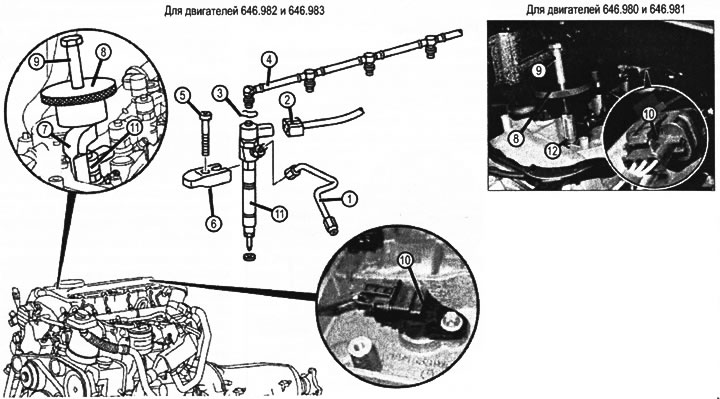
VN 2.130

VN 2.130

1. High pressure fuel line
2. Electrical connector
3. Fuel return pipe retainer
4. Fuel return pipe
5. Screw for fixing the injector clamp
6. Clamp
7. Gripping the impact puller
8. Impact puller weight
9. Guide rod (screw) of the impact puller
10. Camshaft position sensor (B6/1, B6/17)
11. Injector (Y76)
12. Threaded adapter


Removal and installation


1. Remove the clamp (6).

2. Remove the injectors (11). If the injectors cannot be removed, install the grip (7) in place of the clamp (6) and, using the impact puller (8) and (9), remove the injectors (11) together with the sealing ring.

3. Clean the nozzles and nozzle holes using brass brushes of suitable sizes, lubricate the nozzles with a special lubricant, blow out the holes and protect them from contamination by first inserting plugs.

Note: Removing injectors on engines 646.980 and 646.981 differs from that described above (for engines 646.982 and 646.983) the fact that instead of the grip (7) a threaded adapter (12) is used.


4. Install in reverse order. When installing nozzles, to prevent unnecessary stress in high-pressure pipelines, they should be installed (pipelines) on the injectors until the final tightening of the injector mounts,


5. Check the fuel system for leaks by briefly running the engine.

Tightening torques for threaded connections


Injector clamp mounting screw 7 Nm + 90°.
This article is available at: russian, bulgarian, belarusian, ukrainian, serbian, croatian, romanian, polish, slovak, hungarian
The article has been verified: Lukyanov Nikita Ilyich
Share with friends:
◀ Previous
Mercedes Vito 2 / Power and exhaust system
Next ▶

Pressure regulating valve in the high pressure fuel system
High pressure fuel lines
High pressure fuel manifold (HPFC)
Fuel injection pump drive
High pressure fuel pump
High pressure pipe connection fitting to fuel injector
Exhaust gas system
More similar articles for repairing other models

☛ Fuel injectors — checking Mercedes W168 (1997-2004)
☛ Fuel distributor with valve injectors Mercedes W202 (1993-2000)
☛ Fuel injectors — removal and installation Mercedes W124 (1984-1995)
☛ Removal and installation of fuel distribution line and injectors Mercedes W463 (1999-2019)
☛ Removal and installation of fuel distribution line and injectors Mercedes W163 (1997-2005)
☛ Removal and installation of fuel distribution line with injectors Mercedes W140 (1991-1998)
Link in different formats to this article
Comments and feedback from visitors
No comments yet


How much will 16 + 45 ?


Vario 814D (1996-2003, diesel) 
  • General information
  • Maintenance
  • Power unit
  • Engines 602.984/985
  • Engines 904.908/914/923/936
  • Transmission
  • Clutch
  • Manual gearbox 711.613
  • Manual gearbox 710.64/66
  • Manual gearbox 715.051
  • Automatic gearbox 723.345
  • Power take-off box
  • Chassis
  • Front suspension
  • Rear suspension
  • Steering
  • Brake system
  • Body and electrical equipment
  • Interior (internal elements)
  • Exterior (external elements)
  • Heater and air conditioner
  • Electrical diagrams
Vito 2 (2003-2014, diesel) 
  • General information
  • User manual
  • Maintenance
  • Diesel engine OM646
  • Engine repair
  • Cooling and lubrication system
  • Power and exhaust system
  • Transmission
  • Clutch
  • Car gearbox
  • Chassis
  • Front suspension
  • Rear suspension
  • Steering
  • Brake system
  • Body
  • Body elements
  • Electrical equipment
  • Equipment and devices
  • Security systems
  • Electrical circuits
Vito 1 (1996-2003) 
  • General information
  • User manual
  • Maintenance
  • Petrol engines 2.0 l
  • Engine repair
  • Lubrication system
  • Cooling system
  • Power and control system
  • Petrol engines 2.8 l
  • Engine repair
  • Lubrication system
  • Cooling system
  • Power and control system
  • Diesel engines 2.3 l
  • Engine repair
  • Cooling system
  • Lubrication system
  • Turbocharging and recycling
  • Power and control system
  • Diesel engines 2.2 l
  • Engine repair
  • Cooling system
  • Lubrication system
  • Turbocharging and recycling
  • Power and control system
  • Transmission
  • Clutch
  • Mechanical gearbox
  • Automatic gearbox
  • Chassis
  • Front suspension and wheels
  • Rear suspension
  • Steering
  • Brake system
  • Body
  • Exterior (external elements)
  • Interior (internal elements)
  • Electrical equipment
  • Equipment and devices
  • Heater and air conditioner
  • Electrical circuits
Sprinter (1995-2000, diesel) 
  • General information
  • Introduction to the guide
  • Maintenance
  • Power unit
  • Engine repair
  • Lubrication system
  • Cooling system
  • Power and exhaust system
  • Transmission
  • Clutch
  • Mechanical gearbox
  • Automatic gearbox
  • Front axle
  • Rear axle and cardan
  • Chassis
  • Car suspension
  • Steering
  • Brake system
  • Tires and wheels
  • Electrical equipment
  • Equipment and devices
  • Headlights and lighting
  • Power devices
  • Electrical circuits
 
MercedesMan.ru © 2017–2026 · Mobile version · Read about Mercedes · Sitemap: EN BG BY UA RS HR RO PL SK HU · Feedback · Site search · Bookmark A-Class (W168) · C-Class (W201) · C-Class (W202) · C-Class (W203) · E-Class (W123) · E-Class (W124) · E-Class (W210) · G-Class (W463) · M-Class (W163) · S-Class (W116, petrol) · S-Class (W126, petrol) · S-Class (W140) · S-Class (W220) · Sprinter · Vito 1 · Vito 2 · Vario 814D ·
 
We only use cookies without which some of the site's features may not be available.