



Contents: Removal ↡ Installation ↡
Removal
1. Remove the cylinder head and oil pump.
2. Unscrew the connecting rod cap mounting bolts 1 (see figure 5.29). Mark the connecting rod bearings and caps 1 of each cylinder. Do not mix top liners.
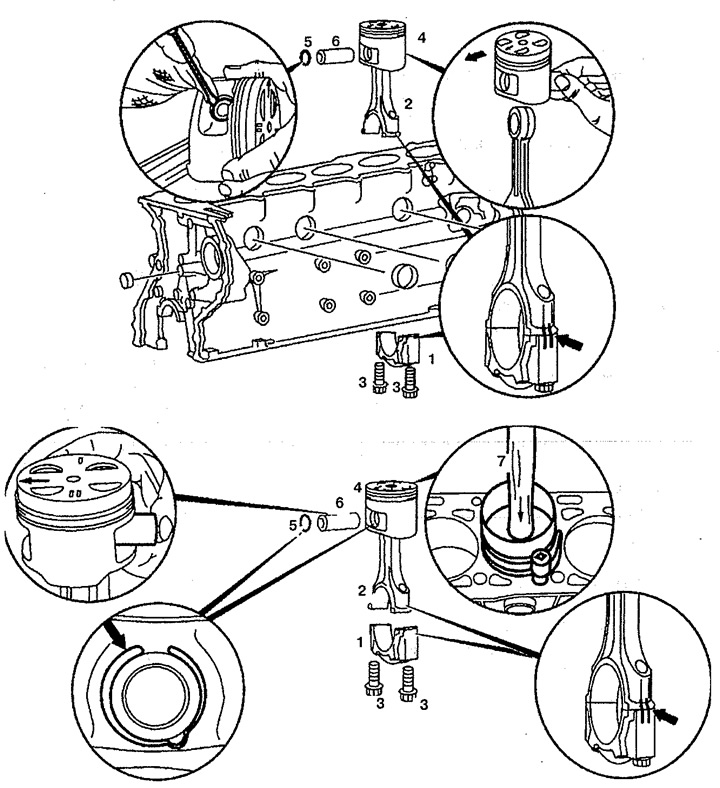
Figure 5.29. Pistons:
1. Connecting rod cover,
2. Connecting rod,
3. Bolt,
4. Piston,
5. Retaining ring,
6. Piston pin.
3. Remove the connecting rods 2 upwards together with the pistons 4. If the direction of movement arrow on the piston cannot be recognized, re-apply it.
4. Remove retaining ring 5 of piston pin 6. Do not damage piston 4.
5. Press out the piston pin 6.
6. Check the connecting rods 2 for any distortion of the holes and grooves.
Installation
7. Lubricate the piston and connecting rod.
8. Install piston 4 on connecting rod 2 in the direction of the direction arrow (in the opposite direction of power flow).
9. Insert the retaining ring 5 of the piston pin 6 into the groove in the piston 4.
10. Install the tension band 7 for the piston rings and tighten it. Piston ring lock: 120°.
11. Install piston 4.
12. Check and, if necessary, replace bolts 3 securing the connecting rod caps.
13. Insert the bearing shells into connecting rod cap 1 and into connecting rod 2. The bearing shells with the oil channel must be installed into connecting rod 2, otherwise the bearing shells will not be lubricated. Anti-twist bearing retainers must be installed in the grooves of connecting rods 2 and connecting rod caps 1.
14. Tighten the connecting rod cap mounting bolts 1. Connecting rod cap 1 and connecting rod 2 have marks (arrows).
15. Check the clearances by rotating the crankshaft.
16. Install the oil pump.
17. Measure the piston protrusion. It should be 0.38-0.62 mm. Install a cylinder head gasket of normal or replaceable thickness.
18. Install the cylinder head.