



Contents: Removal ↡ Installation ↡
Warning: Gasoline is highly flammable - extreme caution must be exercised when working around system components. Keep work area well ventilated - open all doors and windows to create draughts. Do not smoke, do not place open flames or uncovered light bulbs near the work area. Remember that appliances such as heaters, water heaters and dryers can be sources of ignition. Be aware of this if these appliances are installed in the work area. Always keep a fire extinguisher near the work area and read the instructions for use before starting work. When working on fuel systems, protect your eyes and immediately wash off any traces of gasoline that come into contact with your skin with soap and plenty of water. Remember that gasoline vapors are as dangerous as the liquid itself - containers that are emptied of gasoline contain gasoline vapors and are potentially explosive.
Caution: Keep the fuel system clean when working - dirt entering the fuel system may block the passages, resulting in difficulty starting or fuel system failure.
Removal
1. The fuel filter is located in the fuel supply line next to the gas tank. Access to the filter is from the rear, underneath the car.
2. Contact Chapter 4B and depressurize the fuel system. Disconnect the negative battery cable and move it away from the terminal.
3. Place the vehicle on a level surface, apply the parking brake and place chocks under the front wheels. Raise the rear of the vehicle with a jack and place it on supports (see Fig. "Lifting the car and placing it on supports").
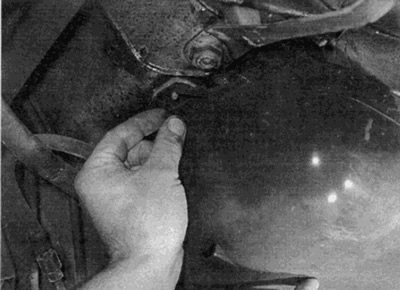
4. Loosen the screws and remove the protective cover from the fuel pump, filter and battery (see fig. 31.4).
5. Clamp the flexible fuel supply hose to the fuel pump and the hose from the filter with suitable clamps. Do not use a vice or flat jaws, as they can damage the hose from the inside.
6. Loosen the connections and disconnect the fuel lines on each side of the filter (see fig. 31.6). Where banjo bolts are used, remove the sealing washers and discard them. New ones should be installed upon installation. Be prepared for some gasoline to spill - place a container under the filter and wrap the surrounding parts in rags.
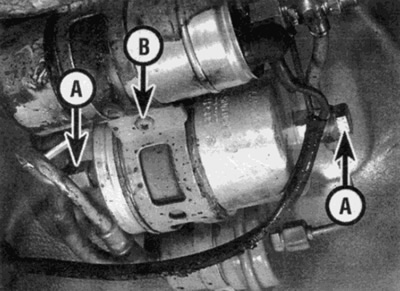
7. Loosen and remove the screws, release the mounting tape and lower the filter down from the mounting bracket (see fig. 31.6). Note that on later models the bracket is held in place by two screws and also supports the fuel pump.
8. If the bracket cannot be lowered sufficiently to remove the fuel filter, where provided, loosen the banjo fittings and disconnect the fuel line from the fuel pump and battery. Be prepared for some gasoline to leak out and remove the sealing washers. Once the fuel line is disconnected, the filter should be able to be lowered for removal.
Installation
9. Installation is carried out in reverse order, taking into account the following points:
- a) Arrow on the side of the filter housing (if it is applied) should indicate the direction of fuel flow towards the engine.
- b) Make sure the filter clamp is correctly positioned on the filter housing on top of the anti-corrosion plastic gasket.
- c) Where banjo bolts are installed, install new sealing washers.
10. When finished, start the engine and check for leaks around the removed parts. Note that air has entered the pump, and therefore it may take a little longer than usual to start the engine.