



The front wheel suspension mechanism consists of shock absorber struts with built-in shock absorbers, lower transverse triangular levers, and an anti-roll bar (not on all models) and transverse leaf spring. Between the ends of the anti-roll bar and the upper surface of the bridge support beam, connecting rods are installed on both sides. Rubber bushings are installed on both ends of the rods, which are placed on the ends of the stabilizer and the beam neck without a threaded connection. The stabilizer is attached to the lower part of the body.
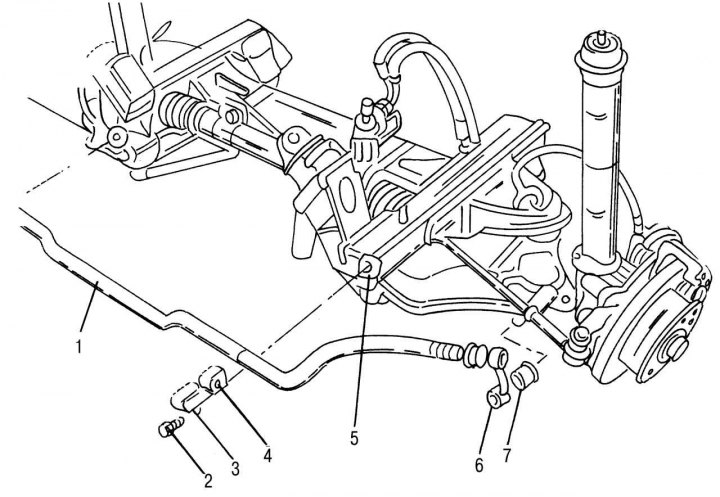
Figure 197. Front axle assembly: 1 - anti-roll bar; 2 — bolt; 3 — anti-roll bar clamp; 4 - rubber-metal support (lubricate with oil when replacing); 5 — nut, 25–28 N·m; 6 - connecting rod; 7 — rubber-metal bushings of the connecting rod (lubricate with oil when replacing)
Both wishbones are attached to the frame at the rear and are connected at the front via a retractable ball joint to the hub housing and steering knuckle. The shock absorber struts are attached to the hub mechanism with four bolts. The upper end of the shock absorber is bolted to the car body. Figure 197 shows what the front suspension mechanism looks like. Depending on the modification, different types of front axles are installed on the vehicles. Front axle VL 0/6 CE-1.6 is installed on models 208D and 212D of series 901 and 902 (designation 730.408). However, these models can also be equipped with a bridge with the designation 730.410. Models 308D and 312D of the 903 series are equipped with a VL 0/7 CE-1.6 bridge with the designation 730.409. Model 412D is equipped with a VL 0/8 CE-1.75 bridge with the designation 730.411. This data is necessary when purchasing spare parts.