



The nuts and bolts used must be clean and lightly lubricated. Check the integrity of the nut faces and thread pitches, remove any burrs that may form. When in doubt, use new bolts and nuts. Self-locking nuts should not be reused, replace them with new ones after one use. Do not wash off grease from nuts and bolts under any circumstances.
When tightening threaded fasteners, always use the permissible tightening torques specified in the special tables. They are combined in the manual appendix to make them easy to find.
All sealing washers, gaskets, locking plates and rings, cotter pins and cuffs must be replaced with new ones during assembly of the unit. The sealing lips of the cuffs should be lightly lubricated with grease before installing them on the shaft. When assembling, special attention should be paid to ensuring that the sealing edges of the cuffs are directed in the direction from which plastic grease or oil may escape.
All indications on the sides of the car (right, left, front and back) should be considered in relation to the forward movement of the vehicle. All doubtful cases are additionally clarified in the text of this repair manual.
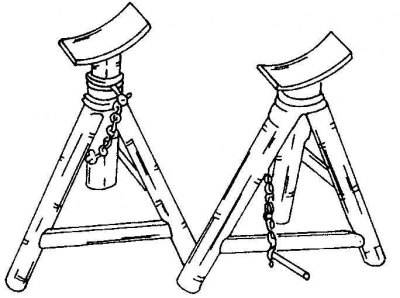
Figure 2. Tripod supports
It is important to pay special attention to the fact that when performing work under a vehicle, it is necessary to carefully ensure that reliable supports are installed under the raised vehicle. Be sure to study subsection 1.5 before lifting the vehicle for repairs. The on-board jack in a car is intended only for changing wheels on the road. For repair purposes it can only be used for "jacking up" during the process of installing the car on the appropriate supports. Special tripod supports, such as in the picture 2, with a height-fixing pin made of durable material capable of supporting the vehicle, must be installed under the vehicle for safety purposes even when a garage jack is used to lift the vehicle. Bricks should never be used as supports; in some cases, hollow wall blocks can be used due to their larger supporting surface, but in this case, a thick board should be additionally placed between the car and the block.
Consistent lubricants, oils, mastics for treating undercarriages and other mineral substances have an aggressive effect on all rubber parts of the chassis and braking system of the car. Particular care should be taken to prevent the listed substances and fuel from coming into contact with parts of the vehicle's hydraulic systems. To clean the brake system parts, use brake fluid or alcohol. But it is important to remember that brake fluid is very toxic and can corrode paintwork.
An important condition for successful repairs is the use of original spare parts. To avoid possible subsequent complications during vehicle operation, do not resort to installing spare parts from unknown manufacturers. Exceptions may be electrical equipment parts and non-original parts approved for installation by the vehicle manufacturer.
When ordering spare parts, it is necessary to indicate the exact designation of the vehicle model with the VIN code, and, if possible, the engine number, as well as the year of manufacture of the vehicle. This information will speed up the fulfillment of your order and eliminate the delivery of unnecessary parts.
All work on the vehicle, and especially on its braking system, steering and suspension, must be carried out with the utmost care and thoroughness. After each repair, the absolute safety of the vehicle and traffic must be ensured.
Original published on the website: www.MercedesMan.ru