



All valves and valve seats should be checked for wear and damage and repaired or replaced if necessary. Valve springs should be checked for their unloaded and loaded lengths and any springs that do not meet the check figures should be replaced. A special test device should be used to accurately check valve springs.
The valve guides are checked for wear with a special test rod. If the outer side slides into the hole, the valve guides must be replaced. The valve guides are knocked out with a special rod. If valve guides of normal size 1 can still be installed, the bushings are driven in with a rod until they reach the stop spring. If valve guides of repair size are to be installed, the main hole must be processed with a hand reamer. The valve guides must be selected so that the required overlap is maintained. Heat the cylinder head in a water bath to a temperature of 80°-90°C and, if possible, cool the guides with dry ice. Lubricate the guides with grease and drive them in with a rod until they reach the stop ring in the cylinder head.
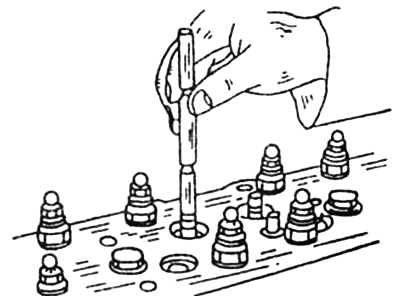
Check the inner diameter of the guides with a control rod. The control side of the control rod should fall, while the side with excess gauge should not pass. If necessary, process the inner side with a reamer.
The valve seat rings are pressed into the cylinder head. It is best to remove the old ring by drilling it out or turning it with a valve seat turning tool until it can be separated. Care must be taken not to damage the cylinder head. Measure the main bore D1.
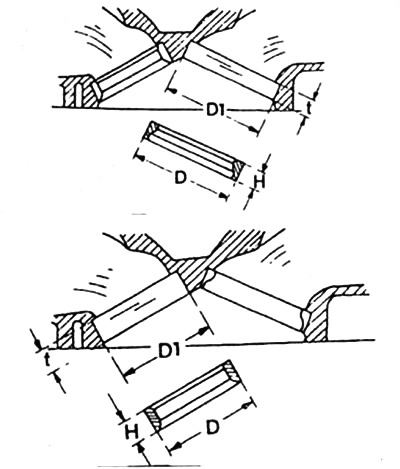
Engine 280S and 280SE: Left - inlet, Right - outlet.
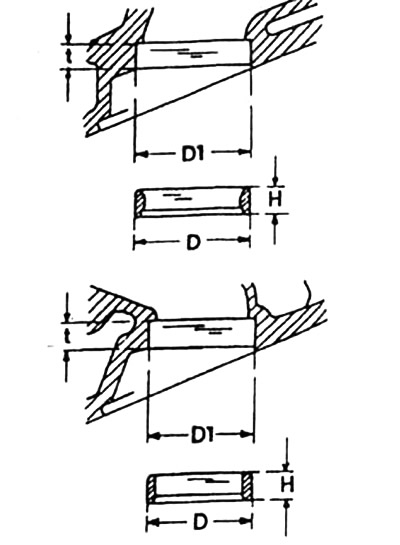
V8 Engine: Left - inlet, Right - outlet.
[Full article available on the resource www.mercedesman.ru]
If necessary, proceed to the next oversize. A new valve seat ring may be used without machining the main bore if the required overlap is present.