



Turn the engine on the mounting stand or work bench so that the oil pan side faces up.
After all the oil passages have been cleared, use a curling rod to drive a steel ball into the back of the oil passage.
Screw in the oil pressure relief valve and tighten the plug bolt.
Insert the main bearing shells in a row into the holes for them in the engine crankcase. The upper bearing shells of V8 engines are provided with a groove for lubrication, while in 6-cylinder engines the upper and lower bearings, with the exception of the 4th bearing, are provided with a groove for lubrication, and the upper shell of the fourth bearing has one hole for oil and one recess for oil at its ends.
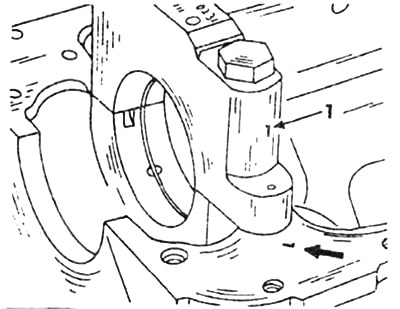
The bearing shells are supplied ready to install for various types of repairs and must only be replaced as a complete set. The central bearing is supplied in case of repairs with an increased width and must, in order to obtain a running layer on the flywheel side, be reworked only on the unloaded side at right angles to the bearing bore.
In general, liners can be replaced when they are new. The same applies to internal liners.
Install the main bearing caps in a row, checking their designation, and tighten their bolts to the required torque.
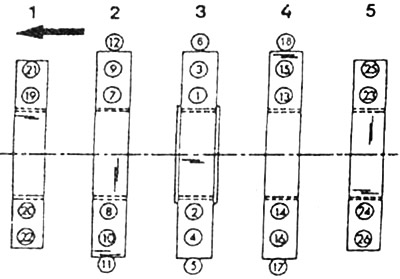
Crankshaft liners on a V8 engine
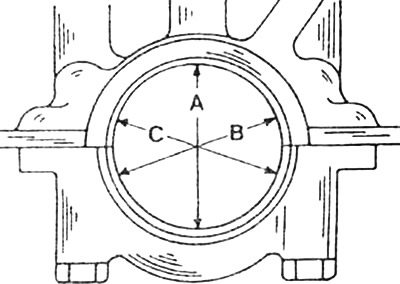
Measure the main bore in directions A, B and C in two planes. For a main bore that exceeds the required value or is conical, machine the bearing cap on the support surface on a lapping plane and remove a maximum of 0.02 mm. The crankshaft bearing caps of V8 engines are machined together with the engine block and are not supplied as spare parts.
Install the crankshaft bearing shells and tighten the bearing cap to the required torque again.
Measure the bearing diameter and check the radial clearance (play). It can be adjusted by replacing the liners, but the average value of the specified bearing clearance must be achieved.
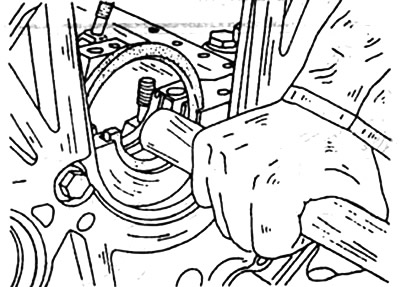
Insert the new radial seal ring into the rear of the engine crankcase and press it firmly with the wooden handle of a hammer.
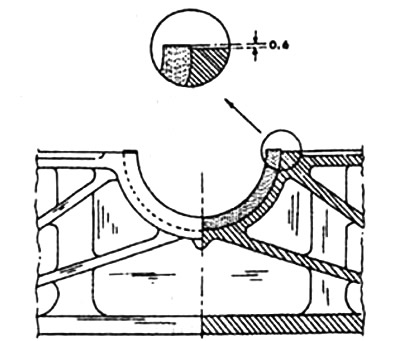
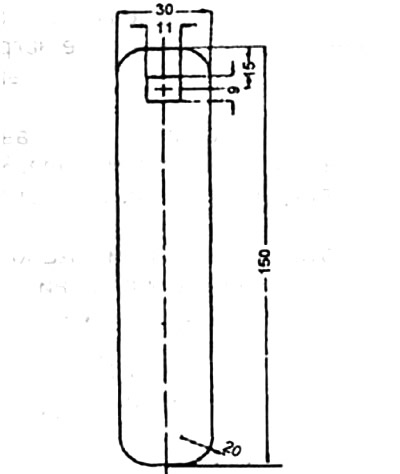
To achieve the required overlap, the radial sealing ring must be cut 0.5 mm above the separation plane. For cutting, you can use a 0.6 - thickness template, which you can make yourself.
Lubricate the radial seal ring, bearing shells and crankshaft with SAE30 engine oil and install the crankshaft with the drive end.
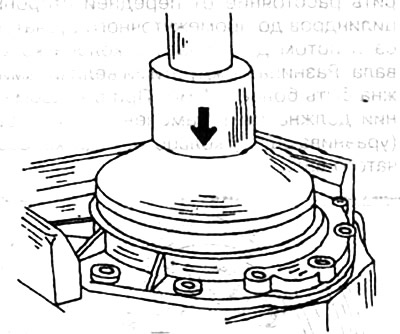
For V8 engines, lubricate the rear cover with sealant and tighten it. Fill the radial sealing ring between the boot and the dust seal with long-term grease and press it into the cover until it stops. For this purpose, it is best to use special tool 117 589 004 300. If this tool is not available, press the sealing ring into the cover first and then tighten the rear cover.
Tighten the crankshaft bearing caps to the specified torque. On V8 engines, self-locking pin bolts are screwed into the cylinder block to secure the crankshaft bearing caps. These bolts should only be tightened once, as the locking effect is lost when they are loosened.
The outer stud bolts are located 2 mm from the center, so the bearing cap can only be mounted in one position. When repairing, screw attachments are not allowed for the self-locking stud bolts of the crankshaft bearing caps.
Tighten the crankshaft bearing cap bolts to the required torque in the required sequence.
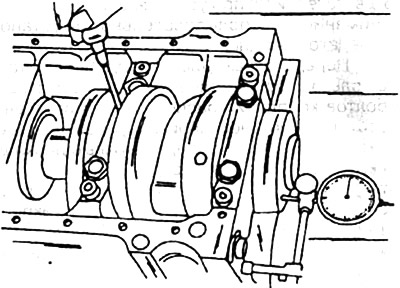
Measure the axial (axial) crankshaft play.
Turn the crankshaft by hand and check if it rotates freely. If it rotates with difficulty, adjust its position by moving the bearing shells with a plastic hammer.
Install the intermediate gear for the ignition distributor drive and the end gear.
Install the shaft with the helical gear to drive the oil pump.
If the crankshaft gear (sprocket) or intermediate gear with bushings has been replaced with new ones, the deviation from coaxiality should be measured. To do this, measure the distance from the front side of the cylinder block to the intermediate gear and then to the crankshaft gear. The difference between these values should not be more than 0.1 mm. If the deviation is greater, the compensating (equalizing) ring behind the crankshaft wheel.
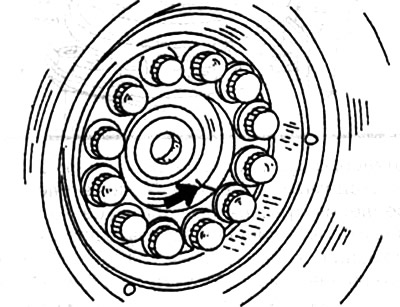
Attach the flywheel or timing plate to the crankshaft flange. The flywheel is marked with the crankshaft. If a new flywheel is installed, it must be the same size and weight as the old one.
Measure the extension diameter of the bolts. If the minimum diameter is reached, the bolts must be replaced with new ones;
Tighten the bolts and tighten them to the required torque and angle, and then tighten the bolts further to an angle of 90°+10°.
For V8 engines, when installing, you need to pay attention to the sequence of installing the transfer discs.
The transfer discs can only be mounted in one position because one of the eight mounting bolts is offset relative to the setting circle at the centers of the holes. Therefore, the transfer disks must be sawed in one specific position and the holes must match exactly. The girth gear is welded to a steel ring and bolted to the transmission disk as well. When the transmission (gearbox) is removed, the sprocket gear remains on the engine.
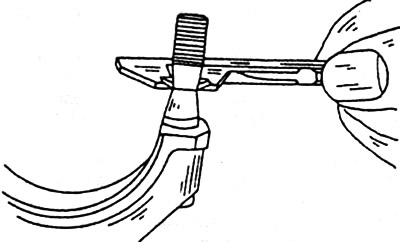
Check the condition of the connecting rod bolts, bushings and turn the connecting rod.
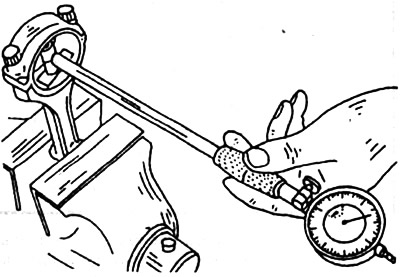
Install the connecting rod bearing cap and tighten the connecting rod bolts.
Measure the main hole.
Install the connecting rod bearing caps together with the liners and tighten the connecting rod bolts.
Measure the bearing diameter and radial clearance. Bearing clearance can be adjusted by replacing the liners, but it is necessary to achieve the average value of the permissible clearance.
Lubricate the connecting rod bushings and piston pins with oil and insert them by hand.
Insert the piston pin retainer into the groove. Install the pistons on the connecting rod so that the arrow points in the direction of travel and the groove for the bearing shell retainer lug points to the left side in the direction of travel or, on V8 engines, to the outside of the engine.
When installing pistons that have already worked, check the piston rings for lateral and axial clearance. Do not heat the pistons or replace the piston pins of individual cylinders.
Insert the piston rings into the grooves on the pistons and check for ease of movement. Distribute the ends of the piston rings evenly around the circumference of the piston.
Lubricate the connecting rod bearing shells and pistons with SAE30 engine oil.
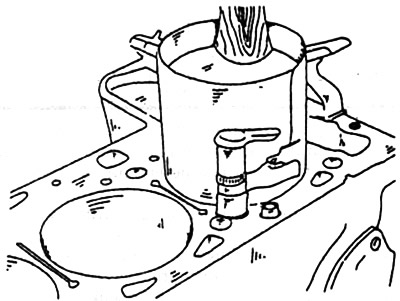
Use piston ring compressor 000 589 2061 00 or compression band 000 589 041 400 and insert the pistons so that the arrow points in the direction of travel, without applying force. On V8 engines, cover the connecting rods with a protective cover to avoid damaging the cylinder walls.
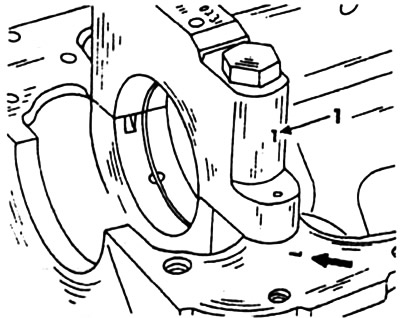
Place the connecting rod bearing caps on the connecting rods in accordance with the digital designations one after another and tighten the connecting rod bearing bolts.
Turn the crankshaft and check for ease of movement between the connecting rod and the piston bore.
In the TDC position of the pistons, measure the distance between the piston bottom and the dividing plane of the cylinder block.
Install the oil pump. For V8 engines, hang the toothed wheel on the chain and slide the oil pump onto the wheel. The tension sleeve in the toothed wheel must be inserted into the recess on the drive shaft. Tilt the oil pump back, install and tighten the toothed wheel mounting bolt. Attach the oil pump with bolts. Hold the chain tensioner spring from turning with a screwdriver while tightening the bolt.
Drive a new spacer ring onto the crankshaft journal.
Lubricate the edges of the new radial seal ring with oil and insert the ring into the clamping hole in the block housing.
For 6-cylinder engines, insert a new radial seal into the oil pan.
Install the damper bars.
Lightly lubricate the top surface of the cylinder block with grease or stick a new oil pan gasket with grease.
Install the pan and tighten the bolts to the specified torque.
On V8 engines, install the front cover.
The intermediate gear bearing bushings, if removed, are pressed into the cylinder block and into the front cover so that the lubrication groove is located at the bottom. Set the crankshaft to the 8th TDC position and check whether the marks on the intermediate gear and on the cylinder block body match. The marks must match, otherwise the ignition distributor will not be able to be installed in the desired position. Replace the rubber sealing rings of the coolant channels and lubricate the sealing surface of the front cover with sealant before installation.
Install the balance disk and pulley. The balance disk on 6-cylinder engines is fixed to the crankshaft using two sliding pins, on 8-cylinder engines - using a disc spring.
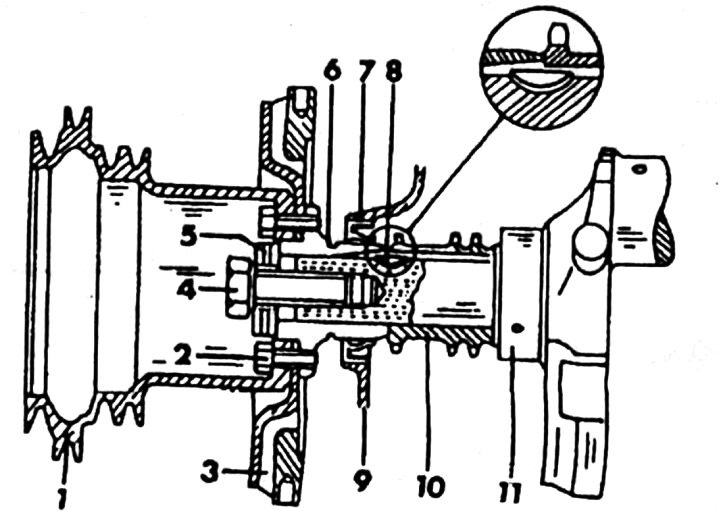
Cross section of V8 engine pulley, damper, hub and transfer disc: 1. Pulley. 2. Bolt N8x22. 3. Vibration damper. 4. Bolt N18x1.5x45. 5. Disc washers (3 pieces). 6. Hub. 7. Radial sealing ring. 8. Disc spring. 10. Front cover, 10. Camshaft toothed wheel. 11. Crankshaft.
The vibration damper, pulley and hub on V8 engines must be fixed together in one specific position. One of the 6 holes is offset from the middle and therefore the holes must be aligned exactly with each other.
Turn the engine over and install the assembled cylinder head. Before doing this, check that the surfaces of the cylinder head and cylinder block are clean and free of foreign objects. In addition, pay attention to the following:
- Do not use sealant on cylinder head gaskets or sealing surfaces.
- Turn the crankshaft until piston No.1 reaches the TDC position of the compression stroke, and install the camshafts in accordance with the markings.
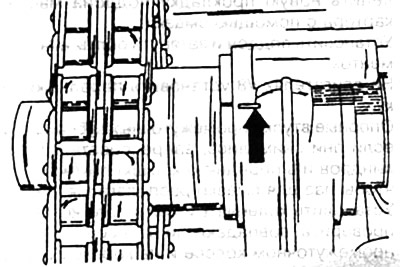
V8 Engine
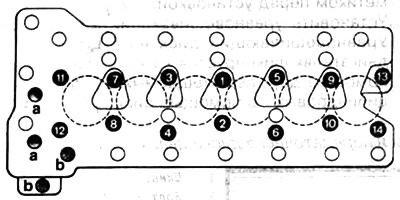
6-cylinder engine
Tighten the cylinder head bolts to the specified torque. Tightening sequence:
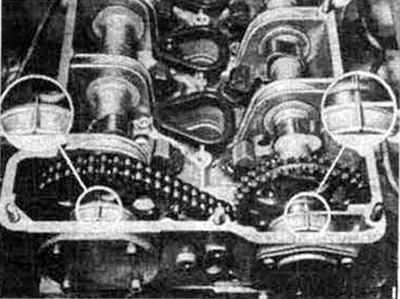
6-cylinder engine
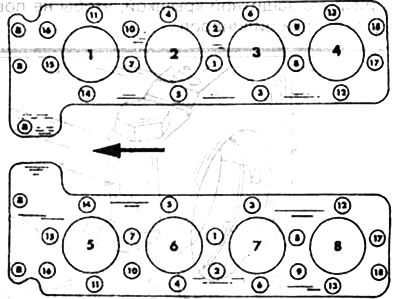
V8 Engine
Raise the chain onto the toothed wheel supports and position it on the camshaft wheel.
Install the disc key onto the camshaft, fit the equalizing disc, and then install the timing gear with chain onto the camshaft.
Place washers and spring washers on the mounting bolts and tighten the bolts.
Install the chain tensioner and tighten the mounting bolts evenly. On 6-cylinder engines, insert the chain tensioner housing into the cylinder head.
Screw on the threaded ring and tighten it to a torque of 50 Nm.
Install the pressure rod together with the installed locking and pressure springs into the housing and tighten the oil jet to a torque of 25 Nm. The pressure rod should jump forward with an audible click. Screw in the plug bolt with the gasket and tighten it to a torque of 50 Nm.
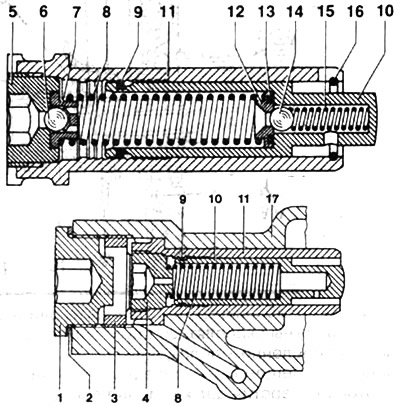
Installing the chain tensioner (6-cylinder engine): 1. Plug bolt. 2. Sealing ring. 3. Threaded ring. 4. Oil jet. 5. Ball seat ring. 6. Ball. 7. Ball housing. 8. Pressure spring. 9. Slot spring. 10. Pressure piston. 11. Housing. 12. Valve washer. 13. Ring. 14. Ball. 15. Pressure spring. 16. Support ring. 17. Cylinder head.
Chain tensioners of different designs, A or B, can be installed.
Turn the engine over and check the timing marks.
If necessary, check the valve timing.
Since the pressure rod of the chain tensioner of 6-cylinder engines cannot be pressed back, the chain tensioner must be disassembled after each removal and the pressure rod set to position A.
When performing installation work on the chain drive - for example, when removing the camshaft gears or damper, it is necessary to first remove the pressure spring with the chain tensioner installed.
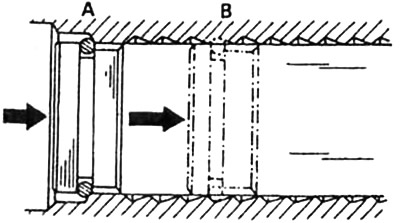
A - chain tensioner in installation position
B - chain tensioner in working position
Install hydraulic valve clearance compensators and rocker arms.
Insert the distributor drive shaft and install the distributor.
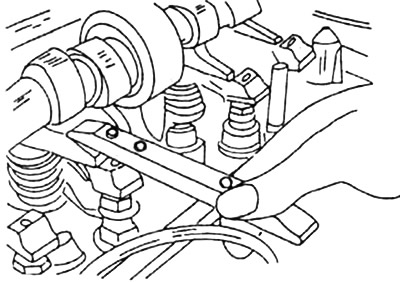
Set the engine again to the TDC position of the first cylinder and check the adjustment marks on the balance disk, camshafts and ignition distributor.
Adjust the valve clearance.
If necessary, check the position of the hydraulic valve clearance compensator and adjust it (v8 engines). On 6-cylinder engines, the valve clearance is measured using a flat feeler gauge between the sliding surface and the base surface of the camshaft cam.
On the installed assembled engine, it is necessary to first remove the tension springs, as well as the rubber gaskets of the spark plug holes. The flat feeler gauge should be pulled tightly when adjusted correctly.
To adjust the valve clearance, the corresponding camshaft cam must be positioned so that the cam nose does not press on the rocker arm, but stands opposite and vertical to the sliding plane.
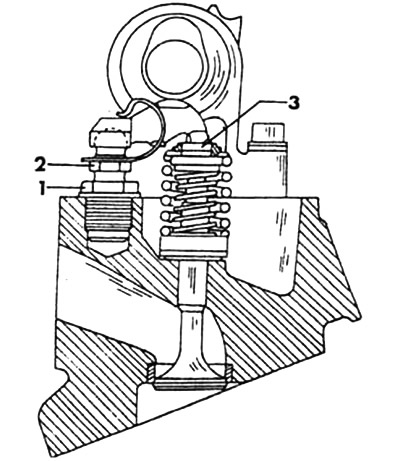
Engine valve control mechanism: 1. Threaded bushing. 2. Valve adjusting bolt. 3. Pusher (pusher)
The valve clearance can be checked or adjusted on a cold or warm engine. If the adjustment is insufficient, replace the pressure device. If the torque of the valve adjusting bolt is less than 20 Nm, replace the adjusting bolt or the adjusting bolt together with the threaded sleeve. 4 Install and tighten the valve cover.
Install the intake and exhaust manifolds, mixture regulator and air duct, carburetor, fuel pump, water pump and fan.
Install the oil filter and dipstick with tube.
Tighten the spark plugs.
Install the generator and belt.
Tighten the engine mounts.
Install the driven disc using a suitable centering rod on the inside of the flywheel.
Install the clutch and tighten the clutch mounting bolts evenly (criss-cross) a necessary moment.
For vehicles with automatic transmission, install a transfer disc.
Install the remaining engine parts. Secure the gearbox to the engine.
The engine is ready for installation.
Fill the engine with oil.