



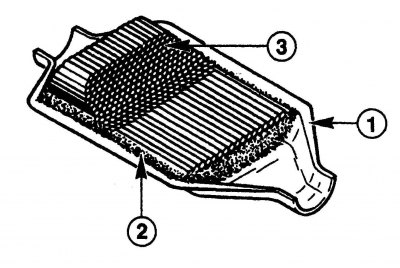
Fig. 5.55. Catalytic converter: 1 – body; 2 – mounting pad; 3 – carrier of active substance
The catalytic converter contains block carriers 3 (Fig. 5.55) coated with an active catalytic substance. This substance contains salts of noble metals, on the surface of which chemical transformations occur. The catalytic converter is fixed in the housing 1 using a mounting pad 2. Since the pad itself is a good insulator, there is no need for additional thermal insulation.
An oxygen concentration sensor is located directly in front of the catalytic converter. It shows the residual oxygen content in the exhaust gases and sends a corresponding signal to the engine control unit, which in turn monitors and changes the composition of the fuel-air mixture (poor or rich). Optimal afterburning in the catalytic converter occurs when the exhaust gases contain a sufficient amount of fuel. The afterburning temperature is 300–800°C, while the fuel-air mixture should contain a larger amount of fuel.
By regulating the excess air coefficient in the catalytic converter, carbon monoxide (CO) and hydrocarbons (CH) are oxidized and nitrogen oxides (NOx) are reduced.
To ensure the required service life of the catalytic converter, the requirements specified below must be met.
Precautions when working with a catalytic converter
Fill the fuel tank with unleaded gasoline only.
When filling or adding engine oil to the engine, be sure to ensure that the oil level does not rise above the maximum mark.
Do not tow the vehicle while the engine is warmed up to operating temperature. Unburned fuel entering the catalytic converter can cause its destruction.
If you have difficulty starting the engine, do not keep the starter on for a long time, since fuel is injected into the cylinders and gets into the exhaust system. Find and fix the problem.
Do not allow the fuel tank to run dry.
If misfires occur, do not increase crankshaft speed. Determine and eliminate the cause of the ignition system malfunction.
Use only spark plugs recommended for this vehicle.
Perform the spark test only with the fuel pump fuse removed.
Do not compare cylinders by turning off the ignition of one of them. This may result in unburned fuel entering the catalytic converter.
Do not park the car on dry grass or leaves after driving. This may cause a fire, as the exhaust system parts in the catalytic converter area are heated to a high temperature.
Do not apply anti-corrosion mastic to the exhaust system parts of the vehicle underbody
Exhaust system repair
Through corrosion can be eliminated by welding, but only for a short time. Special putty or bandage last longer, but in this case, corrosion will appear again, near the repair sites. In exhaust systems with more than one muffler, it is not uncommon for the second muffler to fail after replacing one. Therefore, as a rule, service centers replace the entire system. However, before you start working on the exhaust system, inspect it and decide whether you need to replace individual parts or the entire system.
Sequence of works


1. Raise the vehicle and secure it securely on stands.
2. Remove rusted threaded connections, use only new fasteners, washers and gaskets for assembly.
3. Replace all rubber suspension system parts with new ones.
4. If the system parts have been replaced before, it is better to separate the butt joints of the pipes when they are heated. Service centers use gas burners for this purpose, a good household gas burner will also work for this purpose. Protect your hands with gloves, your eyes with glasses, and prepare a fire extinguisher. Before using the burner, try using a rust solvent.
5. Disconnect the pipes with strong rotational movements and light hammer blows. If this does not help, cut off the pipe connection of the defective muffler exactly 10 cm behind the connection point. Saw the rest of the pipe along the length with a hacksaw and push it apart with a strong screwdriver;
To facilitate removal of the system, lubricate the fastening parts with LIQUI MOLI LM0–508-ASC copper paste.