
Cars BMW Cars Volkswagen Cars Chevrolet Cars Land Rover Cars Lada Cars Honda Cars Peugeot
English Русский
Български
Беларускі
Український
Српски
Hrvatski
Română
Polski
Slovenský
Magyar
Bookmark News and articles Sitemap Feedback Site search
MercedesMan.ru


A-Class C-Class E-Class G-Class M-Class S-Class Others
W123 (1976-1985) W124 (1984-1995) W210 (1996-2002)
  • Main
  • E-Class
  • W210 (1996-2002)
  • Diesel engines
  • Lubrication system
  • Motor oil

Motor oil (Mercedes-Benz E-Class W210)

0
Contents: Selecting oil ↡ Engine crankcase ventilation ↡ Oil consumption ↡
Modern high-performance engines impose special requirements on motor oils. The oil should not evaporate, and the oil film should not break at high temperatures of the cylinder working surfaces. The oil should burn without residue, bind soot and dirt so that they do not settle in the engine. To effectively combat deposits in the engine oil system, oils must have high flushing properties and increased wear resistance.

Timely oil change is necessary for the perfect operation of the engine.


Selecting oil


Mercedes recommends the following brands of oil for its diesel engines:

1. CCMC-D4, CCMC-D5 and CCMC-PD2. API CE or CF-4 oil grades are used only if CCMC grade oil is not available. It does not matter whether you filled the oil at a station or bought it, one of the recommended oil grades should be indicated on the packaging.

Viscosity. A measure of the oil's lubricating properties. In winter, engine oil should be thin enough to lubricate all necessary components immediately after a cold start. In summer, on the contrary, thick oil is required so that the integrity of the lubricant film is not damaged at high temperatures.

SAE class (Society of Automotive Engineers). Indicates the viscosity class, for example SAE 15W-40. The lower the first number, the less viscous the oil is in the cold ("W" - winter). 0W oil has lubricating properties at -30°C, 5W - at -25°C, and 15W - at -15°C. The higher the second number, the better the oil withstands high temperatures.


ACEA (Association of Constructeurs Europeen d'Automobiles). The European oil standard introduced in 1996. Replaces the CCMC standard. For gasoline engines, there are grades A1 (oil with a small content of purified alcohol), A2 (low additive oil), A3 (high performance oil). For diesel engines there are grades B1, B2 and B3.

SSMS (Committee des Constructeurs d'Automobiles du Marche Commun). The specification includes the letters "G" (gasoline engines) and "PD" (diesel engines), as well as a number. The higher the number, the better the quality of the oil.

API (American Petroleum Institute). The specification consists of the letters "S" (gasoline engines), "WITH" (diesel engines) and others. The further the letter is from the beginning of the alphabet, the higher the quality of the oil.

2. Oils with markings CCMS-G4/ G5 or API SG are designed for petrol engines, so they cannot be used for Mercedes diesel engines. But if the packaging has a double marking, for example CCMS-G4/ PD2, this oil is suitable for both types of engines.
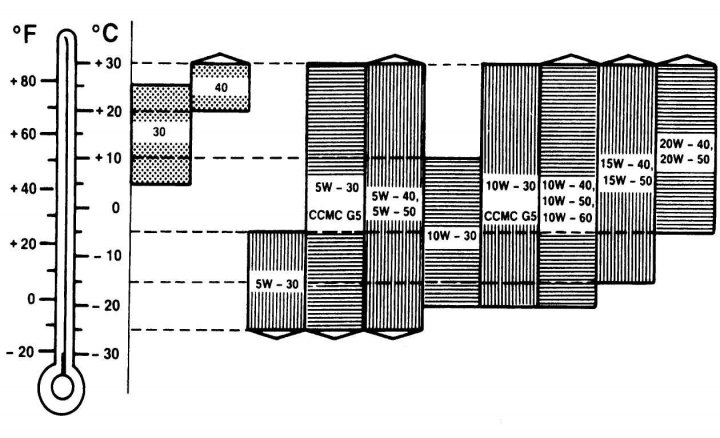
Fig. 4.32. Scale of working ranges of oils

Fig. 4.32. Scale of working ranges of oils


In the European region, with a wide range of winter and summer temperatures, oil of viscosity grade 15W-40 (Fig. 4.32) or 10W-40 can be used throughout the year. Only at very low or high temperatures persisting for a long time should oil of a different viscosity be used.


Engine crankcase ventilation


Engines in good working order pass 50 to 70 liters of exhaust gases per minute through the piston rings into the engine crankcase. These gases must be removed from the engine to avoid creating strong loads on the seals. This is done by crankcase ventilation.

Oil consumption


Some of the oil burns when lubricating the pistons. A well-tuned engine consumes approximately 0.2 l per 1000 km, while Mercedes has a maximum oil consumption of 1.5 l per 1000 km.

High oil consumption


Please note the following circumstances:

1. Before checking oil consumption, you need to make sure that it is not leaking from the engine (visual inspection of the motor).

2. If the oil level is above the maximum mark on the dipstick, then oil consumption will always be higher, since its excess is removed through the ventilation system.

3. Universal oil requires constant checking.

4. A sharp driving style increases the consumption of not only fuel, but also oil, especially when driving at high revs.

5. Oil consumption is always higher during the break-in period of a new car (minimum 5000 km).

6. The engine may be faulty.
This article is available at: russian, bulgarian, belarusian, ukrainian, serbian, croatian, romanian, polish, slovak, hungarian
The article has been verified: Polyakov Zakhar Grigorievich
Share with friends:
◀ Previous
E-Class W210 / Lubrication system
Next ▶

Oil pressure
Oil pump
Lubrication system — general description
Automatic oil level control
Checking the operation of the oil level sensor
Checking the condition of the engine oil
Oil and oil filter change
Lubrication system filling volumes
More similar articles for repairing other models

☛ Heater Fan Motor — Removal and Installation Mercedes W168 (1997-2004)
☛ Motor oil specification Mercedes W202 (1993-2000)
☛ Removal and installation the electric motor of the ventilation flap… Mercedes W463 (1999-2019)
☛ Removal and installation the intake port shutoff motor (612 series… Mercedes W163 (1997-2005)
☛ Checking the windshield wiper motor Mercedes W140 (1991-1998)
☛ Removal and installation the windshield wiper motor and arms Mercedes Sprinter (1995-2000, diesel)
Link in different formats to this article
Comments and feedback from visitors
No comments yet


How much will 27 + 23 ?


W210 (1996-2002) 
  • General information
  • Vehicle description
  • Working conditions and tools
  • Car care
  • Diesel engines
  • Engine repair
  • Lubrication system
  • Cooling system
  • Injection system
  • Supply system
  • Exhaust system
  • Gasoline engines
  • Engine repair
  • Lubrication system
  • Cooling system
  • Control system
  • Power and exhaust system
  • Transmission
  • Clutch
  • Mechanical gearbox
  • Automatic gearbox
  • Drive shafts
  • Chassis
  • Car suspension
  • Steering
  • Tires and wheels
  • Brake system
  • Body
  • Exterior (external elements)
  • Interior (internal elements)
  • Doors and windows
  • Heating and ventilation
  • Electrical equipment
  • Equipment and devices
  • Power devices
  • Lighting and signaling
  • Electrical circuits
W124 (1984-1995) 
  • General information
  • Governing bodies
  • Driving and operation
  • Weekly care
  • Maintenance (gasoline)
  • Maintenance (diesel)
  • Troubleshooting
  • Power unit
  • I4 petrol engine
  • V6 petrol engine (SOHC)
  • V6 petrol engine (DOHC)
  • Diesel engines
  • Engine overhaul
  • Cooling system
  • Heating and ventilation
  • Fuel system (carburetor)
  • Injection system «Bosch CIS-E»
  • Injection system «Bosch HFM»
  • Diesel fuel system
  • Supply system
  • Starting and charging system
  • Ignition system (I4)
  • Ignition system (V6)
  • Preheating
  • Transmission
  • Clutch
  • Mechanical gearbox
  • Automatic gearbox
  • Drive shafts
  • Chassis
  • Brake system
  • Car suspension
  • Steering
  • Body
  • Exterior (external elements)
  • Interior (internal elements)
  • Doors, locks and windows
  • Electrical equipment
  • Equipment and devices
  • Switches
  • Headlights and lighting
  • Electrical circuits
W123 (1976-1985) 
  • General information
  • Introduction to the guide
  • Power unit
  • Engine device
  • Repair M102 engines
  • Repair M110 and M123 engines
  • Cooling and lubrication (M102)
  • Cooling (M110 and M123)
  • Ignition system
  • Power system «Stromberg»
  • Power system «Solex 4A1»
  • Fuel injection «K-Jetronic»
  • Fuel injection «L-Jetronic»
  • Transmission
  • Clutch
  • Mechanical gearbox
  • Automatic gearbox
  • Cardan and rear axle
  • Chassis
  • Front suspension
  • Rear suspension
  • Steering
  • Brake system
  • Body
  • Exterior (external elements)
  • Interior (internal elements)
  • Doors, locks and windows
  • Electrical equipment
  • Equipment and devices
  • Power devices
  • Electrical circuits
 
MercedesMan.ru © 2017–2026 · Mobile version · Read about Mercedes · Sitemap: EN BG BY UA RS HR RO PL SK HU · Feedback · Site search · Bookmark A-Class (W168) · C-Class (W201) · C-Class (W202) · C-Class (W203) · E-Class (W123) · E-Class (W124) · E-Class (W210) · G-Class (W463) · M-Class (W163) · S-Class (W116, petrol) · S-Class (W126, petrol) · S-Class (W140) · S-Class (W220) · Sprinter · Vito 1 · Vito 2 · Vario 814D ·
 
We only use cookies without which some of the site's features may not be available.