
Cars BMW Cars Volkswagen Cars Chevrolet Cars Land Rover Cars Lada Cars Honda Cars Peugeot
English Русский
Български
Беларускі
Український
Српски
Hrvatski
Română
Polski
Slovenský
Magyar
Bookmark News and articles Sitemap Feedback Site search
MercedesMan.ru


A-Class C-Class E-Class G-Class M-Class S-Class Others
W123 (1976-1985) W124 (1984-1995) W210 (1996-2002)
  • Main
  • E-Class
  • W210 (1996-2002)
  • Electrical equipment
  • Equipment and devices
  • Color coding of wires

Color coding of wires (Mercedes-Benz E-Class W210)

0
Contents: Wire connectors ↡ Battery power cables ↡
Contact "15" is energized only when the ignition is on (the key in the lock is in position "II"), while outside the ignition coils, current is supplied to those consumers that should receive voltage only when the engine is running. The wires on the contacts "15" have a black braid, sometimes with the addition of colored stripes for certain units.

Contact "15R" designates contacts that must function in the key positions "I" and "II", as well as when the starter is turned on. The braid is usually black with additional stripes.

Contact "30" is constantly under voltage from the battery or, when the engine is running, from the generator. Therefore, if the tool is handled carelessly, short circuits or sparking are possible if the negative terminal is not removed from the battery. The connected wires are current-carrying and usually have a red braid, with additional stripes of a different color added if necessary.

Contact "30a" is constantly under voltage from the positive pole of the battery through the fuse. Usually, memory units of controller fault codes are connected through it.

Contact "31" - "ground" through which consumers are connected to the "ground" of the car to close the circuit. The wires have a brown braid.

Contact "49" is responsible for the direction indicator and hazard warning system. The color of the wires is black and green with additional stripes of a different color.

Contact "50" – through it, voltage is supplied to the starter during starting. The main color of the wires is purple.


Contact "53" is responsible for the windshield wiper.

Contact "56" is responsible for supplying voltage to the low beam headlights through the yellow wires and to the high beam headlights through the white wires.

Contact "58" is responsible for the parking and side lights, as well as the license plate lighting. The main color of the wire braiding is gray, each with an additional strip of a different color.

Contact "61" is responsible for the charging indicator light ("D+"), the wire color is blue.

Contact "87" it is usually powered, like contact "15", but through a relay, for example, overvoltage protection.

Wire connectors


For a long time, according to ADAC statistics, disconnected connectors were one of the most common causes of malfunctions, and practically all cars. Against this trouble, which happens especially often after six years of operation, Mercedes has applied several innovations. First of all, the car uses many expensive silver-plated round plugs. The connector combs have additional mechanical protection. It is clear that this protection must be surmountable to disconnect the connections. Therefore, it is either a bracket or two side latches that must be pressed to disconnect the connector. Some plugs are equipped with rotary or spring locks. Where possible, the connectors and devices are well protected from moisture.

Battery power cables
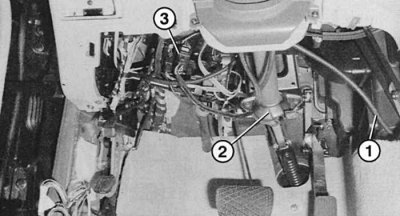


Fig. 9.37. When the upholstery is removed, the power cable (1) coming from the battery in the…

Fig. 9.37. When the upholstery is removed, the power cable (1) coming from the battery in the driver's footwell is visible; steering wheel shaft (2) with extension for adjustable steering column; red plug connection (3) to the airbag


To supply current from the rear-mounted battery to the engine compartment, a large-section red power cable is connected to the positive terminal of the battery (Fig. 9.37). It then passes through a thick (50 mm²) black cable laid along the driveshaft tunnel and ends with a 3-pin connection (X4) in the accelerator pedal area.

From there, the wires go to the starter and other units, to the ignition switch, fuse box, lighting module, generator, heating system and the jumper contact (X 12/3) in the engine compartment. A capacitor (C2) is also installed in the contact connector to suppress interference.
This article is available at: russian, bulgarian, belarusian, ukrainian, serbian, croatian, romanian, polish, slovak, hungarian
The article has been verified: Polyakov Zakhar Grigorievich
Share with friends:
◀ Previous
E-Class W210 / Equipment and devices
Next ▶

Wires and fuses
Airbag system and seat belt pretensioners
Tempomat (cruise control)
Removal the instrument cluster
Instrument cluster — general description
Relay and fuse box mounting block
Fuses — Types and Locations
Replacing the fuse
Relay — purpose and fault finding
Combi relay — location
More similar articles for repairing other models

☛ Checking and replacing spark plugs, condition of high-voltage wires Mercedes W203 (2000-2007)
☛ Checking and replacing spark plugs, checking the condition of… Mercedes W463 (1999-2019)
☛ Checking and replacing spark plugs, checking the condition of… Mercedes W163 (1997-2005)
☛ Checking and replacing spark plugs, checking the condition of… Mercedes W140 (1991-1998)
Link in different formats to this article
Comments and feedback from visitors
No comments yet


How much will 39 + 37 ?


W210 (1996-2002) 
  • General information
  • Vehicle description
  • Working conditions and tools
  • Car care
  • Diesel engines
  • Engine repair
  • Lubrication system
  • Cooling system
  • Injection system
  • Supply system
  • Exhaust system
  • Gasoline engines
  • Engine repair
  • Lubrication system
  • Cooling system
  • Control system
  • Power and exhaust system
  • Transmission
  • Clutch
  • Mechanical gearbox
  • Automatic gearbox
  • Drive shafts
  • Chassis
  • Car suspension
  • Steering
  • Tires and wheels
  • Brake system
  • Body
  • Exterior (external elements)
  • Interior (internal elements)
  • Doors and windows
  • Heating and ventilation
  • Electrical equipment
  • Equipment and devices
  • Power devices
  • Lighting and signaling
  • Electrical circuits
W124 (1984-1995) 
  • General information
  • Governing bodies
  • Driving and operation
  • Weekly care
  • Maintenance (gasoline)
  • Maintenance (diesel)
  • Troubleshooting
  • Power unit
  • I4 petrol engine
  • V6 petrol engine (SOHC)
  • V6 petrol engine (DOHC)
  • Diesel engines
  • Engine overhaul
  • Cooling system
  • Heating and ventilation
  • Fuel system (carburetor)
  • Injection system «Bosch CIS-E»
  • Injection system «Bosch HFM»
  • Diesel fuel system
  • Supply system
  • Starting and charging system
  • Ignition system (I4)
  • Ignition system (V6)
  • Preheating
  • Transmission
  • Clutch
  • Mechanical gearbox
  • Automatic gearbox
  • Drive shafts
  • Chassis
  • Brake system
  • Car suspension
  • Steering
  • Body
  • Exterior (external elements)
  • Interior (internal elements)
  • Doors, locks and windows
  • Electrical equipment
  • Equipment and devices
  • Switches
  • Headlights and lighting
  • Electrical circuits
W123 (1976-1985) 
  • General information
  • Introduction to the guide
  • Power unit
  • Engine device
  • Repair M102 engines
  • Repair M110 and M123 engines
  • Cooling and lubrication (M102)
  • Cooling (M110 and M123)
  • Ignition system
  • Power system «Stromberg»
  • Power system «Solex 4A1»
  • Fuel injection «K-Jetronic»
  • Fuel injection «L-Jetronic»
  • Transmission
  • Clutch
  • Mechanical gearbox
  • Automatic gearbox
  • Cardan and rear axle
  • Chassis
  • Front suspension
  • Rear suspension
  • Steering
  • Brake system
  • Body
  • Exterior (external elements)
  • Interior (internal elements)
  • Doors, locks and windows
  • Electrical equipment
  • Equipment and devices
  • Power devices
  • Electrical circuits
 
MercedesMan.ru © 2017–2026 · Mobile version · Read about Mercedes · Sitemap: EN BG BY UA RS HR RO PL SK HU · Feedback · Site search · Bookmark A-Class (W168) · C-Class (W201) · C-Class (W202) · C-Class (W203) · E-Class (W123) · E-Class (W124) · E-Class (W210) · G-Class (W463) · M-Class (W163) · S-Class (W116, petrol) · S-Class (W126, petrol) · S-Class (W140) · S-Class (W220) · Sprinter · Vito 1 · Vito 2 · Vario 814D ·
 
We only use cookies without which some of the site's features may not be available.