
Cars BMW Cars Volkswagen Cars Chevrolet Cars Land Rover Cars Lada Cars Honda Cars Peugeot
English Русский
Български
Беларускі
Український
Српски
Hrvatski
Română
Polski
Slovenský
Magyar
Bookmark News and articles Sitemap Feedback Site search
MercedesMan.ru


A-Class C-Class E-Class G-Class M-Class S-Class Others
W123 (1976-1985) W124 (1984-1995) W210 (1996-2002)
  • Main
  • E-Class
  • W210 (1996-2002)
  • Electrical equipment
  • Equipment and devices
  • Wires and fuses

Wires and fuses (Mercedes-Benz E-Class W210)

0
In Mercedes cars, individual wires are usually bundled and enclosed in a black braid, which makes it difficult to find the necessary wire. In this case, numerous plug connectors can help you find your way around, the exact position of which and the number of incoming wires are indicated in the electrical equipment diagrams. The wire cross-section is selected depending on the power of the consumer: a 0.5 mm² cross-section is sufficient for a control lamp, a 16 mm² wire is required for a starter. A wire that is too thin can overheat, causing the voltage to drop. As a result, for example, 10 or even 9.5 V reaches the headlights instead of 12 V - their light is dim.

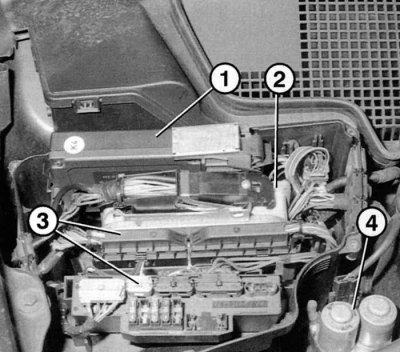
Fig. 9.36. Mounting block location: 1 – ABS/ETS controller; 2 – EDS controller; 3-pin connectors…

Fig. 9.36. Mounting block location: 1 – ABS/ETS controller; 2 – EDS controller; 3-pin connectors for various electronic devices (depending on the configuration); 4 – double valves of the heating system


Most consumers have two wires connected. But usually only one of them can be traced to the battery or generator. The other wire is often already several centimeters away connected to metal parts of the body, engine or gearbox. This is a clear example of how car manufacturers have used for their own purposes the physical principle according to which metal parts, called "ground" by auto electricians, conduct current. In this way, a large number of wires are saved on closing the circuit from the consumer to the negative terminal of the battery, transferring this function to the "ground". If any consumer does not work, the cause is often a lost contact with the "ground". In this case, contact with the "ground" of this consumer is carried out through bypasses, which causes disturbances in the overall system. A certain amount of endurance is needed to work with electrical equipment. The fuse tables and wiring diagrams presented in this book will help you figure it all out. The mounting block (Fig. 9.36) is located under the cover protecting against moisture and splashes, in the rear right part of the engine compartment.


The negative wire of the battery is connected to the "ground"


Current is supplied to the consumer via a wire, the path of which can be traced to the battery with greater or lesser difficulty, which is also reflected in the electrical diagrams. The return circuit is provided by metal parts of the body or engine that conduct electricity. This saves a large number of wires. In some cases, a short wire is still required for the return circuit - usually when the consumer is located directly on metal parts. These so-called "ground" wires always lead to "ground" points or contacts distributed throughout the body and to which the ends of the wires are connected using threaded connections.

The negative terminal of the battery is connected to the body or to the "ground" as auto electricians call it. Always remember this: "minus" is connected to "ground".
This article is available at: russian, bulgarian, belarusian, ukrainian, serbian, croatian, romanian, polish, slovak, hungarian
The article has been verified: Polyakov Zakhar Grigorievich
Share with friends:
◀ Previous
E-Class W210 / Equipment and devices
Next ▶

Airbag system and seat belt pretensioners
Tempomat (cruise control)
Removal the instrument cluster
Instrument cluster — general description
Checking control devices
Color coding of wires
Relay and fuse box mounting block
Fuses — Types and Locations
Replacing the fuse
Relay — purpose and fault finding
More similar articles for repairing other models

☛ Location of fuses Mercedes W168 (1997-2004)
☛ Replacing fuses Mercedes W202 (1993-2000)
☛ Checking and replacing spark plugs, checking the condition of… Mercedes W463 (1999-2019)
☛ Checking and replacing spark plugs, checking the condition of… Mercedes W163 (1997-2005)
☛ Checking and replacing spark plugs, checking the condition of… Mercedes W140 (1991-1998)
☛ Fuses — Description and Replacement Mercedes Sprinter (1995-2000, diesel)
Link in different formats to this article
Comments and feedback from visitors
No comments yet


How much will 21 + 44 ?


W210 (1996-2002) 
  • General information
  • Vehicle description
  • Working conditions and tools
  • Car care
  • Diesel engines
  • Engine repair
  • Lubrication system
  • Cooling system
  • Injection system
  • Supply system
  • Exhaust system
  • Gasoline engines
  • Engine repair
  • Lubrication system
  • Cooling system
  • Control system
  • Power and exhaust system
  • Transmission
  • Clutch
  • Mechanical gearbox
  • Automatic gearbox
  • Drive shafts
  • Chassis
  • Car suspension
  • Steering
  • Tires and wheels
  • Brake system
  • Body
  • Exterior (external elements)
  • Interior (internal elements)
  • Doors and windows
  • Heating and ventilation
  • Electrical equipment
  • Equipment and devices
  • Power devices
  • Lighting and signaling
  • Electrical circuits
W124 (1984-1995) 
  • General information
  • Governing bodies
  • Driving and operation
  • Weekly care
  • Maintenance (gasoline)
  • Maintenance (diesel)
  • Troubleshooting
  • Power unit
  • I4 petrol engine
  • V6 petrol engine (SOHC)
  • V6 petrol engine (DOHC)
  • Diesel engines
  • Engine overhaul
  • Cooling system
  • Heating and ventilation
  • Fuel system (carburetor)
  • Injection system «Bosch CIS-E»
  • Injection system «Bosch HFM»
  • Diesel fuel system
  • Supply system
  • Starting and charging system
  • Ignition system (I4)
  • Ignition system (V6)
  • Preheating
  • Transmission
  • Clutch
  • Mechanical gearbox
  • Automatic gearbox
  • Drive shafts
  • Chassis
  • Brake system
  • Car suspension
  • Steering
  • Body
  • Exterior (external elements)
  • Interior (internal elements)
  • Doors, locks and windows
  • Electrical equipment
  • Equipment and devices
  • Switches
  • Headlights and lighting
  • Electrical circuits
W123 (1976-1985) 
  • General information
  • Introduction to the guide
  • Power unit
  • Engine device
  • Repair M102 engines
  • Repair M110 and M123 engines
  • Cooling and lubrication (M102)
  • Cooling (M110 and M123)
  • Ignition system
  • Power system «Stromberg»
  • Power system «Solex 4A1»
  • Fuel injection «K-Jetronic»
  • Fuel injection «L-Jetronic»
  • Transmission
  • Clutch
  • Mechanical gearbox
  • Automatic gearbox
  • Cardan and rear axle
  • Chassis
  • Front suspension
  • Rear suspension
  • Steering
  • Brake system
  • Body
  • Exterior (external elements)
  • Interior (internal elements)
  • Doors, locks and windows
  • Electrical equipment
  • Equipment and devices
  • Power devices
  • Electrical circuits
 
MercedesMan.ru © 2017–2026 · Mobile version · Read about Mercedes · Sitemap: EN BG BY UA RS HR RO PL SK HU · Feedback · Site search · Bookmark A-Class (W168) · C-Class (W201) · C-Class (W202) · C-Class (W203) · E-Class (W123) · E-Class (W124) · E-Class (W210) · G-Class (W463) · M-Class (W163) · S-Class (W116, petrol) · S-Class (W126, petrol) · S-Class (W140) · S-Class (W220) · Sprinter · Vito 1 · Vito 2 · Vario 814D ·
 
We only use cookies without which some of the site's features may not be available.