



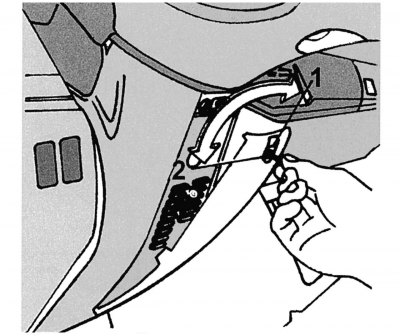
Figure 338. Location of the fuse box |
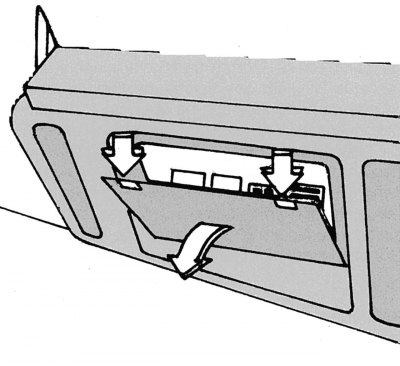
Figure 339. Location of the heater fan fuse (under the driver's seat) |
The fuses are located in a special block under the steering column. To access them, you need to open the cover shown in the picture 338. The cover should be opened in direction 1 and closed in direction 2. On the inside of the cover there is a table describing the location of the fuses. All fuses are numbered. The heater fan fuse is located separately and is located under the driver's seat (figure 339). All additional power consumers can be connected through this unit. The exact location of the fuses depends on the modification. The rules for operating fuses are as follows:
- fuses rarely blow due to network overloads. The cause is usually a short circuit or a faulty electrical appliance. Most often, there is a short circuit to ground somewhere. If the cause is not found, replacing the fuse will not help;
- determine from the electrical circuit when voltage is supplied to the fuse. It can be supplied continuously or at the appropriate position of the ignition switch. Also determine which device's circuit the fuse is connected to;
- when checking with a piece of wire, make a jumper between the fuse contacts, closing the circuit for a second. If a strong spark follows, there is a short circuit somewhere in the circuit. Check the wires leading to the device one by one, disconnecting them. If the sparking disappears, you should look for a fault in the section of the circuit that was just disconnected;
- if sparking does not occur immediately when installing the jumper, turn the key in the ignition switch so that voltage is supplied to the fuse, you can check this with a test lamp. If there is sparking when closing the jumper, check the circuit as described above;
- if the short circuit occurs only when any device is turned on (for example, heated rear window, windscreen wipers, turn signals or brake lights), checking for a spark is more difficult and requires more experience. A small amount of sparking is normal, as a large current is supplied to the consumer. Strong sparking will still indicate a short circuit. If you use an ammeter with a measurement limit of 30 A instead of a jumper made of wire, it will be easier to determine the short circuit. Instantaneous off-scale readings indicate a short circuit (remove the device contact immediately).
Location of fuses
| fuse No | Current strength, A | Connected devices |
| 1 | 15 | Right front and rear side lights |
| 2 | 15 | Right high beam lamp |
| 3 | 15 | Left high beam lamp |
| 4 | 15 | Reverse light lamp |
| 5 | 15 | Brake signal |
| 6 | 20 | Windscreen wiper motor |
| 7 | 15 | Horn, heated rear window, auxiliary device relay |
| 8 | 20 | Interior lighting, cigarette lighter, radio (terminal "30") |
| 9 | 15 | Clock, alarm |
| 10 | 15 | Instrument lighting, number plate light, low beam |
| 11 | 15 | Left front and rear side lights |
| 12 | 15 | Right low beam lamp |
| 13 | 15 | Left low beam lamp |
| 14 | 15 | Rear and front fog lights |
| 15 | 15 | Radio (terminal "15") |
| 16-18 | 15 | Reserve for additional equipment |
Note: If an appliance stops working, it is often due to poor contact of the fuse holding contacts or oxidation of the contacts, causing the circuit to be interrupted. In this case, you need to remove the fuse, clean the contacts and install a new fuse.