
Cars BMW Cars Volkswagen Cars Chevrolet Cars Land Rover Cars Lada Cars Honda Cars Peugeot
English Русский
Български
Беларускі
Український
Српски
Hrvatski
Română
Polski
Slovenský
Magyar
Bookmark News and articles Sitemap Feedback Site search
MercedesMan.ru


A-Class C-Class E-Class G-Class M-Class S-Class Others
W463 (1999-2019)
  • Main
  • G-Class
  • W463 (1999-2019)
  • Electrical equipment
  • Equipment and devices
  • Fuses — General Information

Fuses — General Information (Mercedes-Benz G-Class W463)

0
To protect the contact circuits of the vehicle's electrical equipment, various combinations of fuses, fuse links and circuit breakers are used. The main mounting block is installed in the engine compartment, another mounting block of relays and fuses is located in the vehicle's interior, under the instrument panel.

To protect the contact circuits of the vehicle's electrical equipment, various combinations of fuses, fuse links and circuit breakers are used, most of which are concentrated in two mounting blocks (see Specifications).

Each individual fuse is used to protect a specific electrical circuit or several circuits at once. A label with an identification card of the location of the fuses in the mounting block is usually glued to the cover of the latter, on its inner side.

The fuse boxes contain compact fuses with bayonet terminals that can be easily removed from their sockets in the box with your fingers if necessary. If any of the power consumers fails, the condition of the corresponding fuse should always be checked first. Turn the ignition key to the ON position and probe the open terminals of each fuse with a test lamp. If the lamp lights up when connected to each terminal, the fuse is OK. If voltage is present only on the power supply side, the fuse has blown. Note also that the fuse body is usually made of transparent plastic, through which the condition of the working jumper can be easily determined.
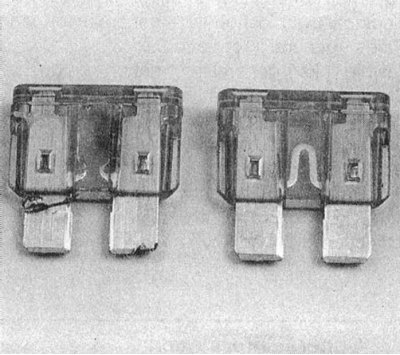
The fact that the contact jumper of a failed fuse has burned out can be easily detected by visual…

The fact that the contact jumper of a failed fuse has burned out can be easily detected by visual inspection of its translucent body


When replacing a blown fuse, make sure that the replacement fuse you install matches the type of the element that has failed. Fuses rated for different current ratings may not physically differ from each other, but they are not interchangeable. Each electrical circuit has different operating parameters and requires a different degree of protection, so replacing a fuse (designed for a certain current strength) that does not correspond to its parameters is fraught with the most serious consequences (until a fire breaks out). Operating parameters of the fuse (rated current) usually marked on its plastic body.

If the new fuse also fails immediately after installation, there is no point in replacing it further - first you need to identify and eliminate the cause of the overload in the circuit. In most cases, this is a short circuit in the connecting wiring caused by damage to its insulation.
This article is available at: russian, bulgarian, belarusian, ukrainian, serbian, croatian, romanian, polish, slovak, hungarian
The article has been verified: Polyakov Zakhar Grigorievich
Share with friends:
◀ Previous
G-Class W463 / Equipment and devices
Next ▶

Search for causes of electrical equipment failures
General information and precautions
On-board electrical equipment specifications
Circuit Breakers — General Information
Relays — general information and checking the correct functioning
Digital data bus CAN
Disconnecting and connecting electrical wiring of mounting blocks and control modules
Removal and installation fuse and relay mounting blocks
More similar articles for repairing other models

☛ Location of fuses Mercedes W168 (1997-2004)
☛ Replacing fuses Mercedes W202 (1993-2000)
☛ Fuses and relays Mercedes W123 (1976-1985)
☛ Fuses and Relays Specifications Mercedes W163 (1997-2005)
☛ Electrical fuses Mercedes W140 (1991-1998)
☛ Fuses — Description and Replacement Mercedes Sprinter (1995-2000, diesel)
Link in different formats to this article
Comments and feedback from visitors
No comments yet


How much will 18 + 40 ?


W463 (1999-2019) 
  • General information
  • Introduction to the guide
  • Controls and instruments
  • Driving and operation
  • Maintenance
  • Power unit
  • Engine repair
  • Cooling system
  • Heating and ventilation
  • Power system (gasoline)
  • Fuel system (diesel)
  • Exhaust system
  • Ignition and control system
  • Charging and starting system
  • Transmission
  • Automatic gearbox
  • Transfer case
  • Axles front and rear
  • Chassis
  • Brake system
  • Front suspension
  • Rear suspension
  • Steering
  • Body
  • Exterior (external elements)
  • Interior (internal elements)
  • Doors, locks and windows
  • Electrical equipment
  • Equipment and devices
  • Switches in salon
  • Headlights and lighting
  • Audio system and navigation
  • Electrical circuits
 
MercedesMan.ru © 2017–2026 · Mobile version · Read about Mercedes · Sitemap: EN BG BY UA RS HR RO PL SK HU · Feedback · Site search · Bookmark A-Class (W168) · C-Class (W201) · C-Class (W202) · C-Class (W203) · E-Class (W123) · E-Class (W124) · E-Class (W210) · G-Class (W463) · M-Class (W163) · S-Class (W116, petrol) · S-Class (W126, petrol) · S-Class (W140) · S-Class (W220) · Sprinter · Vito 1 · Vito 2 · Vario 814D ·
 
We only use cookies without which some of the site's features may not be available.