



Contents: General information ↡ Advantages ↡ Data transfer format ↡ Priorities ↡ Error recognition ↡ Data Frame Level Mechanisms ↡ Bit-level mechanisms ↡ Troubleshooting ↡ Types CAN bus ↡
General information
Modern vehicles use several CAN data exchange network buses (Controller Area Network) between modules/control units of various systems and controllers of vehicle actuators.
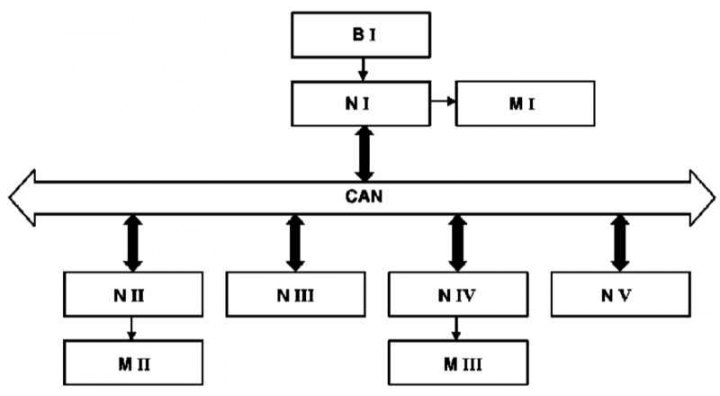
The order of data exchange via CAN bus
B - Sensor 1; CAN - Computer Network Communications Bus; M - Executive elements I-III (servomechanisms); N - Control units/controllers IV
The bus is full duplex (or just duplex), i.e. any device connected to it can simultaneously receive and transmit messages.
The signal from the sensitive element of the corresponding information (sensor) is sent to the nearest control unit, which processes it and transmits it to the CAN data exchange bus.
Any control unit connected to the CAN data bus can read this signal, calculate the control parameters based on it and control the operation of the corresponding actuator.
Advantages
With a conventional cable connection of electrical and electronic devices, a direct connection is made between each control unit and all sensors and actuators from which it receives measurement results or which it controls.
The complication of the control system leads to excessive length or number of cable lines.
Compared to standard cabling, the data bus provides:
- Reduction in the number of cables. The wires from the sensors are only drawn to the nearest control unit, which converts the measured values into a data packet and transmits the latter to the CAN bus;
- The actuator can be controlled by any control unit that receives the corresponding data packet via the CAN bus and calculates the control action value based on it;
- Improving electromagnetic compatibility;
- Reduction in the number of plug connections and reduction in the number of contact terminals on control units;
- Weight loss;
- Reducing the number of sensors, since the signals from one sensor (for example, from the coolant temperature sensor) can be used by different systems;
- Improved diagnostic capabilities. Since signals from one sensor (for example, speed signal) are used by different systems, then if a fault message is issued by all systems using this signal, the fault is usually in the sensor or control unit that processes its signals. If a fault message is received from only one system, although this signal is also used by other systems, then the cause of the fault is most often in the processing control unit or servo mechanism;
- High data transfer rate - up to 1 Mbit/s is possible with a maximum line length of 40 m. Currently, the data transfer rate on Mercedes-Benz vehicles ranges from 83 kbit/s to 500 kbit/s;
- Several messages can be transmitted successively over the same line.
The CAN data bus consists of a two-wire cable made in the form of a twisted pair. All devices are connected to this line (device control units).
Data transmission is carried out with duplication on both wires, and the logical levels of the data bus are mirrored (that is, if a logical zero level (0) is transmitted on one wire, then a logical one level (1) is transmitted on the other wire, and vice versa).
The two-wire transmission scheme is used for two reasons: for error control and as a basis for reliability.
If a voltage spike occurs on only one wire - for example due to electromagnetic compatibility (EMC) issues - then the receiving units may identify this as an error and ignore the spike.
In the event of a short circuit or break in one of the two CAN bus wires, thanks to the integrated software and hardware reliability system, switching to the single-wire operation mode is performed. The damaged transmission line is no longer used.
The order and format of data transmitted and received by users (subscribers) messages are defined in the data exchange protocol.
An essential distinguishing feature of the CAN data bus compared to other bus systems based on the subscriber addressing principle is message-related addressing.
This means that each message transmitted over the bus is assigned its own permanent address (identifier), marking the content of this message (eg: coolant temperature). The CAN data bus protocol allows the transmission of up to 2048 different messages, with addresses 2033 to 2048 being permanently assigned.
The data volume in one CAN bus message is 8 bytes.
The receiver block processes only those messages that are stored in its own identification list (acceptability control).
Data packets can only be transmitted if the CAN bus is free (i.e., if after the last packet there was an interval of 3 bits, and none of the control units starts transmitting the next message). In this case, the logical level of the data bus must be recessive (logical "1").
If several control units start transmitting messages simultaneously, the priority principle comes into effect, according to which the message with the highest priority will be transmitted first without loss of time or bits (arbitration of requests for access to the shared data bus).
Each control unit that loses its arbitration right automatically switches to receive and tries to send its message again as soon as the data bus becomes free again.
In addition to data packets, packets of requests for specific messages via the CAN data bus are also used for information exchange; the control unit that is able to provide the requested information responds to such a request.
Data transfer format
In normal transmission mode, the following packet configurations are used:
- Data Frame (message frame) for transmitting messages via the CAN data bus (eg: coolant temperature);
- Remote Frame (request frame) to request messages via the CAN data bus from another control unit;
- Error Frame (error frame), - all connected control units are notified that an error has occurred and the last message on the CAN data bus is invalid.
The CAN data bus protocol supports two different message frame formats that differ only in the length of the identifier: Standard and Extended.
Currently, only the standard format is used in the data exchange systems of Daimler Chrysler vehicle control systems.
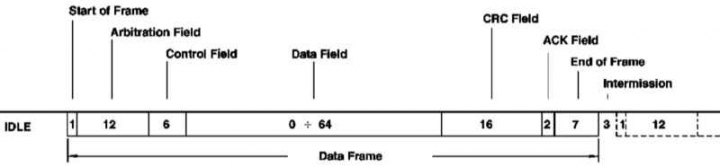
Frame format
Each frame of messages transmitted via the CAN bus consists of seven consecutive fields:
- Start of Frame (start bit): Marks the start of a message and synchronizes all modules;
- Arbitration Field (arbitrage field): This field consists of an 11-bit identifier (address) and one control bit (Remote Transmission Request-Bit), marking the frame as Data Frame (data frame) or as Remote Frame (remote request frame);
- Control Field (control bits): The 6-bit control field contains the IDE defining bit (Identifier Extension Bit), used to recognize the type of format being used (standard or extended), a reserve bit for subsequent extensions and, in the last 4 bits, information about the number of data bytes contained in the Data Field (see below);
- Data Field (data): The data field can contain from 0 to 8 bytes of data, - transmission of 0-byte messages via the CAN bus is used to synchronize distributed processes;
- CRC Field (control field): CRC field (Cyclic-Redundancy-Check Field) contains 16 bits and is used for control error detection during transmission;
- ACK Field (confirmation of acceptance): ACK field (Acknowledgement Field) contains a signal confirming the reception of all receiver units that have received a message via the CAN bus without errors;
- End of Frame (end of frame): Marks the end of the frame;
- Intermission (interval): The interval between two adjacent data frames. The interval length must be at least 3 bits, after which any of the control units can begin transmitting the next packet;
- IDLE (rest mode): If no control unit is transmitting messages, the CAN bus remains in idle mode (waiting) until the next packet is transmitted.
Priorities
To process data in real time, it must be possible to transmit it quickly.
This not only requires a high physical data rate line, but also requires rapid access to the common CAN bus if multiple control units need to transmit messages simultaneously.
In order to differentiate the messages transmitted via the CAN data bus according to their degree of urgency, different priorities are provided for individual messages.
For example, ignition timing has the highest priority, slip values have the average priority, and outside air temperature has the lowest priority.
The priority with which a message is transmitted on the CAN bus is determined by the identifier (address field) the corresponding message.
The identifier corresponding to the smaller binary number has higher priority, and vice versa.
The CAN data bus protocol is based on two logical states: Bits are either "recessive" (logical "1") or "dominant" (logical "0"). If a dominant bit is transmitted by at least one module, then recessive bits transmitted by other modules are overwritten.
Example
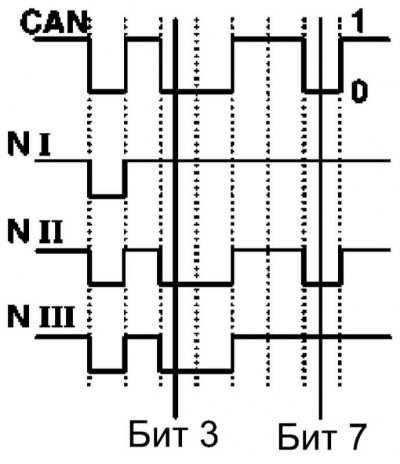
Example of arbitration organization
The first control block (NI) loses arbitration from the 3rd bit
The third control block (N III) loses arbitration from the 7th bit
The second control unit (N II) retains access rights to the CAN data bus and can transmit its message
If several control units simultaneously start transmitting data, the conflict for access to the common data bus is resolved by "bitwise arbitration of common resource requests" using the corresponding identifiers.
When transmitting the identifier field, the transmitting unit checks after each bit whether it still has the right to transmit, or whether another control unit is already transmitting a message with a higher priority on the bus.
If the recessive bit transmitted by the first transmitter is overwritten by the dominant bit of another transmitter, then the first transmitter loses its right to transmit (arbitration) and becomes the receiver.
Other control units will attempt to transmit their messages via the CAN data bus only after it is free again. In this case, the right to transmit will again be granted in accordance with the priority of the message via the CAN data bus.
Error recognition
Interference can lead to errors in data transmission. Such errors occurring during transmission must be recognized and eliminated. The CAN data bus protocol distinguishes between two error recognition levels:
- Data Frame Level Mechanisms (data frame);
- Bit-level mechanisms.
Data Frame Level Mechanisms
Cyclic-Redundancy-Check
Based on the message transmitted via the CAN data bus, the transmitter unit calculates control bits, which are transmitted together with the data packet in the "CRC Field" field (checksums). The receiving unit recalculates these control bits based on the message received via the CAN data bus and compares them with the control bits received together with this message.
Frame Check
This mechanism checks the structure of the transmitted block (frame), that is, the bit fields with a given fixed format and the frame length are rechecked.
Errors detected by the Frame Check function are marked as format errors.
Bit-level mechanisms
Monitoring
Each module monitors the logic level of the CAN data bus when transmitting a message and determines the differences between the transmitted and received bits. This ensures reliable recognition of global and local bit errors occurring in the transmitter unit.
Bit Stuffing
In each data frame between the field "Start of Frame" and the end of the "CRC Field" field must be no more than 5 consecutive bits with the same polarity.
After each sequence of 5 identical bits, the block transmitter adds one bit with the opposite polarity to the bit stream.
Receiver units clear these bits after receiving a message on the CAN data bus.
Troubleshooting
If any CAN data bus module detects an error, it interrupts the current data transfer process by sending an error message. The error message consists of 6 dominant bits.
Thanks to the error message, all control units connected to the CAN data bus are notified of the local error that has occurred and, accordingly, ignore the message transmitted previously.
After a short pause, all control units will again be able to transmit messages via the CAN data bus, with the message with the highest priority once again being sent first.
The control unit whose CAN data bus message caused the error also begins retransmitting its message (automatic Repeat Request function).
Types CAN bus
Different CAN buses are used for different control areas. They differ from each other in data transfer speed.
The transmission speed of the CAN data bus in the "engine and chassis" area (CAN-C) is 125 kbps, while the CAN data bus "Interior" (CAN-B) is designed for a data transmission speed of only 83 kbps due to the smaller number of particularly urgent messages. /With.
Data exchange between the two bus systems is carried out through so-called "gateways", i.e. control units connected to both data buses.
D2B fiber optic bus (Digital Daten-Bus) data is applied to the "Audio/Communications/Navigation" area. Fiber optic cable can transmit significantly more information than a copper cable bus.
CAN-C - "Engine and chassis" bus
In the final control unit, a so-called data bus termination resistor with a resistance of 120 Ohm is installed on each side, connected between both data bus wires.
The engine compartment CAN data bus is only activated when the ignition is on.
More than 7 control units can be connected to the CAN-C bus.
CAN-B - "Salon" bus
Some control units connected to the CAN data bus of the passenger compartment are activated regardless of whether the ignition is switched on (eg: single lock system).
Therefore, the CAN data bus of the passenger compartment must be in the functional readiness mode even when the ignition is off, which means that the ability to transmit data packets must be ensured even when the ignition is off.
In order to reduce the quiescent current consumption as much as possible, the CAN data bus, when there is no data required for transmission, goes into passive standby mode and is activated again only the next time it is accessed.
If any control unit is in the passive standby mode of the passenger compartment CAN data bus (for example, a single lock control module) transmits a message through it, then only the main system module receives it (electronic ignition switch, EZS/EIS). The EZS module stores this message in memory and sends a wake-up signal to all control units connected to the CAN-B bus.
When activated, EZS checks for the presence of all CAN data bus users and then transmits the previously stored message.
More than 20 control units can be connected to the CAN-B bus.