



Contents: General information ↡ Checking for voltage in the circuit ↡ Finding the Causes of a Short Circuit ↡ Search for ground faults ↡ Search for chain breaks ↡ Electrical connectors - general…↡
Warning! The procedures described below allow for general diagnostics of the main electrical circuits, but should not be used to check vulnerable electrical systems, especially those that include electronic control modules!
General information
A typical electrical circuit consists of an electrical consumer (working element), a set of switches, relays, actuators, fuses, fuse links/circuit breakers related to the operation of this element, as well as the connecting electrical wiring, its terminals and connectors. In order to facilitate the diagnostic procedures, a list of diagnostic Electrical connection diagrams.
Before you start looking for the reasons for the failure of a failed power consumer, carefully study the corresponding electrical circuit, try to imagine as clearly as possible the operating principle of the elements included in the suspected circuit. The list of possible reasons for failure can be minimized by excluding from it properly functioning components related to the operation of the circuit being checked. In case of simultaneous malfunction of several components, the most likely cause of failure is the failure of a fuse/fuse link common for the corresponding circuits, or a grounding fault.
Most often, electrical equipment failures are explained by simple reasons, such as oxidation or loosening of terminal connections, failure of a fuse or fusible link, failure of a relay, etc. Before you start looking for internal defects of the actual failed component, carefully check the condition of all fuses, connectors and connecting wires related to its operation.
To determine the list of components and connectors to be checked, study the corresponding electrical connection diagrams (see Electrical connection diagrams).
Among the diagnostic tools most often used to troubleshoot electrical equipment is the universal circuit meter/voltmeter (for some tests, a regular 12-volt lamp with a set of connecting wires will also work), a test lamp with an individual power source (sometimes also called a conductivity meter), an ohmmeter, a power supply with a set of connecting wires, and a set of jumper wires equipped with various types of connecting terminals and, preferably, a built-in circuit breaker or fuse (to bypass suspected circuit sections or electrical components). Before using diagnostic equipment, carefully study the electrical connection diagram of the components of the corresponding circuit (see Electrical connection diagrams).
When identifying the cause of an unstable failure (faults of this kind are usually associated with oxidation of contact terminals or weakening of the fastening of terminal connections of electrical wiring) a simple circuit test can be performed by twitching various sections of the wiring of the corresponding circuit, as a result of which the defective section of the circuit is localized. This test can be performed together with any of those listed below in the corresponding subsections.
In addition to problems associated with poor electrical connections, the most likely and frequently occurring failures of electrical circuits include breaks and short circuits in the circuit.
A circuit break is usually caused by mechanical damage to the conductive wires or disconnection of the contact terminals, which leads to the opening of the electrical circuit and the cessation of circulation of electric current in it. As a result of a circuit break, its working component stops functioning, but the corresponding fuses/fuse links do not fail.
A short circuit is a short circuit of the electrical wiring that is not provided for by the design of the circuit. In this case, the current begins to circulate along the shortest path, in most cases going to ground. Short circuits are most often associated with a violation of the integrity of the insulation of the electrical wiring and inevitably lead to the failure of the corresponding fuses/fuse links.
Checking for voltage in the circuit
1. Checking for voltage is a routine check when any electrical consumer fails. Connect one of the leads ("-") of a circuit tester/voltmeter to the negative battery terminal or any reliable ground point on the vehicle's chassis/engine. Connect the other lead of the meter to a terminal connection of the circuit being tested, preferably the one closest to the battery or fuse. Apply power to the circuit. Remember that some circuits are only energized in certain ignition switch positions. If voltage is present (the meter lamp turns on, or the corresponding reading is recorded on the voltmeter indicator), this means that the section of the circuit between the tested terminal connection and the battery is in good condition.
2. Continue testing in this manner, moving from one terminal connection in the circuit to the next, moving away from the battery/fuse. The faulty section of the circuit will be located between the point where the meter does not register voltage and the nearest tested good terminal connection. Most often, the cause of failure is a broken wiring, or oxidation/loosening of the contact element.
Finding the Causes of a Short Circuit
1. First of all, disconnect the electrical consumer(s) of the circuit being tested (consumers of electrical energy, or the useful load of a circuit, are components whose operation consumes the current circulating in the circuit, such as lamps, electric motors, heating elements, etc.). Remove the fuse protecting the circuit being tested and connect a test lamp or voltmeter to its installation terminals. Apply power to the circuit - remember that some circuits are supplied with power only in certain positions of the ignition switch. If there is voltage at the fuse terminals, then there is a short circuit in the circuit - pull the wiring, since the short circuit can be caused by the destruction of its insulation and be unstable. If there is no voltage, but the fuse continues to burn out after replacement when power is applied to the circuit, then there is an internal defect in the consumer(s) of electricity, the switch or the insulation of the wiring.
2. Alternatively, the test can be done using an ohmmeter: disconnect all the contact connectors of the suspected section of the circuit and start connecting the ohmmeter between each of the connectors and the ground, the meter registering the presence of conductivity (zero reading) indicates a short circuit to ground in the electrical wiring connected to the corresponding terminal of the connector being tested.
Text republished from the website MercedesMan.ru
Search for ground faults
The negative terminal of the battery is grounded to the "mass", which is the metal of the power unit, chassis and body elements of the car. The electrical circuits of most electrical equipment are designed in such a way that the wiring is used only to supply power to the consumer from the positive terminal of the battery, while the current is returned to the battery through the metal of the mass. This means that the fastening elements of the consumers of electrical energy form the return part of the electrical circuit. In view of the described situation, loosening of the fastening or corrosion of the supporting elements of the working component of the circuit entails a violation of the correct functioning of the circuit (from the complete failure of the latter to partial failure of various sections of the chain)In particular, as a result of loosening of the fasteners, the brightness of the lighting fixtures may decrease (especially if there is a common ground with another circuit), or the speed of rotation of the electric motor (for example, a windshield wiper drive or a cooling system fan). In this case, the failure of one circuit can cause a malfunction of another, at first glance in no way connected with the failed one. Please note that on many cars certain units are connected to each other by special grounding buses. Such buses are used in cases where there is no direct contact between the metal parts of the blocks due to the equipment of the supports with flexible rubber bushings (as, for example, in the suspension supports of the power unit).
1. To check the integrity of the component grounding, disconnect the battery and connect one of the ohmmeter leads to a known reliable ground point on the vehicle. Connect the other lead of the meter to the ground point of the component being tested. The device should record zero resistance, otherwise, you should check the integrity of the electrical connection (see below).
2. If you suspect that the quality of the terminal connection is compromised, disassemble the grounding contact unit and clean the mating surfaces of the terminals to bare metal. Try to completely remove all traces of corrosion and dirt, then scrape off the paint with a knife, achieving unambiguous contact of the metal surfaces. When assembling the unit, ensure that the fasteners are tightened securely. Place knurled washers between the wiring terminals and the ground contacts to ensure the quality of the electrical connection. To prevent future corrosion, coat the mated terminal connections with acid-free petroleum jelly or silicone grease. Good products include an aerosol for sealing ignition system components and a moisture-repellent grease.
Search for chain breaks
Intermittent failures of power consumers are most often associated with a violation of the quality of terminal connections due to oxidation or loosening of fasteners. Often, to bring the component into working condition, it is enough to simply pull the corresponding wiring harness / electrical connector. The easiest way to find a break in the circuit is to check its working areas for conductivity. Disconnect the power supply to the circuit and use a meter equipped with an autonomous power source. Connect the meter wires to both outputs of the circuit being tested (power supply terminal and a well-grounded point). If the device detects the presence of conductivity (zero resistance/tester lamp triggering), therefore, the section of the circuit being tested is in good condition. Otherwise, there is a break. The correct operation of the switches can be checked in a similar way.
Electrical connectors - general information
Most on-board electrical circuit connectors are made of plastic and are multi-pin. The halves of these connectors are held together securely by snapping the locking tabs of the connectors into place. Large connectors, such as some of those located under the dashboard, are most often held together by through bolts threaded through the center of the connectors.
To disconnect connectors equipped with plastic locks, a small screwdriver is usually used, with which the locking tabs should be carefully pressed (first carefully study the design of the mated connector - it is often not easy to determine the method of fixing its parts by eye); some connectors are equipped with several locking elements). Pull only by the plug, and under no circumstances by the wiring harness, to avoid accidental damage to the contact terminals built into the connector.
Connectors always consist of two sections, the terminals of one of which enter into the terminals of the other. When studying a schematic representation of a connector, try to first determine which of its sections is shown in the illustration - connected to the harness or fixed to the component. Remember that the terminals of one section of the connector are always placed in mirror image in relation to the terminals of the other.
When checking for continuity between the connector terminals or measuring voltage between any of the terminals and ground, always connect the meter probes to the terminals on the rear (harness) side of the corresponding connector section.
Note: If necessary, use miniature probes, or insert an unbent paper clip into the connector, to which you can then connect the measuring lead using an alligator clip.
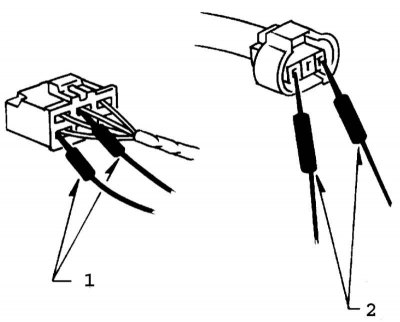
The voltage measurement at the contact terminals of the mated electrical connector is performed by inserting the measuring probes (1) into the terminals from the rear side of the plug; with a sealed connector design, the tester can be connected to the terminal side of the plug using miniature probes (2).
If the connector is of a sealed design, the meter can be connected to the terminal side of the connector, however, in this situation, special care must be taken to avoid damaging the terminals.