



Contents: Fuses and fuses ↡ Relay ↡
Fuses and fuses
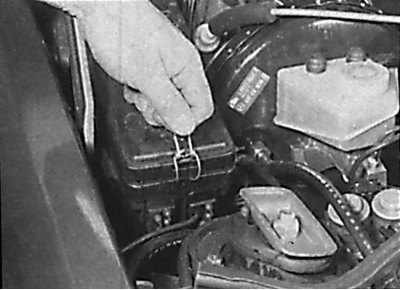
Removal the spring clip securing the fuse and relay box cover
Information about the fuses is located on the inside of the fuse and relay box cover
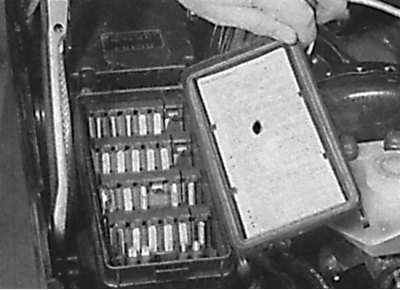
The fuses are located in the fuse box and relay located in the rear of the engine compartment. On some models, additional fuses are installed, located in the additional fuse box, which is located behind the main fuse box.
To access the fuses, detach the spring clip and remove the cover from the fuse and relay box (see Fig. Removing the spring clip securing the fuse and relay box cover).
The location of the fuses and the electrical circuits protected by the fuses are shown on the sticker located on the inside of the fuse and relay box cover.
Before removing the fuse, turn off the ignition. To remove the fuse, use tweezers to remove the fuse from the socket. Remove the fuse from the tweezers. The wire inside the fuse is easily visible and will be severed if the fuse is blown.
Always replace a fuse with another fuse of the same rating. Each fuse is marked with the amount of current it protects. Never replace a fuse more than once without determining the cause of its blown circuit.
Relay
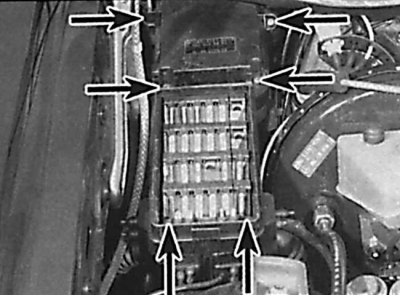
Location of the screws securing the relay box cover
Location of relays on the fuse and relay box
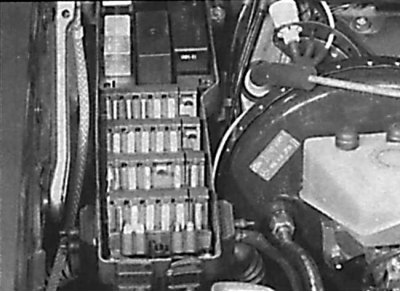
The relays are located in the fuse and relay box located at the rear of the engine compartment. To access the relays, detach the spring clip and remove the cover from the fuse box, then remove the screws and remove the cover from the relay box (see fig. Location of screws for fastening the relay box cover, Location of relays on the fuse and relay box).
A relay is an electronically controlled switch that is typically used as follows:
- a relay can switch large currents remotely from the circuit in which the current flows, allowing the use of thinner wires and switch contacts;
- a relay can have more than one control input, unlike a mechanical switch;
- - the relay can perform the function of a timer, for example, set the interval for the windshield wipers to operate.
If a relay-controlled system fails and the relay is probably the cause of the failure, listen to the relay when the system is on. If the relay is working properly, you should hear a click when it is turned on. If the relay is working properly, the cause of the failure is in the components or connecting wires. If the relay does not work, it means that it is not receiving the main power supply or control pulse, or the relay is faulty.
To replace the relay, turn off the ignition and simply pull the relay out of the socket and insert a new one in its place.