



General Provisions
1. The power unit is mounted on three supports, one on each side of the engine and one at the bottom rear behind the gearbox (see fig. 17.1). Additionally, on some models, an engine movement limiter is installed in front of the engine between the sump and the cross member. Some models are also equipped with an engine support shock absorber, installed on the left side of the engine.
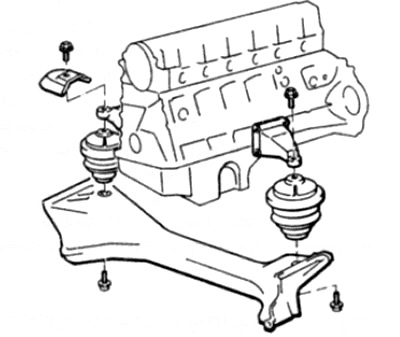
Fig. 17.1. Front engine mounts
Examination
2. For better access, raise the front of the vehicle and support it on stands (see "Lifting the car and placing it on supports").
3. Check the condition of the rubber bearings. If cracks, hardening or separation from the metal at any point are detected, the bearing should be replaced.
Publication taken from an online resource (mercedesman.ru)
4. Make sure all support fasteners are securely tightened.
5. Using a large screwdriver or metal rod, pry the support with a lever to check for wear. If this does not work, have an assistant move the engine back and forth or side to side while checking for free play in the supports. Although a small amount of play is present even in new parts, increased wear will be noticeable. If play is detected, first check the reliability of the support fastening. Then, if necessary, replace the worn parts.
6. The engine travel limiter is adjustable and when checking the engine mounts, the limiter adjustment should be checked as described below.
7. To check the condition of the engine mount shock absorber, remove the shock absorber as described in this paragraph. Then move the shock absorber piston through its full stroke and then through its short stroke. In both cases, a constant and even resistance should be felt. If the resistance is uneven, jumpy, or there is visible damage or wear to the shock absorber, it should be replaced.
Replacement
Left and right engine mounts
8. If you have not already done so, raise the front of the vehicle and support it on jack stands (see "Lifting the car and placing it on supports").
9. Support the engine either by hanging it with a hoist and winch or by placing a jack with a wooden spacer underneath the pallet. Make sure the engine is securely supported before starting work.
10. Remove the engine shield from below as described in Chapter 11.
11. Where required, loosen and remove the adjusting bolt from the engine travel limiter (see item 30).
12. On models equipped with an engine mount shock absorber, remove the two bolts securing the lower end of the shock absorber to the front cross member.
13. Unscrew the bolts securing the left and right engine mounts to the front cross beam.
14. Unclip the radiator fan shroud and place it on top of the fan blades as described in Chapter 3.
15. Connect the hoist and winch to the front rigging bracket of the engine, then carefully lift the hoist to raise the engine.
16. Where required, remove the heat shield from the right engine mount.
17. Loosen the bolts securing the engine mounts to the mount brackets, then remove the mounts.
18. If desired, you can then unscrew the support brackets from the cylinder block.
19. Installation is carried out in reverse order, taking into account the following points:
- a) Tighten all fasteners to the required torque.
- b) When installing the engine travel limiter, adjust the limiter as described below.
Rear powertrain support
20. If not already done, raise the front of the vehicle and support it on stands (see "Lifting the car and placing it on supports")
21. If necessary, remove the engine shield as described in Chapter 11.
22. Support the gearbox using a jack with a wooden spacer.
23. Where provided, loosen the support adjuster screw.
24. Unscrew the bolts securing the support crossmember to the body bottom, then unscrew the two bolts securing the crossmember to the support and remove the crossmember.
25. Unscrew the nut securing the support to the gearbox and remove the support.
26. Installation is carried out in reverse order, taking into account the following points:
- a) Tighten all fasteners to the required torque.
- b) Before tightening the support adjuster screw, adjust the limiter as described below.
Engine travel limiter
27. If you have not already done so, raise the front of the vehicle and place it on stands (see "Lifting the car and placing it on supports").
28. If necessary, remove the engine shield as described in Chapter 11.
29. Turn the steering wheel all the way in any direction.
30. Loosen and remove the engine travel limiter adjuster bolt
31. Loosen the two mounting bolts and remove the travel limiter.
32. Begin installation by installing the travel limiter in place and tightening the mounting bolts to the required specifications.
33. Lower the car to the ground so that it rests on its wheels.
34. Install the adjusting bolt, but do not tighten it at this stage.
35. Completely loosen the adjusting screw of the rear support of the power unit.
36. It is best to use a special device from Mercedes-Benz to install the rubber limiter. However, two strips of metal plate approximately 3.0 mm thick can be used. Slide the device or metal strips on each side of the rubber limiter (see fig. 17.36).
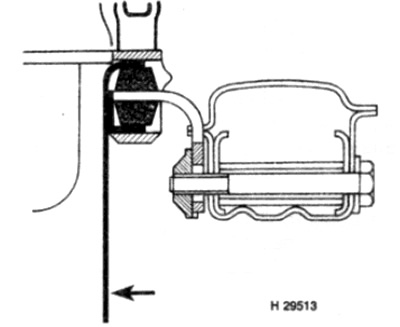
Fig. 17.36. Using a special device (shown by arrow) to adjust the engine travel limiter
37. Grasp the engine and move the power unit with your hand, rocking it from side to side.
38. Tighten the rear support adjustment screw to the required specifications.
39. Tighten the travel limiter adjustment bolt to the required torque.
40. Where provided, install the engine shield.
Engine mount shock absorber
41. The shock absorber support is bolted between the engine support bracket and the front cross beam.
42. Unscrew the two bolts securing the lower end of the shock absorber to the front cross member (see fig. 17.42).
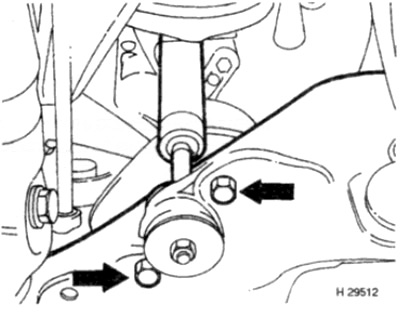
Fig. 17.42. Bolts for fastening the engine mount shock absorber to the cross beam (shown by arrows)
43. Unscrew the bolt securing the upper end of the shock absorber to the engine support bracket.
44. Compress the stand as much as necessary so that it can be pulled out of the support bracket.
45. If the shock absorber rubbers are removed from the shock absorber, note their location and orientation so that they can be reinstalled correctly.
46. Installation is carried out in reverse order.