
Cars BMW Cars Volkswagen Cars Chevrolet Cars Land Rover Cars Lada Cars Honda Cars Peugeot
English Русский
Български
Беларускі
Український
Српски
Hrvatski
Română
Polski
Slovenský
Magyar
Bookmark News and articles Sitemap Feedback Site search
MercedesMan.ru


A-Class C-Class E-Class G-Class M-Class S-Class Others
190 (W201) (1982-1993) W202 (1993-2000) W203 (2000-2007)
  • Main
  • C-Class
  • W201 (1982-1993)
  • Power unit
  • Power system (carburetor)
  • Throttle Cable — Removal, Installation and Adjustment

Throttle Cable — Removal, Installation and Adjustment (Mercedes-Benz C-Class W201)

0
Contents: Removal ↡ Installation ↡ Adjustment ↡

Removal


1. Working in the engine compartment, remove the square retainer (see fig. 7.1) and disconnect the throttle cable from the carburetor guide lever. Release the cable by passing it through the slot in the guide lever bracket.
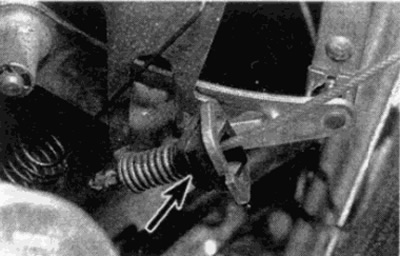
Fig. 7.1. Disconnect the throttle cable from the carburetor guide lever by removing the square…

Fig. 7.1. Disconnect the throttle cable from the carburetor guide lever by removing the square retainer (shown by arrow)


2. Remove the cable sheath from the bracket by pressing the tabs on the plastic retainer and removing it (see fig. 7.2).
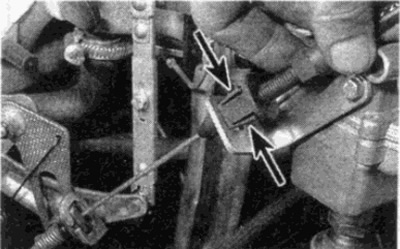
Fig. 7.2. Wringing out the paws (shown by arrows) plastic holder, remove the cable sheath from the…

Fig. 7.2. Wringing out the paws (shown by arrows) plastic holder, remove the cable sheath from the bracket


3. Working in the driver's footwell, unhook the return spring, then remove the retaining ring and separate the cable from the top of the pedal arm.


Article based on data from the website: MercedesMan

4. Carefully push the cable housing through the engine compartment bulkhead bushing.

Note: Do not remove the bushing from the bulkhead.


5. On the outer bulkhead, remove the rubber sealing grommet, then pull the cable into the engine compartment through the inner bulkhead grommet.

Installation


6. Install the cable in the reverse order of removal. Before connecting the cable to the carburetor lever mechanism, adjust the mechanism and cable as described in the next paragraph.

Adjustment


7. Start the engine and warm it up to normal operating temperature, then turn off the ignition.

8. Where installed, disconnect the constant speed/air conditioner control rod from the control lever on the carburetor.

9. On vehicles equipped with an automatic transmission, disconnect the end of the pressure control cable from the spherical socket on the guide lever.

10. On models with Stromberg carburetor equipped with a vacuum throttle valve lifter unit (part of the toxicity reduction system), start the engine again and do the following:
  • a) With the engine running, clamp the throttle valve lifter vacuum hose (with the throttle cam follower retracted).
  • b) Stop the engine.
  • c) Check that the throttle mechanism lever does not touch the throttle cam adjusting screw.
  • d) If necessary, turn the adjusting nut so that the lever separates from the adjusting screw.

11. On models with a Slromberg carburetor, with the throttle cable disconnected from the guide lever, loosen the clamp screw on the sliding linkage. Move the linkage until the roller rests against the idle speed limiter (see fig. 7.11). While holding the lever mechanism in this position, tighten the clamp screw.
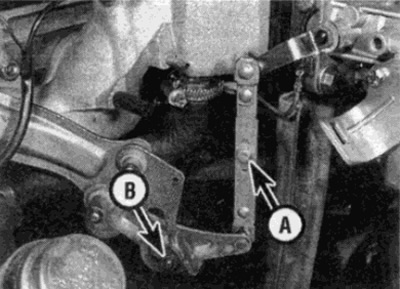


Fig. 7.11. The device of the translational lever mechanism

Fig. 7.11. The device of the translational lever mechanism
A Screw of the connecting rod clamp
In the Video


12. On models with a Pierburg carburetor, fully retract the throttle actuator pushrod by pinching the vacuum hose, running the engine for a few seconds, and then turning the ignition off again. With the throttle cable disconnected from the guide lever, adjust the stroke of the control rod so that the stroke is approximately 0.5 mm.

13. Connect the throttle cable to the guide lever.

14. On models with an adjustable full throttle stop located behind the pedal, rotate the throttle stop pin to the left and pull it out slightly.

15. Have an assistant fully depress the accelerator pedal on manual transmission models, or enough to get close (but not yet engage) the downshift switch on automatic transmission models.

16. In this case, the throttle lever on the carburetor should touch the full throttle limiter plate on the side of the carburetor. To achieve this, on models without a limiter under the pedal, turn the adjusting nut on the throttle mounting bracket (see Fig. 7.16, a, b).
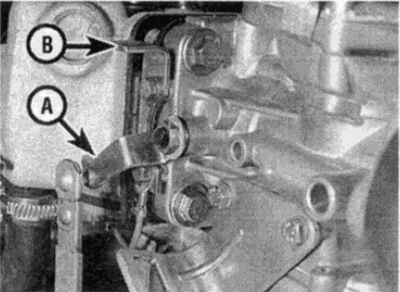
Fig. 7.16, a. The throttle lever on the carburetor should touch the full throttle opening limit…

Fig. 7.16, a. The throttle lever on the carburetor should touch the full throttle opening limit plate
A Throttle Lever
B Limit plate for full opening of the throttle valve
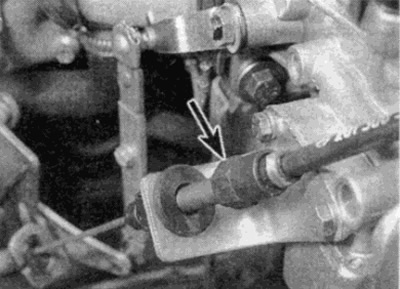

Fig. 7.16, b. Adjusting nut (shown by arrow) on the support bracket

Fig. 7.16, b. Adjusting nut (shown by arrow) on the support bracket


17. Release the accelerator pedal, allowing the roller to rest against the idle speed limiter on the guide lever. On models with an adjustable full throttle limiter mounted behind the pedal, lock the pin by turning it to the right. Be careful not to move the pin too far in or out.


18. In this position, the rod at the end of the throttle cable should rest against the compression spring with no free play. To achieve this position, adjust the adjusting nut on the cable on the pedal side - the adjusting nut can be loosened from the driver's seat (see fig. 7.18).
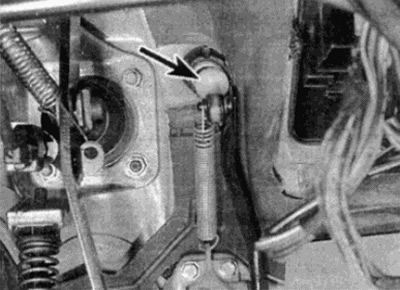
Fig. 7.18 Adjusting nut (shown by arrow) idle speed of the throttle cable on the accelerator pedal

Fig. 7.18 Adjusting nut (shown by arrow) idle speed of the throttle cable on the accelerator pedal


19. Where necessary, remove the clamp from the throttle actuator lifter vacuum hose.

20. If required, connect and adjust as described in Chapter 12, constant speed control / air conditioning control rod.

21. On models with automatic transmission, connect the pressure control cable and adjust its operation as described in Chapter 7B.
This article is available at: russian, bulgarian, belarusian, ukrainian, serbian, croatian, romanian, polish, slovak, hungarian
The article has been verified: Lukyanov Nikita Ilyich
Share with friends:
◀ Previous
C-Class 190 (W201) / Power system (carburetor)
Next ▶

Gas tank — removal and installation
Fuel level indicator sensor — removal and installation
Fuel pump — removal and installation
Air Cleaner Temperature Control System — Checking and Replacing Parts
Air cleaner and filter element — removal and installation
Stromberg 175 CDT Carburetor — Basic Information and Parts Replacement
Pierburg 2E-E carburetor fuel system — basic information and replacement of parts
Carburetor — removal and installation
Intake manifold — removal and installation
Intake Manifold Heater — Removal and Installation
More similar articles for repairing other models

☛ Gear Selector Cable — Adjustment Mercedes W168 (1997-2004)
☛ Accelerator cable — removal, installation and adjustment Mercedes W124 (1984-1995)
☛ Maintenance of throttle actuator components Mercedes W463 (1999-2019)
☛ Seat adjustment Mercedes W163 (1997-2005)
☛ Seat adjustment Mercedes W140 (1991-1998)
☛ Idle speed adjustment Mercedes Sprinter (1995-2000, diesel)
Link in different formats to this article
Comments and feedback from visitors
No comments yet


How much will 41 + 16 ?


W203 (2000-2007) 
  • General information
  • Introduction to guide
  • User manual
  • Maintenance
  • Power unit
  • Gasoline engines
  • Diesel engines
  • Cooling system
  • Ventilation and heating
  • Supply system
  • Injection system (gasoline)
  • Injection system (diesel)
  • Exhaust system
  • Ignition and control system
  • Charge and launch systems
  • Transmission
  • Mechanical gearbox
  • Automatic gearbox
  • Clutch and drive shafts
  • Differential
  • Chassis
  • Brake system
  • Car suspension
  • Steering
  • Body
  • Exterior (external elements)
  • Interior (internal elements)
  • Electrical equipment
  • Equipment and devices
  • Lighting system
  • Electrical diagrams (2000)
  • Electrical diagrams (since 2001)
W202 (1993-2000) 
  • General information
  • User manual
  • Driving a car
  • Car care
  • Maintenance
  • Power unit
  • Gasoline engines
  • Diesel engines
  • Lubrication system
  • Cooling system
  • Heating and ventilation
  • Ignition system
  • Fuel system
  • Injection system (gasoline)
  • Injection system (diesel)
  • Exhaust system
  • Transmission
  • Clutch
  • Car gearbox
  • Chassis
  • Suspension, wheels and tires
  • Steering
  • Brake system
  • Body
  • Exterior (external elements)
  • Interior (internal elements)
  • Doors and windows
  • Electrical equipment
  • Equipment and devices
  • Power devices
  • Lighting system
  • Electrical circuits
190 (W201) (1982-1993) 
  • General information
  • Introduction to the guide
  • Operation and care
  • Maintenance (gasoline)
  • Maintenance (diesel)
  • Troubleshooting
  • Power unit
  • Petrol engine I4
  • Petrol engine V6
  • Diesel engines
  • Engine overhaul
  • Cooling and heating
  • Power system (carburetor)
  • Injection system (gasoline)
  • Injection system (diesel)
  • Exhaust system
  • Charge and start system
  • Ignition system (I4)
  • Ignition system (V6)
  • Diesel heating system
  • Transmission
  • Clutch
  • Mechanical gearbox
  • Automatic gearbox
  • Cardan shaft and axle shafts
  • Chassis
  • Brake system
  • Car suspension
  • Steering
  • Body
  • Exterior (external elements)
  • Interior (internal elements)
  • Doors, locks and windows
  • Electrical equipment
  • Equipment and devices
  • Electrical circuits
 
MercedesMan.ru © 2017–2026 · Mobile version · Read about Mercedes · Sitemap: EN BG BY UA RS HR RO PL SK HU · Feedback · Site search · Bookmark A-Class (W168) · C-Class (W201) · C-Class (W202) · C-Class (W203) · E-Class (W123) · E-Class (W124) · E-Class (W210) · G-Class (W463) · M-Class (W163) · S-Class (W116, petrol) · S-Class (W126, petrol) · S-Class (W140) · S-Class (W220) · Sprinter · Vito 1 · Vito 2 · Vario 814D ·
 
We only use cookies without which some of the site's features may not be available.