
Cars BMW Cars Volkswagen Cars Chevrolet Cars Land Rover Cars Lada Cars Honda Cars Peugeot
English Русский
Български
Беларускі
Український
Српски
Hrvatski
Română
Polski
Slovenský
Magyar
Bookmark News and articles Sitemap Feedback Site search
MercedesMan.ru


A-Class C-Class E-Class G-Class M-Class S-Class Others
190 (W201) (1982-1993) W202 (1993-2000) W203 (2000-2007)
  • Main
  • C-Class
  • W201 (1982-1993)
  • Power unit
  • Power system (carburetor)
  • Gas tank — removal and installation

Gas tank — removal and installation (Mercedes-Benz C-Class W201)

0
Contents: Removal ↡ Installation ↡
Warning: This operation must be carried out in a well-ventilated area.


Removal


1. Before starting work, empty the gas tank. This is best done after waiting until almost all the gasoline has been used up as a result of normal operation. The remainder should be sucked out through the filler neck by siphoning or using a hand pump.

2. Place the vehicle on a level surface and place chocks under the front wheels. Raise the rear of the vehicle with a jack and securely support it on jack stands (see Fig. "Lifting the car with a jack and placing it on supports").

Warning: It is not recommended to use an inspection pit; gasoline vapors are heavier than air and can easily collect on the floor of a pit, creating a potential hazard.


3. Disconnect the negative battery terminal.

4. Working from underneath the vehicle, disconnect the fuel inlet and outlet lines and the vent hose from the fuel tank. Mark the hoses so that they can be reinstalled correctly. Plug any open holes in the fuel tank and hoses to reduce fuel spillage and prevent dirt from getting into the fuel system.

5. Remove the large rubber grommet from the gas tank.

6. Working from the trunk, unfasten the holders and move the carpet back. Unfasten the buttons and holders, then remove the fuel filler panel (see Fig. 6.6, a, b).
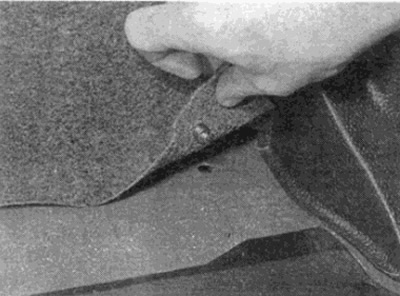
Fig. 6.6, a. Unfasten the buttons...
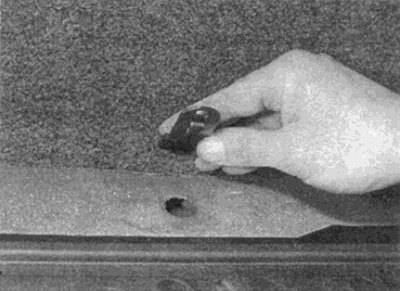
Fig. 6.6, a. Unfasten the buttons...


Fig. 6.6, b....and fuel tank panel holders

Fig. 6.6, b....and fuel tank panel holders


7. Referring to the description in Chapter 4, disconnect the plug from the fuel level sensor unit connector. Release the wire from the holders.


8. Loosen the fuel tank mounting nuts, lift the fuel tank slightly and remove the drain hose. Remember how the drain hose is routed so you can install it the same way. Separate the filler neck from the body and remove the sealing ring (a) and sleeves (see fig. 6.8).
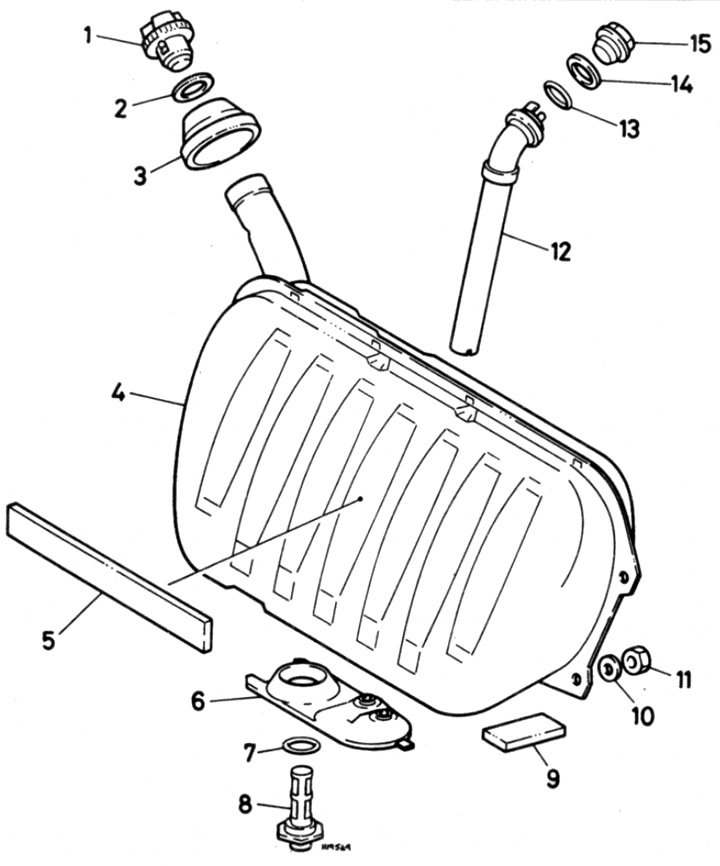
Fig. 6.8. Gas tank and related parts

Fig. 6.8. Gas tank and related parts
1 Filler cap
2 Sealing ring
3 Sealing sleeve
4 Gas tank
5 Back padding strip
6 Closing rubber bushing
7 Mesh filter seal
8 Filter
9 Bottom padding strip
10 Washer
11 Nut
12 Fuel level indicator unit
13, 14 Sealing rings
15 Sensor assembly nut


9. Lift the gas tank up, pull it back towards you and remove the gas tank from the luggage compartment. Remove the padding strips if they are not secured.

10. Unscrew the mesh filter from the fuel tank and remove the sealing ring. Using clean gasoline, remove all traces of deposits. Using a new sealing ring, install and tighten the mesh filter securely.

11. If you find sediment or water in the fuel tank, remove the fuel gauge sender as described in paragraph 5, and rinse the tank with a small amount of clean gasoline.

If the gas tank is significantly corroded or leaking, it should either be repaired by a professional or replaced.


Warning: Do not attempt to repair the gas tank yourself by welding or soldering. The gas tank may contain an explosive mixture of air and gasoline vapor.


Installation


12. Install the gas tank in reverse order. Please note the following:
  • a) Where provided, tighten all fasteners to the required torque.
  • b) Check that the packing strips are installed correctly.
  • c) Check that the fuel tank drain hose is routed as it was before removal.
  • d) Check that the sensor plug is securely connected to the socket.
  • d) Perform a test drive and make sure that there are no gasoline leaks around the removed parts.
This article is available at: russian, bulgarian, belarusian, ukrainian, serbian, croatian, romanian, polish, slovak, hungarian
The article has been verified: Lukyanov Nikita Ilyich
Share with friends:
◀ Previous
C-Class 190 (W201) / Power system (carburetor)
Next ▶

Fuel level indicator sensor — removal and installation
Fuel pump — removal and installation
Air Cleaner Temperature Control System — Checking and Replacing Parts
Air cleaner and filter element — removal and installation
Basic information and precautions
Throttle Cable — Removal, Installation and Adjustment
Stromberg 175 CDT Carburetor — Basic Information and Parts Replacement
Pierburg 2E-E carburetor fuel system — basic information and replacement of parts
Carburetor — removal and installation
Intake manifold — removal and installation
More similar articles for repairing other models

☛ Removal and installation the fuel tank filler flap Mercedes W123 (1976-1985)
☛ Removal and installation the expansion tank Mercedes W463 (1999-2019)
☛ Access to the fuel tank filler neck Mercedes W163 (1997-2005)
☛ Access to the fuel tank filler neck Mercedes W140 (1991-1998)
☛ Removal and installation the fuel tank flap Mercedes Vito 2 (2003-2014, diesel)
Link in different formats to this article
Comments and feedback from visitors
No comments yet


How much will 16 + 18 ?


W203 (2000-2007) 
  • General information
  • Introduction to guide
  • User manual
  • Maintenance
  • Power unit
  • Gasoline engines
  • Diesel engines
  • Cooling system
  • Ventilation and heating
  • Supply system
  • Injection system (gasoline)
  • Injection system (diesel)
  • Exhaust system
  • Ignition and control system
  • Charge and launch systems
  • Transmission
  • Mechanical gearbox
  • Automatic gearbox
  • Clutch and drive shafts
  • Differential
  • Chassis
  • Brake system
  • Car suspension
  • Steering
  • Body
  • Exterior (external elements)
  • Interior (internal elements)
  • Electrical equipment
  • Equipment and devices
  • Lighting system
  • Electrical diagrams (2000)
  • Electrical diagrams (since 2001)
W202 (1993-2000) 
  • General information
  • User manual
  • Driving a car
  • Car care
  • Maintenance
  • Power unit
  • Gasoline engines
  • Diesel engines
  • Lubrication system
  • Cooling system
  • Heating and ventilation
  • Ignition system
  • Fuel system
  • Injection system (gasoline)
  • Injection system (diesel)
  • Exhaust system
  • Transmission
  • Clutch
  • Car gearbox
  • Chassis
  • Suspension, wheels and tires
  • Steering
  • Brake system
  • Body
  • Exterior (external elements)
  • Interior (internal elements)
  • Doors and windows
  • Electrical equipment
  • Equipment and devices
  • Power devices
  • Lighting system
  • Electrical circuits
190 (W201) (1982-1993) 
  • General information
  • Introduction to the guide
  • Operation and care
  • Maintenance (gasoline)
  • Maintenance (diesel)
  • Troubleshooting
  • Power unit
  • Petrol engine I4
  • Petrol engine V6
  • Diesel engines
  • Engine overhaul
  • Cooling and heating
  • Power system (carburetor)
  • Injection system (gasoline)
  • Injection system (diesel)
  • Exhaust system
  • Charge and start system
  • Ignition system (I4)
  • Ignition system (V6)
  • Diesel heating system
  • Transmission
  • Clutch
  • Mechanical gearbox
  • Automatic gearbox
  • Cardan shaft and axle shafts
  • Chassis
  • Brake system
  • Car suspension
  • Steering
  • Body
  • Exterior (external elements)
  • Interior (internal elements)
  • Doors, locks and windows
  • Electrical equipment
  • Equipment and devices
  • Electrical circuits
 
MercedesMan.ru © 2017–2026 · Mobile version · Read about Mercedes · Sitemap: EN BG BY UA RS HR RO PL SK HU · Feedback · Site search · Bookmark A-Class (W168) · C-Class (W201) · C-Class (W202) · C-Class (W203) · E-Class (W123) · E-Class (W124) · E-Class (W210) · G-Class (W463) · M-Class (W163) · S-Class (W116, petrol) · S-Class (W126, petrol) · S-Class (W140) · S-Class (W220) · Sprinter · Vito 1 · Vito 2 · Vario 814D ·
 
We only use cookies without which some of the site's features may not be available.