Contents: Checking the condition of the…↡ Measuring the diameter of cylinders ↡ Checking and processing the upper…↡ Selection of standard size pistons ↡ Checking the condition of the…↡ Measuring crankshaft bearing journals ↡ Selection of main bearing shells ↡ Installing main bearing caps ↡ Installing pistons ↡
VN 2.069
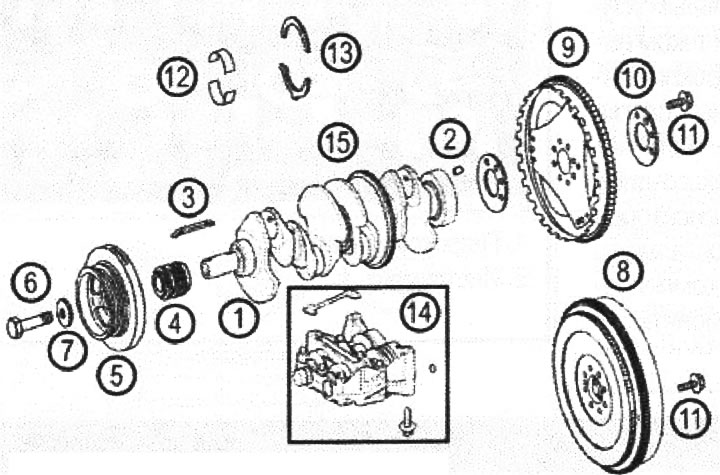
1. Knee hall (A 646 031 07 01) subsequently replaced by (A646 031 04 01 +001 A108 991 00 67) As an option: (A 611 031 05 01 001 001 001)
1. Crankshaft (A 611 031 05 01) subsequently replaced by (A646 031 04 01 +001 A108 991 00 67) As an option: (A646 031 07 01)
1. Crankshaft (A 646 031 04 01)
2. Flywheel pin
3. Segment key
4. Timing drive sprocket block
5. Crankshaft pulley with torsional vibration damper
6. Screw for fastening the pulley to the crankshaft
7. Washer
8. Flywheel
9. Flywheel ring gear G40
10. Washer (MF4)
11. Flywheel mounting screw M10x1x28.5
12. Crankshaft main bearing shells, set, standard size 58.00 mm
13. Thrust bearings, set 2.15 mm
14. Balance mechanism
15. Drive gear of the balance mechanism
Note: The figure shows a version of the crankshaft equipped with a balancer mechanism drive gear and a balancer mechanism, which are not installed on the OM646 engines used for the vehicle described. These units are shown for the information of auto mechanics.
We recommend that you pay attention to the number of crankshaft modifications, information about which is provided for a better understanding of the diversity of designs of the OM 646 engine family.
Checking the condition of the parts of the gearbox and crank mechanism consists of the following operations.
- Checking the condition of the cylinder block.
- Checking the condition of the crankshaft.
- Checking the condition of the connecting rods.
Repair of the piston group and crank mechanism consists of the following works.
- Repair of the cylinder block, including boring of cylinder liners to the repair size or replacement of liners, mechanical treatment of the upper surface, replacement (if necessary) cooling jacket plugs, replacement of oil channel plugs (after cleaning the oil channels).
- Repair of the crankshaft, which consists of grinding the journals of the plain bearings to repair dimensions, cleaning the oil channels and dirt traps.
- Selection of pistons based on the results of cylinder block repair.
- Selection of main and connecting rod bearing liners based on the results of crankshaft inspection and processing.
- Replacement of upper connecting rod bushings based on the results of connecting rod inspection.
Checking the condition of the cylinder block
Checking the condition of the cylinder mirror
Checking the condition of the cylinder block consists of the following work.
- Visual inspection of the cylinder mirror condition.
- Measurements of cylinder diameter.
- Visual inspection of the condition of the upper plane of the connector (with the cylinder head).
- Measuring deviations from the parting planes with the cylinder head, with the oil pan and with the manifolds.
Visual inspection of the cylinder mirror condition
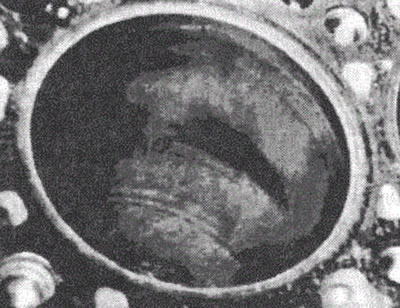
Glossy areas, abrasions, individual shiny areas, for example, in the middle of the cylinder or in the area of the cylinder head mounting screws. The cylinder block is suitable for further use.
VN 2.070
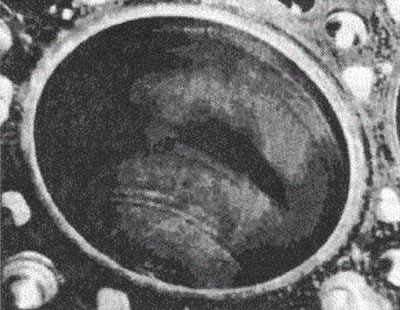
Visible scratches, traces of friction, starting in the area of the top dead center of the upper piston ring and descending downwards.
Intangible traces of dry friction that occur as a result of fuel washing away the oil film, for example, during frequent cold engine starts when the vehicle is operated over short distances.
Such "smoothed" traces of friction, which appear on the cylinder mirror mainly in the area of the cylinder head mounting screws and in the area of lateral pressure of the piston skirt, are within normal limits.
The piston rings are not damaged.
The cylinder block is suitable for further use.
VN 2.071
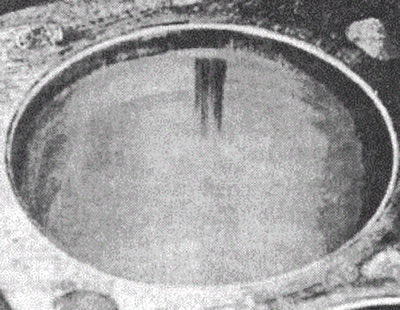
Ring-shaped visible marks on the cylinder mirror in the area of the top and bottom dead centers of the piston rings are not a sign of a malfunction.
The cylinder block is suitable for further use.
VN 2.072
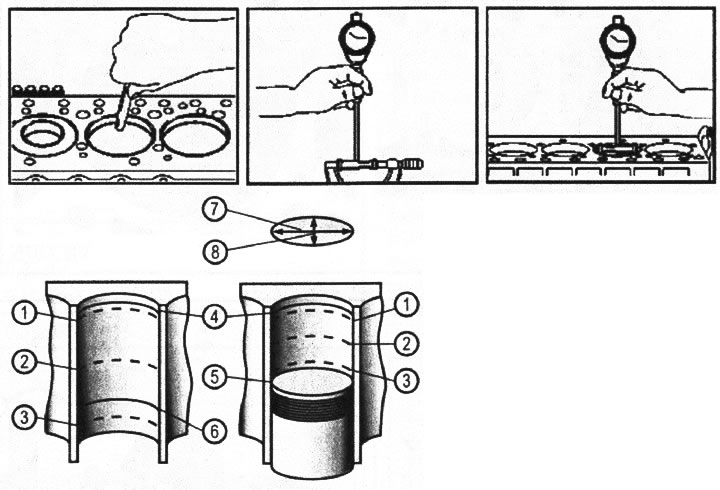
Measuring the diameter of cylinders
VN 2.073
1. Cylinder diameter measurement point
2. Cylinder diameter measurement point
3. Cylinder diameter measurement point
4. Top dead center of the upper compression ring
5. Bottom dead center of the upper edge of the piston
6. Bottom dead center of the non-removable ring
7 and 8. Mutually perpendicular directions of measurement (along and across the engine axis)
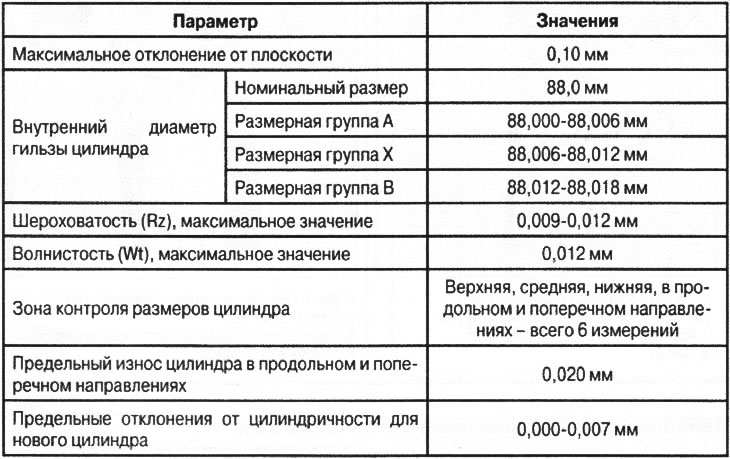
Cylinder control parameters
Control parameters of plane elements of the cylinder block
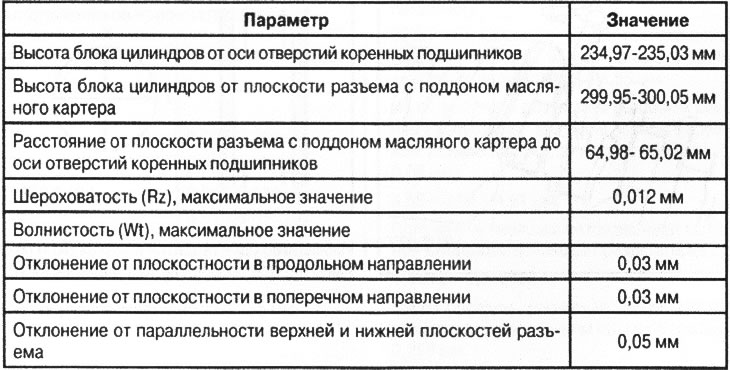
Checking and processing the upper plane of the cylinder block
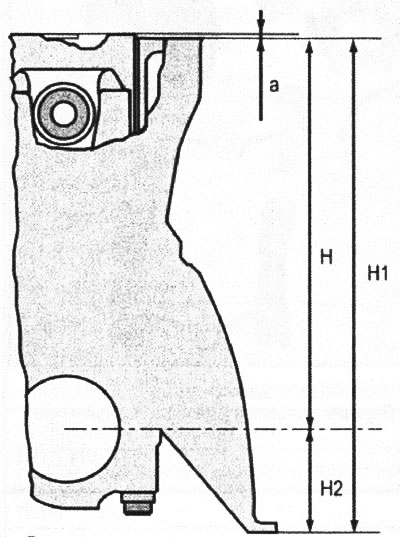
VN 2.074
a. Piston protrusion
H. Height of cylinder block from the axis of main bearing holes
H1. Height of cylinder block from plane of joint with oil pan
H2. Distance from the plane of the joint with the oil pan to the axis of the main bearing holes
Selection of standard size pistons
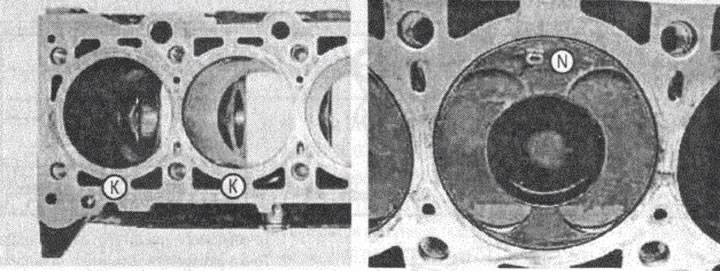
When replacing the liners, the cylinders are machined to a standard size. The diameter of the cylinders processed at the manufacturing plant corresponds to three precision classes: A, B and X,
The mark indicating the accuracy class of a given cylinder is located in the place indicated in the figure by the letter (K).
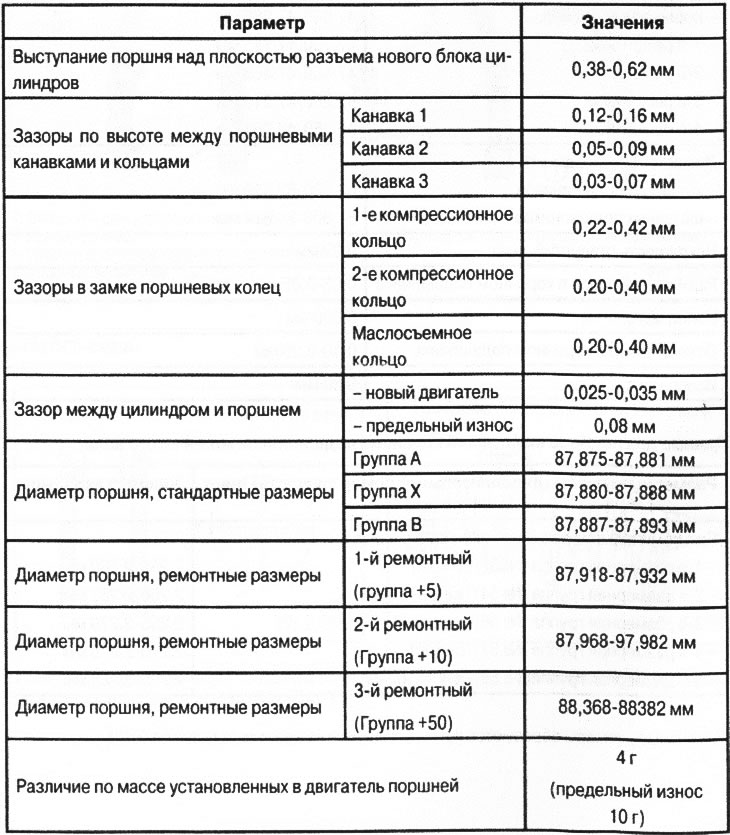
Similar to engine cylinders, standard size pistons are also divided into three size groups: A, B and X. The piston size group marking is applied to the piston crown at point (N) (see figure VN 2.075). When installing new standard size parts, the markings on the piston must match the markings on the cylinder block for each individual cylinder. The values of the control parameters of the pistons are presented in the table.
The selection of piston repair sizes should be made based on the sizes purchased for piston repair.
Next, the specialist boring the cylinders must be guided by the standardized clearances in the cylinder-piston pair.
VN 2.075
Checking the condition of the crankshaft
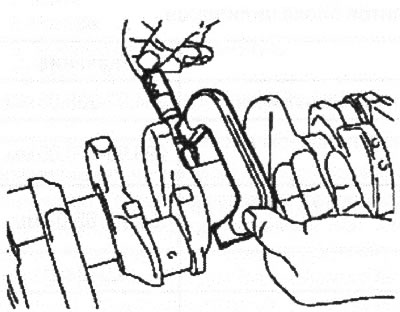
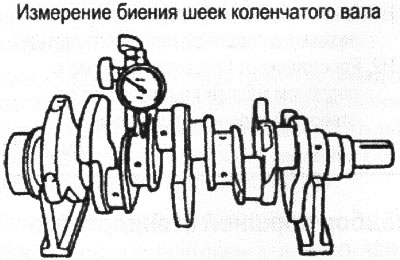
Checking the condition of the crankshaft consists of a visual inspection of the shaft for damage and visible signs of wear, measuring the diameter of each journal using a micrometer, measuring the radial runout of the crankshaft journals using a dial indicator when installing the outer main journals of the shaft on measuring prisms.
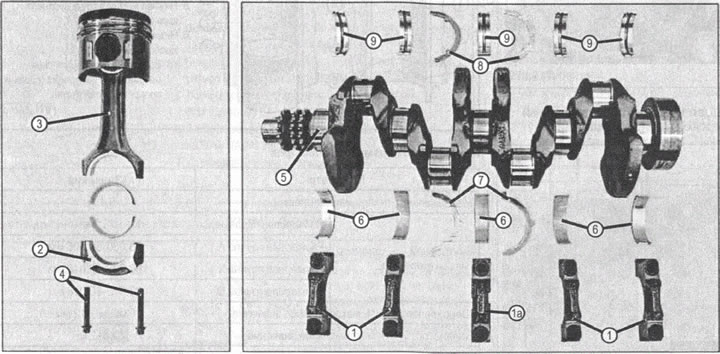
VN 2.076
1. Main bearing caps
1a. Main bearing cap No. 3
2. Connecting rod bearing caps
3. Connecting rod
4. Connecting rod bearing cap screws
5. Crankshaft
6 Lower main bearing shells
7. Thrust bearings
8. Thrust bearings
9. Upper main bearing shells
Measuring crankshaft bearing journals
VN 2.077
VN 2.078
VN 2.079
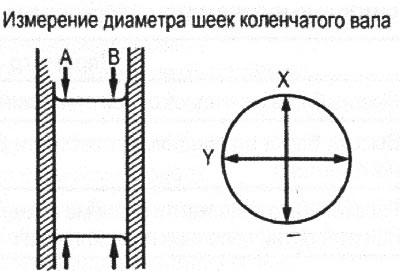
The measurement is made at points (A) and (B) as shown in the figure VN 2.072, in two mutually perpendicular directions X and Y.
Article borrowed from the web portal: Mercedesman.ru
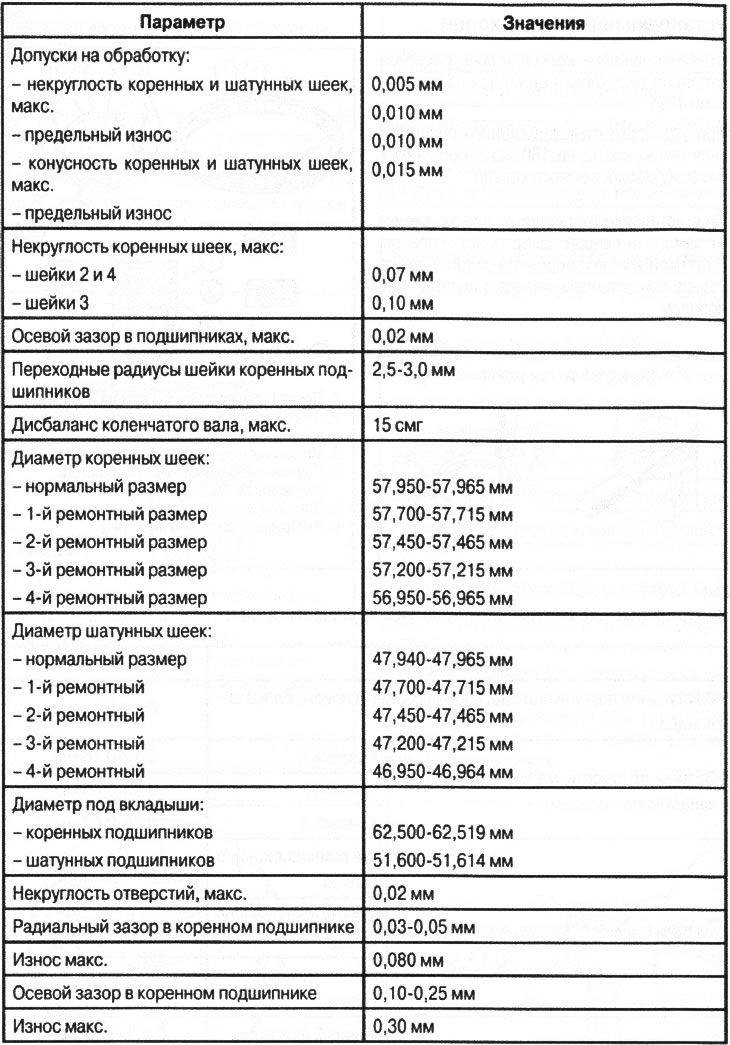
Crankshaft control parameters
Data for selection of crankshaft main bearing shells
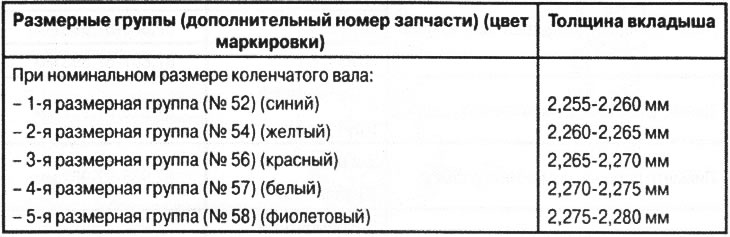
Repair dimensions are formed by thickening each insert by 0.125 mm.
Selection of main bearing shells
The selection of liners is made based on the results of precise measurements of the crankshaft journal diameters using the data table for selecting liners.
In addition, you can use the method for determining the calculated clearance in the crankshaft bearings based on measuring the crankshaft and main bearing holes with the liners installed.
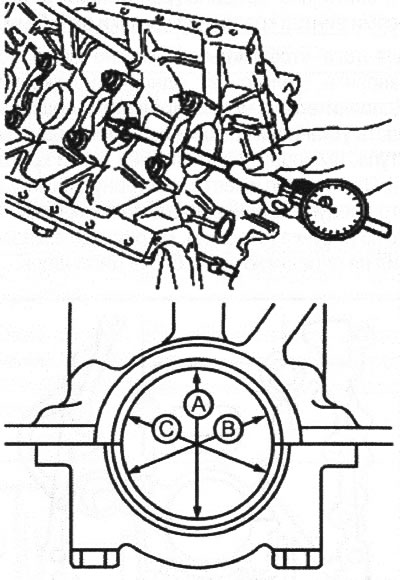
To do this, measure the diameter of the holes in the bearing seats in direction (A) (for example, 62.51 mm).
VN 2.080
Then measure the diameter of the crankshaft main journals (for example, 57.95 mm).
Based on the measurements, the thickness of the liners can be determined.
For example:
62.51 mm (main bearing bore diameter) - 57.95 mm (main bearing journal diameter) - 4.55 mm.
From the obtained result we subtract the average standard value of the clearance in the main bearing (0.03 mm + 0.05 mm): 2 = 0.04 mm):
4.55 - 0.04 = 4.51 mm.
The resulting number is double the thickness of the liner, which should be divided by 2: 4.51: 2 = 2.255 mm.
Thus, the calculated required liner thickness in this example will be 2.255 mm.
After this, you should select an insert using the table.
For example, with a thickness of 2.255 mm, you should select the upper and lower inserts with a blue mark, which corresponds to the 1st size group.
Note: This method of selecting bearings is suitable for a standard crankshaft size.
If necessary, it is necessary to repair the worn crankshaft. You should select the repair size and purchase the appropriate liners. Then - based on measurements of the actual diameter of the hole with the inserts installed (from the tightened main bearing caps) machine the crankshaft so that the actual clearance value in each bearing is within the standard limits (0.03-0.05 mm).
Installing main bearing caps
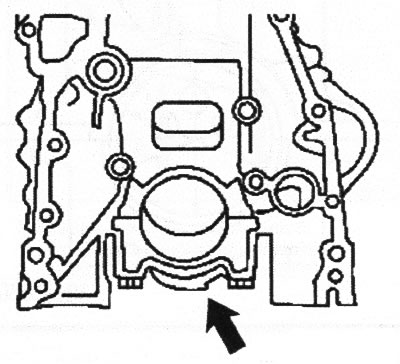
The axis of the mounting hole for the liner in the main bearing cap is offset relative to the middle of the distance between the axes of the cap mounting screws by 0.5 mm so that the cap can only be installed in one position. Additionally, you can check the correct installation of the cover by the orientation of the protrusion located on the bottom of the cover. This protrusion has a characteristic shape and should be oriented as shown in the figure (arrow). The figure shows a view of the front of the cylinder block.
VN 2.081
Tightening the crankshaft main bearing cap screws
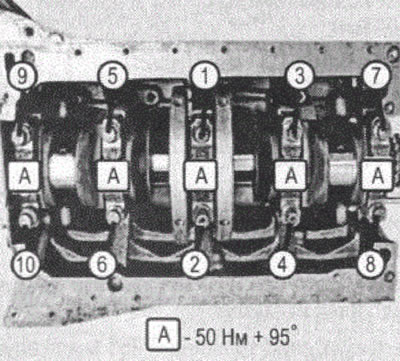
Scheme of application of tightening forces for screws fastening main bearing caps: 50 Nm + 95°.
The tightening sequence is shown in the figure VN 2.082,
VN 2.082
Installing pistons
Installing piston rings
The joints of the piston rings must be located around the circumference of the cylinder at a distance of 120°.
When installing, position the spring expander joint at 180° relative to the oil scraper ring connector.
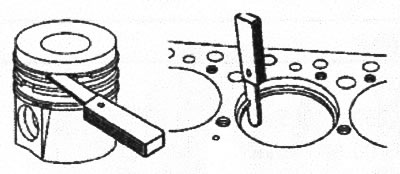
When installing piston rings, you should measure the axial clearance between the ring and the wall of the piston groove and the clearance in the ring lock when installing the ring in the cylinder without a piston.
VN 2.084
1 First compression ring (flat)
2. Second compression ring (with a conical surface)
3. Oil scraper ring (unitary)
4. Spring radial spiral expander
5. Piston
6. Ring release tool
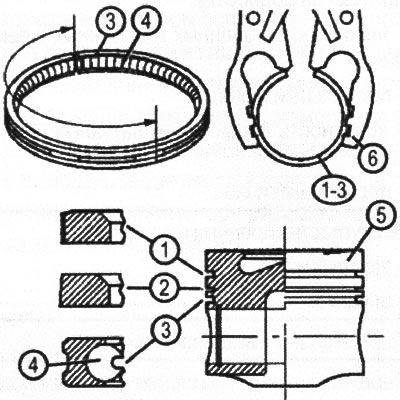
VN 2.085
Control parameters for pistons and piston rings