



Removal
1. Remove the air intake 10 (see figure 9.2).
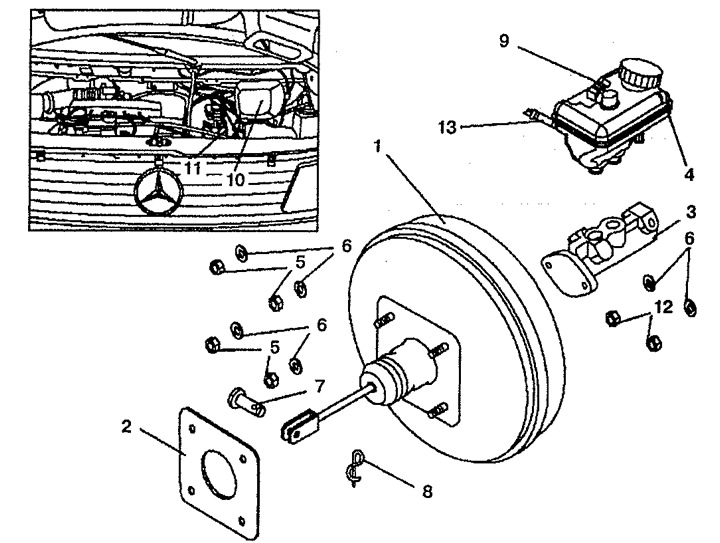
Figure 9.2. Brake booster:
1. Vacuum amplifier,
2. Gasket,
3. Master brake cylinder,
4. Brake fluid reservoir,
5. Nut M8,
6. Washers,
7. Bolt,
8. Cotter pin,
9. Brake fluid level sensor wiring connector,
10. Air intake,
11. Vacuum tube,
12. Nuts,
13. Pipe to the main brake cylinder.
2. Remove the master brake cylinder 3.
3. Remove vacuum tube 11 from vacuum booster 1.
4. Remove the cover under the instrument panel (on model 638.2 and on right-hand drive models).
5. Loosen bolt 7 securing vacuum booster 1 to the brake pedal.
6. Loosen the four nuts 5 securing the vacuum booster 1 to the pedal bracket.
7. Remove the vacuum booster 1.
Installation
8. Installation is carried out in the reverse order of removal. When installing the vacuum booster 1, do not pinch the brake fluid level sensor wiring.
Examination
9. Connect tester 030 to vacuum booster 1 (see figure 9.3).
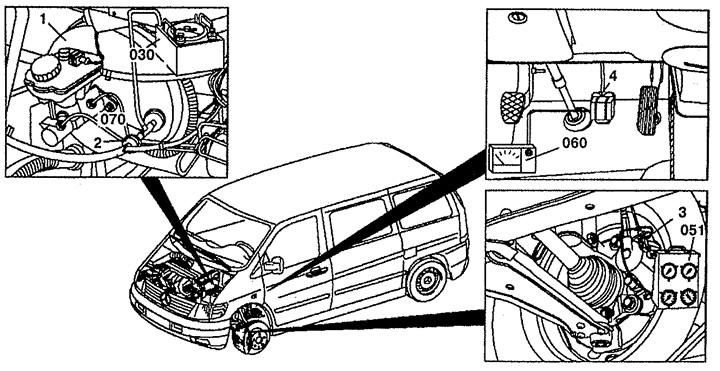
Figure 9.3. Checking the vacuum booster:
1. Vacuum amplifier,
2. Shut-off valve,
3. 070. Adapter,
4. Brake pedal,
030. Tester,
051. Pressure gauge,
060. Device for measuring the force on the brake pedal.
10. Connect pressure gauge 051 to adapter 3 on the brake mechanism using a clamp.
11. Install the 060 brake pedal force measuring device on brake pedal 4.
12. Start the engine, press and release the accelerator pedal to create a vacuum. If the vacuum does not reach the required value or decreases quickly, check the toroidal ring between the vacuum booster and the master cylinder. Check the shut-off valve and, on vehicles with 601 engines, check the vacuum pump.
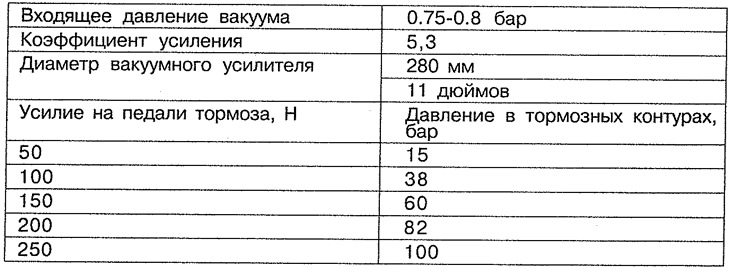
13. Press the brake pedal with a certain force and measure the vacuum. The pressure values in the brake circuits depending on the vacuum are presented in Table 9.1.
Table 9.1. Pressure values in brake circuits depending on vacuum.
14. Disconnect all connected devices and bleed the brake system.